Kuala Lumpur: Remembrance and Nostalgia
As the door of the airport express train slid open at Kuala Lumpur in Malaysia, I stepped out to meet my 18-year-old self—the curious, young student intern who once walked these streets two decades ago with dreams larger than the towering Twin Towers.
As I excitedly traced my younger self’s footsteps with my friend and ex-colleague Christine, I discovered that many landmarks of yesterday had vanished.
The sophisticated penthouse office in the bustling commercial district where I once worked had burnt down. And the bungalow in Subang Jaya, where I was hosted by an Indian-Malay family, was untraceable amidst rows of identical homes.
In the backdrop of a melancholic Hiraeth—a deep longing for a place and time that no longer exists—we savoured the unchanged flavours of my favourite drink, Iced Teh Tarik, milk tea poured on ice. Decades later, I remained fascinated with how Indian chai took on a whole new flavour when paired with ice.
Nostalgia kicked in again at our old-time favourite Sunway Mall, a proud icon of the first wave of globalisation, now standing like a lighthouse in the ocean of new-age consumerism. At a time when retail in India was mostly mid-sized shopping centres, its vast scale had mesmerised me.
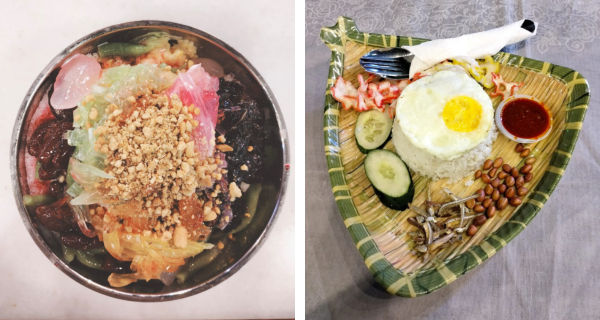
[L to R: Shaved ice dessert, Air Batu Campur; Malaysian food]
We ordered an extra-large bowl of Air Batu Campur (ABC)—a bright riot of pink, yellow and green layers of shaved ice, syrup and jelly beans. I remembered being mesmerised the first time I saw sunlight streamed through the transparent cup. Old structures from my past had collapsed, but thankfully the flavour of ABC was still the same. In that taste that defied time, I gleaned a message: in this impermanent world, the only thing eternal is savouring the essence of life.
My sensory explorations continued at another ultra-modern mall with Moroccan-style seating, fragrant terrace gardens and elaborate flower canopies. Here I watched Christine's dance troupe—draped in gorgeous embroidered Baju Kurung—perform with grace.
At the intersection of tradition and modernity, past and present, I discovered a spring of nourishment in Kuala Lumpur. It flowed through nurturing family-run Chinese buffets, the Bangladeshi street food seller at Bricklane who looked out for my well-being, and the community meal of Bak Kut Teh (hearty, layered pork soup) with locals who made me feel like family. During this long solo journey where I mostly dined alone and often missed my family and friends, shared meals and human presence became my ultimate luxury.
As I stood watching the sun set over the horizon, I realised that even as a city transforms, it still holds sacred space for who we once were.
Melaka: A Search for Identity
After a week in Kuala Lumpur, I travelled to Melaka to spend two days at the tiny historical port town and UNESCO World Heritage Site. I had first come here for an office offsite at a fancy resort. Back then, I had loved the resort experience, but I had also yearned to explore the town’s culture and history. Now two decades later, I had returned for a deep dive.
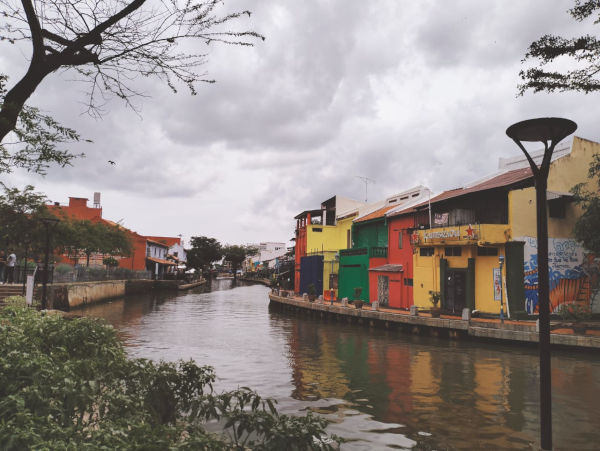
[A scene from Melaka]
As I walked past historic buildings, I saw Melaka’s vintage pages packaged in glossy tourist-friendly wrapping. Sometimes I felt the same resort vibe from all those years ago. I had come seeking authenticity, but I was witnessing a grand show put on for tourists: Tuk-tuks adorned with giant soft toys playing ‘Mr Lonely’ in front of grand colonial buildings and museums. Bohemian kitsch coexisting with deep tradition.
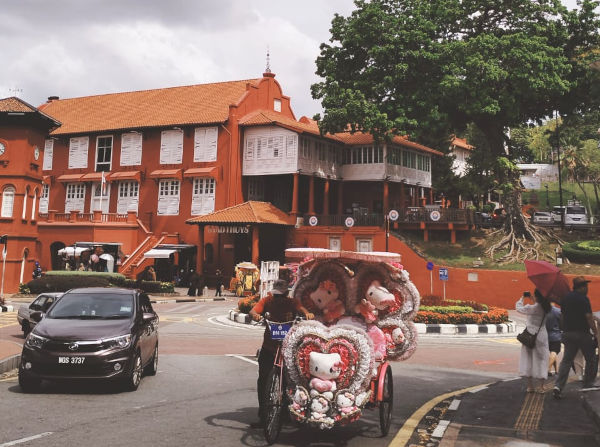
[Tuk Tuks with soft toys in front of historic buildings in Melaka]
Yet, beneath the Instagram-ready facade, the true spirit of the city occasionally slipped through.
I wandered into a traditional tea shop tucked in the mist of modern cafes. Sitting amidst elderly Chinese locals, I sipped steaming cups of tea in old porcelain cups. The smiling owner loved the bindis I gifted her and treated me to charcoal-grilled buttered toast.
Later, while exploring Jonker street, the popular walking street lined with quirky cafes and heritage buildings, I found an eatery serving Melaka’s famous Nyonya cuisine.
As I savoured a fish curry rich with the smoky depth of Nyonya cuisine’s signature black nuts called Buah Keluak, I reflected on how Melaka was teaching me to remember my own depth by peeling back filters—not just from the town, but also from myself.
During a sunset boat ride down Melaka River, past colourful houses, I felt a gentle drifting away of a land saturated with old memories. Later, vibing to a musician singing ‘Fly Me to the Moon’ beneath a star-lit sky by the river, I felt the surfacing of a new ground within me, where new experiences awaited.
Borneo: The Rebirth
From cities I moved to the primitive rainforests of Borneo—the land that inspired this journey. Borneo was high on my bucket list, a rare gem waiting to be explored. Spanning Malaysia, Indonesia and Brunei, this vast forest is home to rare flora and fauna.
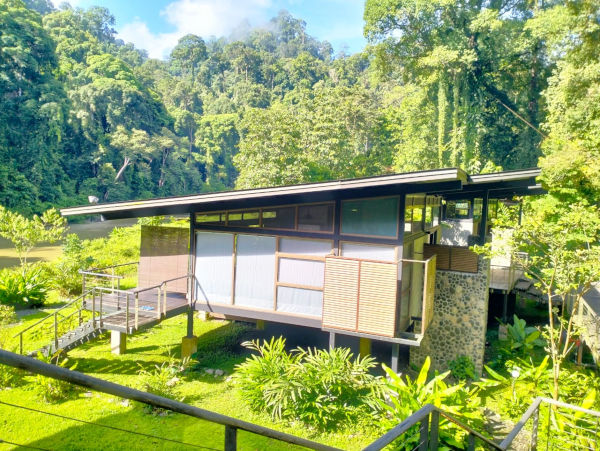
[My chalet in Danum Valley, Borneo]
When I unexpectedly received an invitation from a luxury wildlife lodge for a professional visit, it felt like destiny. I have always believed that it is not the traveller that selects the destination; but the place beckons the traveller when they are truly ready. I spent three nights in the remote rainforests of Danum Valley in Malaysian Borneo.
One night, I heard something move outside my luxurious wooden chalet. I have adapted to living alone in mountains and forests, but this spooked me.
I froze as four glowing green lights pierced the darkness. Did my wildlife adventure include a surprise alien visit?
As my eyes adjusted to the darkness, the forms sharpened: a mother and her fawn drinking from the river flowing outside. They held me in their unblinking gaze as I tiptoed into the balcony, dissolving the boundaries between man, animal and forest. My soul lit up green.
What a delightful farewell gift on my last night at Danum Valley, a habitat of rare animals. The Valley had revealed itself after three hours of off-roading through rocky roads, past giant ferns and serpentine rivers from the tiny Lahad Datu airport.
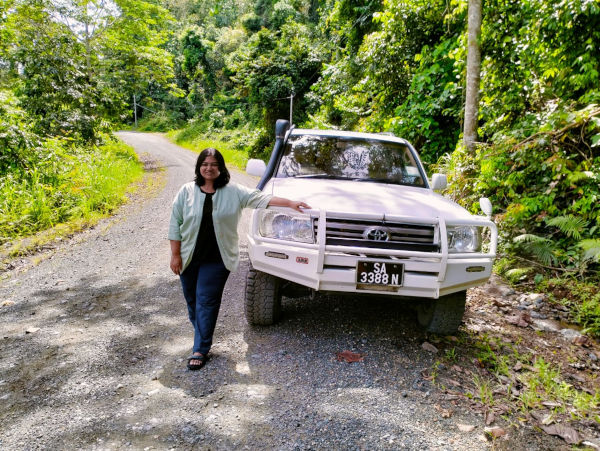
[Off-roading to Danum Valley in Borneo]
My days here were filled with deep connections with animals and humans. Kind strangers helped me while trekking on a forest canopy (walking across suspension bridges high in the trees) in search of orangutans and rafting down the muddy Danum River spotting elusive gibbons and hornbills, and through slippery walks leading to gourmet picnic lunches. At wine-and-cheese evenings, people in safari suits with binoculars in hand invited me to join them. Each encounter—human or wild—reaffirmed my faith in connection.
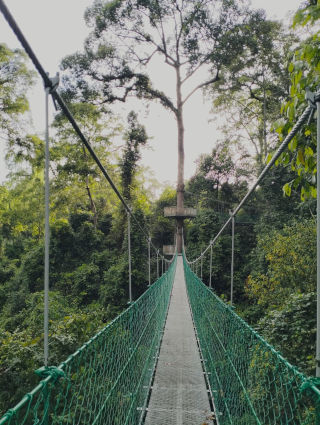
[Forest canopy walk, Danum Valley]
Once when I faltered on a muddy trek, my guide slowed down to walk beside me. He said I was courageous to do this journey alone—hardly any travellers venture to Danum Valley alone. I realised that here I was as rare as the species I had hoped to meet.
After four satisfying days in Danum, I returned to Kota Kinabalu, Borneo’s main town. From there I followed the footsteps of other travellers I met and took a flight to Sandakan, the base for guaranteed wildlife sightings.
At the Sepilok Orangutan Sanctuary, a glass wall separated us from the giant primates. As I watched parents nurturing babies and a lounging teenage ape scrolling his finger across a leaf, as if browsing a mobile phone, I marvelled at how far in our evolutionary journey we have arrived. As I stared at our closest evolutionary cousins with whom we share 97% of our DNA, I felt plugged into the mysterious root memory that holds answers to all our existential questions.
At the Sun Bear Conservation Centre, after viewing several ape species in an open forest, I finally met the world’s smallest bear. The not-so-small silky black bears were engrossed in their gourmet watermelon brunch. I was fascinated to learn that these heavy bears built their nests with leaves and branches high up in trees. Nature has a lot to teach us about engineering feats.
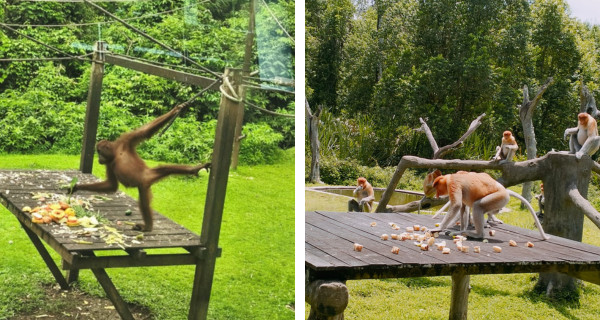
[L to R: An orangutan at its lunch; A group of Proboscis Monkey]
The Proboscis Monkey Conservation Centre turned out to be an alien Planet of Apes. We scurried for cover when the orange monkeys with curved flappy noses bared their canines and jumped ‘playfully’ into the viewing area—a clear message that they are the boss here.
Later, during a river cruise on the River Kinabatangan, a herd of Pygmy elephants—the tiniest elephants in the world—floated into my vision like a dream. Smaller than their African and Indian cousins, they stood proudly rooted in their own identity.
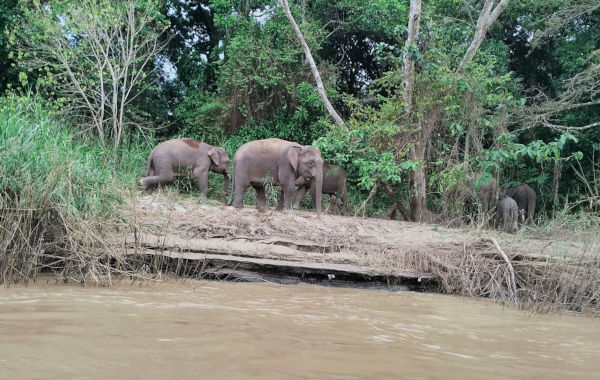
[Pygmy elephants at Kinabantangan River safari]
As I watched the babies play in the loving gaze of their mothers, once again man, animal and nature blended into a primordial singularity. Something within me shed old layers. It felt as if the maternal energy of the rainforests had birthed a new me. Born—Neo.
Awakening in Borobudur
With that renewed self, I arrived at Borobudur Temple in Yogjakarta, Java, the world’s largest Buddhist monument.
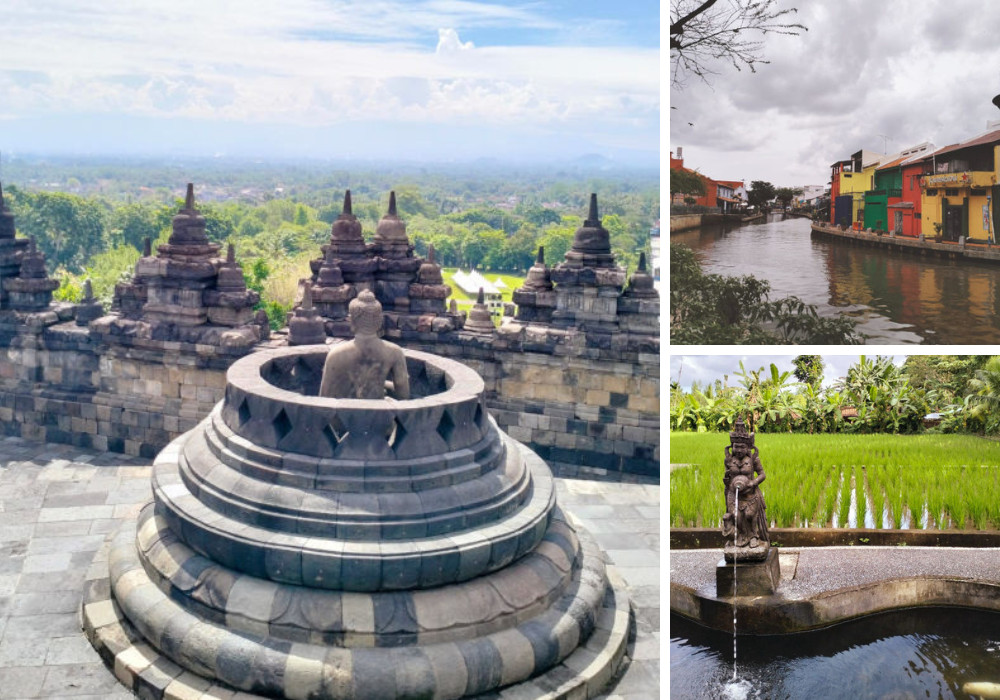
A buggy ride under the blazing Javanese sun brought us to its base. We were given coir sandals to protect the ancient stones. Walking past monks in maroon and saffron robes, I reached the monument’s base—a pyramid of stupas rising into the sky like a mandala carved in stone.
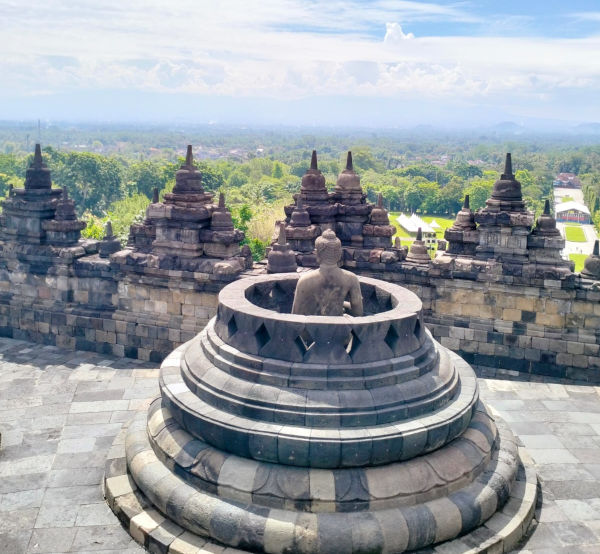
[Buddha overlooking the cloud-covered volcanoes of Borobudur]
Borobudur Temple is a physical map of an inner journey—ascending from Kamadhatu (realm of desire), to Rupadhatu (realm of form), to Arupadhatu (realm of formlessness).
At the summit, I stood beside the Buddha statue gazing toward mist-shrouded volcanoes. The fiery earth of Java seemed to bow to his serenity. Inside me too, something volatile cooled and settled into peace.
I walked down the pyramid steps back into the realm of desires, carrying with me the gift of Borobudur’s inner peace.
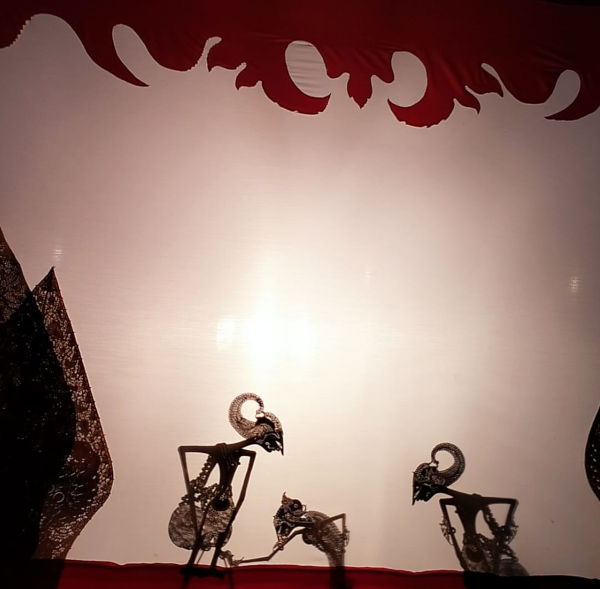
[Shadow puppet show on Ramayan in Yogyakarta, the gateway to Borobudur]
Bali: Drinking from the Sweet Spring of Life
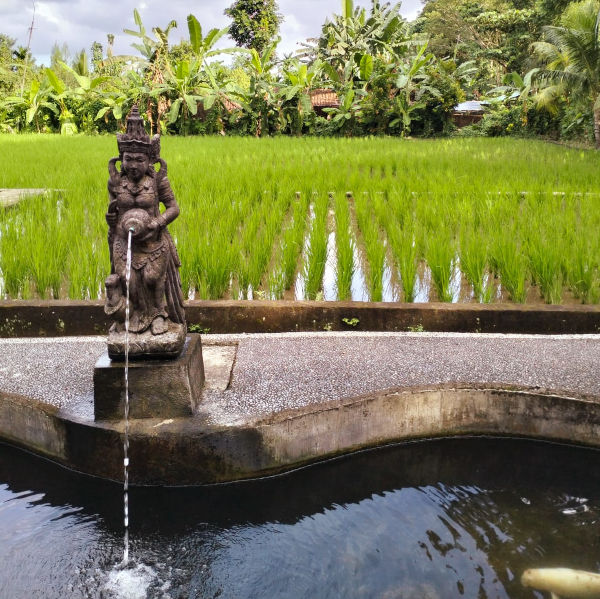
[A rice terrace field in Bali]
Bali was a sweet poem. The people are so soft-spoken, I wondered how they managed to conduct business. Yet their quiet grace disarmed even the hardest negotiators.
From luxurious resorts to humble homestays, beauty oozed in flower decorations, little offerings in cane baskets, and ponds with fish. Once standing between the tame stillness of an infinity pool and the wild crash of the ocean at a luxury resort in Candidasa, I wondered which life should I choose—comfort or wilderness?
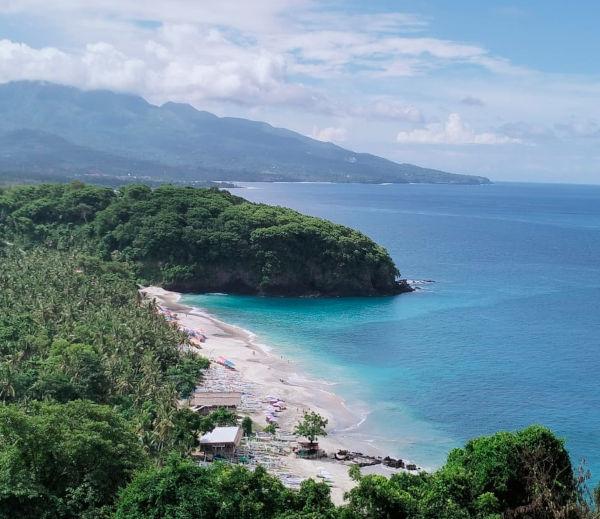
[Candidasa beach, Bali]
Riding a cable car down to a stunning, secluded beach in Jimbaran, I felt both gratitude and solitude. Solo travel rarely makes me lonely—but profound beauty sometimes does.
One tranquil evening, while sunset gazing from my bougainvillea-fringed balcony, a notification beeped on my phone. Operation Sindoor. India and Pakistan on the brink of war. I was numb.
It felt strange to be alone in a peaceful Hindu Island, cocooned in a Muslim country at such a time.
Over the next few days, as I dealt with crippling anxiety, Bali became my classroom in peaceful coexistence of religions.
I chanced upon a Church of Allah! When I asked locals, they casually shrugged and said, “God is also called Allah here.”
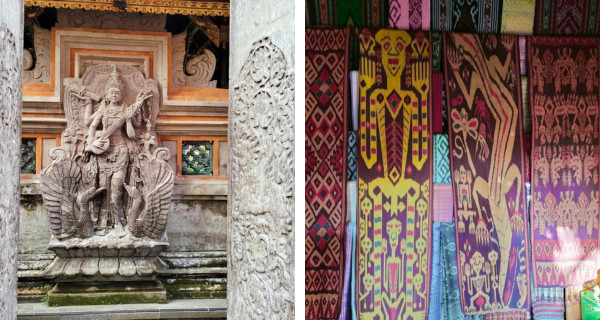
[L to R: A statue of Saraswati at a door in Bali; Traditional textile weaving at a village in Lombok island, east of Bali]
It was also interesting to see my own culture in the mirror of Balinese Hindu traditions. Ganesha statues graced the entrance of many hotels and shops. In a Barong dance depiction of Ramayana, “Sinta” was saved by “Anomana”.
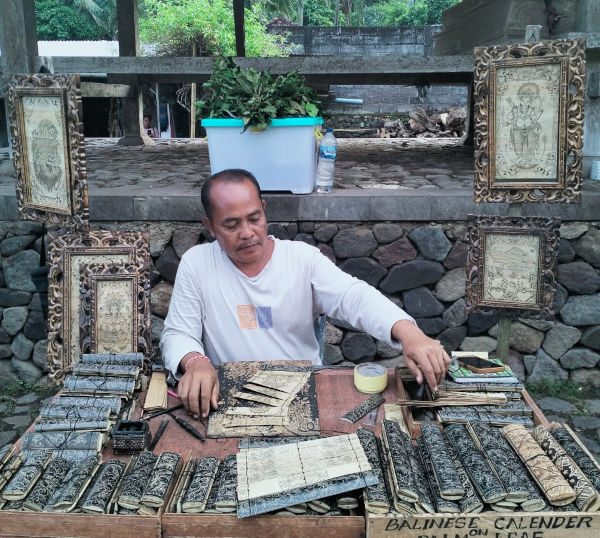
[At Tenganan village, Bali: An artist makes palm leaf paintings, similar to the palm leaf art at Raghurajpur in Orissa. Bali and Orissa had a close cultural connection due to maritime trade]
Sitting by a fire, watching the flickering silhouettes of men with frangipani tucked behind their ears chanting in trance, I found myself questioning: Who am I beyond all my identity linked to country, religion, profession and relationships?
At a Legong dance, Apsara dancers with the sweetest smiles depicted mythological stories of violent battles through intricate finger movements.
I discovered that in Balinese, my name Piya means sweets (Pia). Perhaps that is what I was meant to rediscover—the sweet spring of life, hardened by worldly battles.
Jakarta: Caffeine, Connections and Closure
[A street in Jakarta]
After the sweetness of Bali, Jakarta, my final stop, was a shot of caffeine. Rebellion in every sip.
Elderly DJs with Mohawks got young blood grooving to edgy music at nightclubs. Women in hijab and denim danced and smoked freely beside men to the beats of Bollywood and Bailamos. The vibe was unapologetic liberation.
I had a memorable seafood meal on my last day sitting on a red plastic chair at a streetside stall, as the elderly owner watched over me. Her son lit a candlelight to make the meal special. This unique candlelight lunch under a bright sun reminded me of all the times during this trip that I felt embraced by the light of life.
Later, at the airport, after a shopping spree I found I didn’t have enough local currency for a much-needed coffee to deal with a creeping headache.
I reflected on all the times during this trip when the limitations of money’s worth and the priceless value of human kindness had been revealed to me.
Someone bought me a metro ticket when my notes were too large; another night, a shopkeeper gave me a lift back when I was stranded with a wallet full of money, but no transport; a young girl helped me carry my bags when my taxi dropped me far from my hotel.
As I looked for headache pills in my medicine pouch, I suddenly found a forgotten, large wad of currency notes. I was rich again, but almost out of time. Flight boarding had started and I had only enough time to buy a coffee and snacks before boarding my flight.
As I rushed to the boarding gate sipping the most valuable cappuccino of my life, I realised that the beautiful parting gift this journey had given me was a luxury mindset—the ability to recognise that kindness and human connections are the real luxuries of life.
I had finally reached the end of my two-and-half month journalling adventure, noting down timeless truths deeply revealed by ancient rainforests, volcanoes, animals and man.
While Kuala Lumpur reunited me with my enthusiastic younger self, Melaka stripped off all filters to reveal my real self. Borneo had birthed a new me and Borobodur awakened deeper self-realisation. Bali nourished me with the sweet spring of life and Jakarta gifted me discretion to understand what is truly valuable in life.
As I completed the last page of journalling, a final thought surfaced. Perhaps we are shaped not only by the miles we travel, but the truths we are finally brave enough to face.
Travel Tips
Borneo
- Hotels in Borneo are mostly nature resorts in the luxury and ultra luxury category or in the hostel category. For moderate budget travellers, staying at Sandakan town is best. Hotel Sandakan is a good choice.
- From Sandakan, you can take a cab to Sepilok Conservation Park for orangutan and Sun Bear sightings.
- For Kinabantangan River Safari and Proboscis monkey parks, best to book shared tours.
- You can opt for a direct road trip from Danum to Kinabantangan and fly out from Sandakan airport.
Bali
- The less touristy beaches are on the eastern side in Candidasa.
- Definitely visit Tirtha Ganga, a beautiful water-themed temple, and Tenganan village where palm leaf paintings are made.
- For the best beaches, take the ferry (approx 1 hour) from Bali to Gili Islands.
- Try the seafood barbeque at Jimbaran beach.