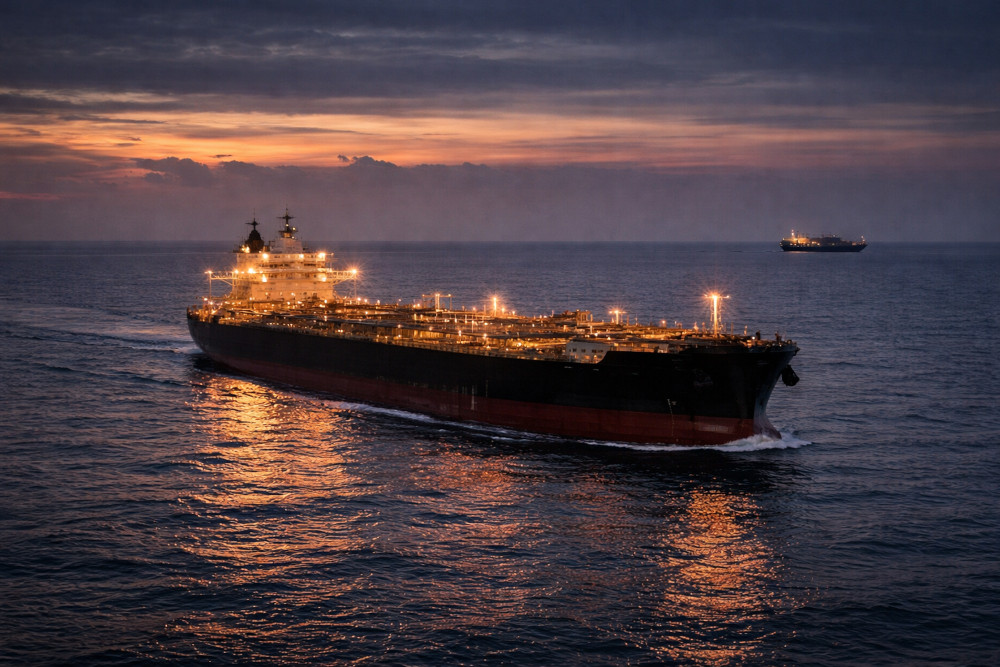
[Oil tankers moving through the Gulf carry a significant share of the world’s energy supply. Even limited disruption in these waters can ripple across global energy markets.]
The war involving the United States, Israel and Iran is no longer confined to conventional military operations. It has evolved into a complex confrontation that now operates simultaneously across military, economic and technological domains.
Military strikes, energy markets and global supply chains are tightly intertwined in a single strategic contest whose outcome—and duration—remain uncertain.
The latest signals from Tehran suggest that the confrontation may deepen further. In his first public statement since assuming office, Iran’s Supreme Leader indicated that retaliation against the United States and Israel would continue, underscoring the likelihood that the conflict may become a prolonged contest rather than a short military exchange.
At this stage it increasingly appears that Iran’s strategic logic may shape how the conflict evolves. Tehran’s approach seeks to exploit structural vulnerabilities in the global economy as a way of offsetting its conventional military inferiority. While the US and Israel possess overwhelming airpower, Iran’s strategy of sustained disruption across the Gulf creates constraints that cannot be resolved through military force alone.
Iran’s strategy operates on two tracks. The first is conventional warfare—missile, drone and proxy attacks designed to impose costs on US and Israeli military capabilities. The second is a strategic attack on the most vulnerable point of the global economy: energy. By threatening shipping routes, energy infrastructure and maritime logistics in the Gulf, Tehran is deliberately extending the battlefield beyond its own territory and compelling the United States to defend regional energy flows while absorbing wider economic consequences.
This doctrine reflects decades of adaptation following the Iran–Iraq War and years of sanctions that limited Tehran’s access to advanced conventional weapons. Unable to match Western airpower, Iran has built a layered deterrence architecture centred on drones, ballistic missiles, proxy networks, cyber capabilities and maritime disruption.
The objective is not decisive victory but a doctrine that combines strategic endurance with attrition—absorbing pressure while imposing continuous economic and military costs that gradually wear down the adversary.
“Iran is not attempting to defeat the US or Israel militarily. Instead it is shifting the centre of gravity of the conflict from the battlefield to the global economy.”
Iran is instead expanding the conflict into domains where Western military superiority matters far less. By linking battlefield attrition with disruption to global energy flows, shipping routes and industrial supply chains, Tehran is pushing the conflict into domains where Western military superiority offers fewer advantages.
From Energy Shock to Supply-Chain Disruption
The second track of Iran’s strategy becomes visible most clearly in the energy system. The Strait of Hormuz lies at the centre of this approach.
Threatening disruption in the Strait serves as a form of economic coercion that generates pressure far beyond the Middle East. By signalling that shipping requires Iranian approval and targeting vessels that fail to obtain it, Tehran is attempting to convert geography into leverage over global energy markets.
Several vessels have already been attacked. Some countries have reportedly sought assurances from Tehran to ensure safe passage through the Strait. Reports also suggest that Chinese vessels continue to transit the corridor carrying Iranian oil bound for China.
Energy markets depend heavily on uninterrupted maritime logistics, and even limited disruption can trigger disproportionate price volatility. The International Energy Agency has described the current disruption as one of the largest supply shocks in the history of the global oil market.
Flows through the Strait—normally around 20 million barrels per day—have dropped sharply.
Iranian drone and missile strikes targeting oil infrastructure, LNG terminals and ports across the Gulf indicate that economic disruption is not collateral damage but a central strategic objective. Saudi Arabia’s Ras Tanura refinery, Qatar’s LNG facilities, Iraq’s oil producers, Bahrain’s refineries, Kuwait’s Shuaiba port and the UAE’s Jebel Ali port have all faced operational disruption.
The immediate result has been a sharp reduction in Gulf production as exporters struggle to move energy commodities safely. Once storage fills up, production shutdowns follow. Restarting production after shutdowns can take weeks, meaning that even if maritime traffic resumes quickly, supply constraints may persist.
Analysts estimate that Gulf producers have curtailed more than eight million barrels per day of crude output, along with roughly two million barrels per day of condensates and natural gas liquids. Refining operations have also been hit, with several million barrels per day of refining capacity temporarily offline.
In response, the International Energy Agency has authorised the largest coordinated emergency release of strategic oil reserves in its history—around 400 million barrels. The United States has also announced a release of more than 170 million barrels from its Strategic Petroleum Reserve to stabilise markets.
Yet strategic reserves provide only partial relief. These reserves are designed to compensate for temporary supply disruptions, not sustained shortages. Even several hundred million barrels represent only a fraction of the oil that normally passes through the Strait each month.
The economic consequences are already visible in global markets. Oil prices have surged above $100 per barrel as traders price in the risk of prolonged disruption to Gulf energy flows. Financial markets have also reacted nervously, reflecting concerns that sustained supply shocks could reignite inflation and slow global growth.
Any sustained disruption in the Strait therefore creates cascading shocks, extending from crude production to refined fuel markets such as diesel, jet fuel and liquefied petroleum gas. Because many Asian refineries depend heavily on Middle Eastern crude, the shock spreads rapidly through global petrochemical and industrial supply chains.
“The cascading nature of these supply chains means the economic consequences extend far beyond the energy sector.”
Crucial intermediates such as polyethylene, polypropylene and mono-ethylene glycol depend directly on hydrocarbon inputs. Middle Eastern producers account for roughly 20–30% of global supply for several of these products. Supply disruption therefore creates immediate shortages in Asian and European markets.
Feedstock prices for naphtha, propane and butane have surged sharply since the war began, pushing costs through manufacturing supply chains.
The cascading nature of these supply chains means the economic consequences extend far beyond the energy sector. Plastics, synthetic fibres, packaging materials and chemical intermediates feed into industries ranging from automobiles to electronics.
Helium shortages linked to gas disruptions could also affect semiconductor manufacturing across Taiwan, the United States, China, Japan and South Korea.
Industries such as shipping, aviation, construction and agriculture all depend heavily on petrochemical derivatives. Fertiliser production in particular relies on natural gas feedstock. Sustained disruption in LNG supply could therefore affect agricultural productivity and food prices.
Implications for India
The disruption has already begun reshaping global energy flows.
Russia has emerged as an immediate beneficiary as refiners search for alternatives to disrupted Gulf supply. India moved particularly quickly. On March 5, Donald Trump said that India could purchase Russian cargoes already at sea. But Indian refiners had already begun looking for Russian cargoes even before that announcement, anticipating tightening supply conditions in global markets.
Industry estimates suggest that Indian buyers secured as much as 80% of available Russian cargoes already in transit, effectively locking in alternative supplies as markets were adjusting to the shock.
As a result, Russian Urals crude—normally sold at a discount to Brent—has in some cases traded at a premium, reflecting the sudden scarcity of comparable medium-sour grades.
Yet India’s ability to respond to the disruption reflects a broader structural shift in its energy sourcing strategy.
Speaking in Parliament on March 12, Petroleum Minister Hardeep Singh Puri said India had already secured crude volumes exceeding what would normally have arrived through the disrupted Strait route during the same period.
He noted that the non-Hormuz sourcing has risen to roughly 70% of India’s crude imports, up from about 55% before the conflict began. India now sources crude from nearly 40 countries, a diversification strategy developed over several years that has given the country greater flexibility in moments of geopolitical disruption.
Russian crude provides one important alternative supply channel that bypasses the Strait of Hormuz and cushions the immediate supply shock. At the same time India remains significantly exposed to Middle Eastern energy flows. Roughly 40% of India’s crude imports normally transit the Strait, underscoring the country’s continued vulnerability to sustained disruption in the Gulf.
LNG risks and energy diversification
The conflict also creates risks for India’s liquefied natural gas sector.
India is roughly 50% self-sufficient in natural gas, while the remaining half is imported as LNG. Of these imports, around 40% comes from Qatar, making the stability of Gulf gas flows critical for India’s energy system.
Disruptions to production or shipping routes in the Gulf therefore create immediate uncertainty for LNG-dependent sectors such as fertiliser production, power generation and petrochemicals.
Reports suggest that India has quickly contracted for Oman LNG cargoes in spot markets. Indian companies are also exploring diversified LNG sourcing options, including spot cargoes from Norway, Nigeria, the United States and Australia. Puri told Parliament that large LNG cargoes were arriving on an almost daily basis through alternative supply routes, and India would have “sufficient gas production and supply arrangements to sustain this position even in the event of a prolonged conflict”.
These adjustments illustrate how quickly energy markets respond when major supply corridors come under stress.
Strategic balancing
India’s rapid move to secure Russian crude also intersects with a more delicate geopolitical calculation.
Washington has allowed a temporary 30-day window for continued purchases of Russian oil, providing short-term flexibility for buyers navigating the sudden supply disruption.
India is unlikely to treat this as merely a temporary reprieve. The national security argument may well be used to justify continued purchases of Russian crude beyond the 30-day window. The decision will involve balancing energy security, market conditions, geopolitical pressures and the evolving sanctions environment.
“The current crisis may become another test of India’s strategic balancing act—between securing energy supplies and managing its relationships with both Washington and Moscow.”
Trump himself may ultimately face pressure from global markets to ease some restrictions on Russian crude if the conflict persists. Neither the United States nor other producers could ramp up supply quickly enough to fully replace lost Gulf production. In that scenario Washington may seek a diplomatic middle path that quietly allows additional Russian exports to flow into the market.
The economics of attrition
This strategic context also shapes the debate around claims by US President Donald Trump that American airstrikes have degraded Iran’s drone and missile capabilities.
Washington argues that strikes on launch sites, storage depots and command networks have weakened Iran’s ability to sustain attacks. Yet the continuing pace of Iranian drone and missile strikes suggests that the underlying capability remains resilient.
Iran’s military infrastructure is deliberately decentralised. Launchers are mobile, storage facilities are dispersed and production networks are spread across multiple locations. Drone units can operate from small concealed launch points, making complete destruction extremely difficult even under sustained bombardment.
Cost asymmetry also favours Iran. Relatively inexpensive drones can force the US or Israel to deploy interceptor missiles costing hundreds of thousands—or even millions—of dollars.
Iran has also invested heavily in a domestic industrial base for drone production. Even when airstrikes destroy launch sites or stockpiles, new systems can be assembled and deployed quickly.
Rising uncertainty
The deeper question is whether Washington can actually end the war on its own terms—by weakening Iran’s nuclear capabilities or forcing regime change. Iranian officials have framed endurance itself as victory.
In his first public statement since assuming office, Iran’s new Supreme Leader Ayatollah Mojtaba Khamenei signalled that the conflict is unlikely to end quickly. The statement, read on state television, vowed continued retaliation against the United States and Israel and suggested that Iran would continue using its leverage over the Strait of Hormuz and other regional pressure points.
The rhetoric from Tehran also suggests the leadership is preparing for a prolonged confrontation. Iranian leaders have warned that retaliation against the United States and Israel will continue and have hinted at the possibility of opening additional fronts in the conflict.
The message reinforces the strategic logic guiding Tehran’s response: escalation and endurance rather than rapid de-escalation.
There is also an emerging political dimension inside the United States. Some observers have begun speculating about whether Trump might ultimately scale back the conflict if the economic and strategic costs rise too quickly. In Washington policy circles this possibility has been described—somewhat crudely—as the “TACO” scenario: Trump Always Chickens Out.
Whether such an outcome materialises remains uncertain. But if the conflict settles into prolonged uncertainty rather than decisive escalation, the consequences will extend well beyond the battlefield.
Persistent war risk across the Gulf would raise shipping insurance costs, discourage industrial investment and embed higher risk premiums across global energy markets.
Iran appears to be wagering that sustained economic disruption will eventually generate political pressure inside the United States and among its allies. Domestic constraints on prolonged military operations mean the conflict is as much a contest in the global political economy as it is a military confrontation.
If anything, the new leadership appears to be doubling down on the strategy of extending the conflict into the global economic system.
Nuclear risks
Another layer of uncertainty surrounds Iran’s nuclear programme.
Israeli and US forces have reportedly targeted facilities linked to Iran’s historical nuclear weapons research, including sites associated with the nuclear programme at Parchin. Satellite imagery suggests that at least one facility may have suffered significant damage.
The strategic implications remain unclear.
On one hand, damaging nuclear infrastructure could delay Iran’s programme and give Washington a rationale for winding down military operations. On the other hand, such strikes may alter Tehran’s long-term strategic calculus.
If the regime survives intact, its leadership may see stronger incentives to rebuild nuclear capabilities covertly or accelerate development at undisclosed locations.
The war’s real test
As the conflict continues, its trajectory may depend less on battlefield outcomes than on the resilience of global energy systems, supply chains and political tolerance for rising economic costs.
The US and Israeli objective of weakening Iran’s nuclear capabilities now intersects with a much broader challenge: managing the economic consequences of a war that has spread across the arteries of the global economy.
In that sense, the conflict may ultimately be decided as much in global energy markets and supply chains as on the battlefield itself.
Dig Deeper
How the US–Israel–Iran conflict is reshaping energy markets and India’s strategic choices.
Energy, Power and Regional Disruption
In this essay, Vivek Y Kelkar examines how the war quickly evolved beyond a military confrontation into an energy and geopolitical shock, with the Strait of Hormuz emerging as a central pressure point.
Read the full essay
The Risks to India’s Strategic Hedging
Kelkar explores how the conflict complicates India’s carefully balanced relationships across the Middle East, Russia and the West—and the difficult diplomatic choices that could follow.
Read the full essay