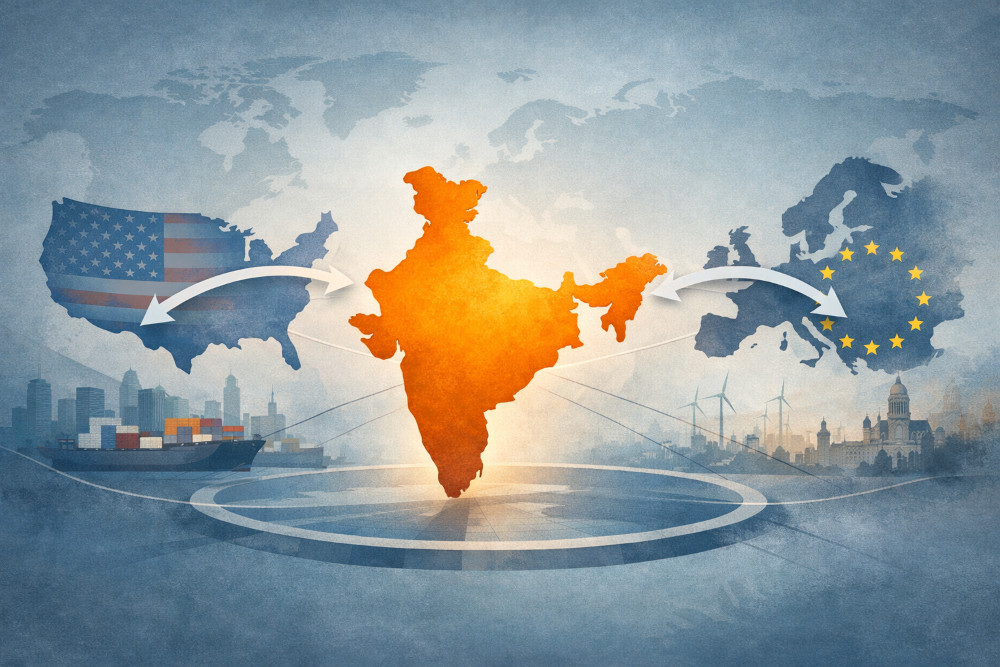
[India between markets and power: trade access with the US and EU reshapes the meaning of strategic autonomy.]
The joint press statement from New Delhi and Washington announcing the interim trade framework between India and the United States is not just about tariffs. It is about how strategic autonomy now works in a world where access to markets and geopolitics are increasingly linked.
For India, the deal brings both relief and warning. Access to the world’s largest market has been stabilised. But this access now comes with clearer geopolitical expectations attached.
At first glance, the rollback of US tariffs to an 18% headline rate restores India’s competitiveness relative to regional rivals. It protects labour-intensive exports from losing market share.
Domestic political economy has clearly shaped the outcome of the US deal. It brings into sharp relief the frictions that sit at the heart of any trade negotiation and compromise. Agriculture and dairy remain India’s firm red lines.
The interim framework reflects this balancing act. It lists selected US food products—such as dried distillers’ grains, soya oil, and red sorghum—for tariff reduction. Each reflects the priorities of American farmers, among the world’s largest producers of corn, soya, and sorghum. At the same time, these are not mainstream crops in India. Imports will continue, and crop substitution remains feasible.
By protecting core crops, large-acreage products, and agri segments with national or regional sensitivities, India has avoided a domestic backlash that could have delegitimised its broader trade strategy.
In industry, tariff relief has been targeted at sectors where India already has scale or ambition, while policy space has been retained for future upgrading. This selectivity limits exposure, even if it cannot eliminate risk.
Beneath the tariff numbers, however, lies a harder truth. India did not so much choose this negotiation as accept that refusing accommodation would have carried higher geo-economic costs. Autonomy today is less about refusal and more about calibration. India has bought time—but at the cost of signalling a willingness to align with Washington’s priorities, much like many other countries.
Beneath the tariff numbers, however, lies a harder truth. India did not so much choose this negotiation as accept that refusing accommodation would have carried higher geo-economic costs.
This strategy, and its tensions, become clearer when the trade deal is read alongside India’s Union Budget 2026. The Budget reinforces the deal by deepening strategic and commercial ties with the United States in selected sectors. It offers duty exemptions for aircraft components, nuclear equipment, clean-energy inputs, advanced medical devices, and pharmaceuticals. These are capital-intensive, technology-driven areas where American firms are strong. India is opening access where strategic cooperation and high-value imports overlap.
The stated goal of $500 billion in bilateral trade by 2030 should be seen as an intention rather than a firm commitment. Even so, some Budget provisions raise sensitive questions while remaining central to the deal’s success. A key example is the 20-year tax holiday for foreign data-centre operators serving global markets from India.
This move aligns closely with US interests, and potentially with those of the EU as well. The main beneficiaries are likely to be large American hyperscalers. India is offering land, power, water, and long-term tax concessions to host AI infrastructure. Yet the platforms, intellectual property, and profits will largely remain offshore. The costs—energy demand, water stress, and pressure on local grids—will be borne domestically. Some spillover benefits may emerge through investments in power or related sectors, but the imbalance is hard to miss.
These choices highlight a central paradox. Strategic autonomy remains India’s stated doctrine. But the tools needed to sustain growth—capital, technology, energy security, and market access—are now deeply tied to global power shifts. They are shaped as much by US-China rivalry as by India’s own security concerns.
The Russia-Ukraine war adds another layer of risk to the India-US trade framework. Any eventual outcome will be influenced not just by Washington and Moscow, but also by Beijing’s positioning. The European Union, despite its economic weight, has limited ability to shape outcomes decisively.
For India, the implication is not a sudden break with Russia. Instead, constraints are tightening gradually. Sanctions, energy markets, and geopolitics are increasingly linked to trade. India’s room for manoeuvre is narrowing, even if its core relationships remain intact.
As US influence over sanctions and conflict dynamics continues to affect global oil markets, India’s energy strategy becomes as much diplomatic as economic. India has already diversified its suppliers, including higher imports from the US and others, without sharply reducing purchases from Russia so far.
Concerns about pressure on India’s energy choices—especially Russian oil—are not unfounded. But American leverage is often overstated. Even under a more transactional Trump administration, India’s ties with Moscow are unlikely to collapse. They may, however, become more explicitly transactional. Russia will watch not only oil flows, but also India’s defence choices. India’s approach will remain long-term and calibrated, rather than reactive.
The trade framework therefore points not to a single outcome, but to several possible paths.
Calibrated stabilisation: Tariff risk is contained, exports recover, and strategic cooperation with the US continues despite geopolitical friction. This balance, however, is fragile. In a world shaped by transactional politics, assuming stability could leave India exposed to sudden shifts.
Conditional integration: Deeper ties in technology, energy, defence, and advanced manufacturing could speed up India’s industrial upgrading and embed it more firmly in global value chains. But market access would increasingly depend on alignment beyond trade—covering energy sourcing, technology controls, defence choices, and diplomatic signals. Over time, this could narrow policy space.
De-linking from China: India’s manufacturing ecosystem still depends heavily on Chinese intermediates. If expectations of rapid de-linking move faster than India’s ability to replace these inputs, costs will rise and competitiveness will suffer. Any gains from tariff relief could then be eroded. Over the medium to long term, however, benefits from US and EU agreements could support a more gradual shift.
Strategic triangulation: This is the ideal outcome. The US deal becomes one pillar alongside an EU trade agreement and other FTAs. China evolves into one among several important linkages, rather than a dominant one. The EU track offers predictability and legal durability that the US framework lacks. Together, these arrangements could sustain exports in the short term and encourage investment, technology transfer, and domestic capability over time. The risk is that excessive tilt toward any one partner weakens diversification itself.
Which path prevails will depend less on headline tariff rates than on implementation and political management. The interim nature of the US framework is not a weakness. It reflects an awareness that trade arrangements under a Trump administration can shift abruptly.
One factor cuts across all scenarios: domestic politics. If trade liberalisation becomes associated with import pressure or uneven gains, resistance will grow. This would limit future room for manoeuvre and reduce India’s ability to use trade as a strategic tool.
The agreement is therefore not an endpoint, but a waypoint. It tests whether India can secure economic gains without sliding into strategic dependence. It also tests whether Washington is willing to engage India as a partner rather than as a pressure point. Finally, it asks whether diversification across markets and alliances can realistically cushion geopolitical shocks.
One factor cuts across all scenarios: domestic politics. If trade liberalisation becomes associated with import pressure or uneven gains, resistance will grow. This would limit future room for manoeuvre and reduce India’s ability to use trade as a strategic tool.
Strategic autonomy is not disappearing. It is being reshaped. It is now conditional, negotiated, and situational. In today’s fractured global order, autonomy increasingly means avoiding dependence on any single axis. That is the logic—and the risk—embedded in India’s trade arrangements with the United States and the European Union.