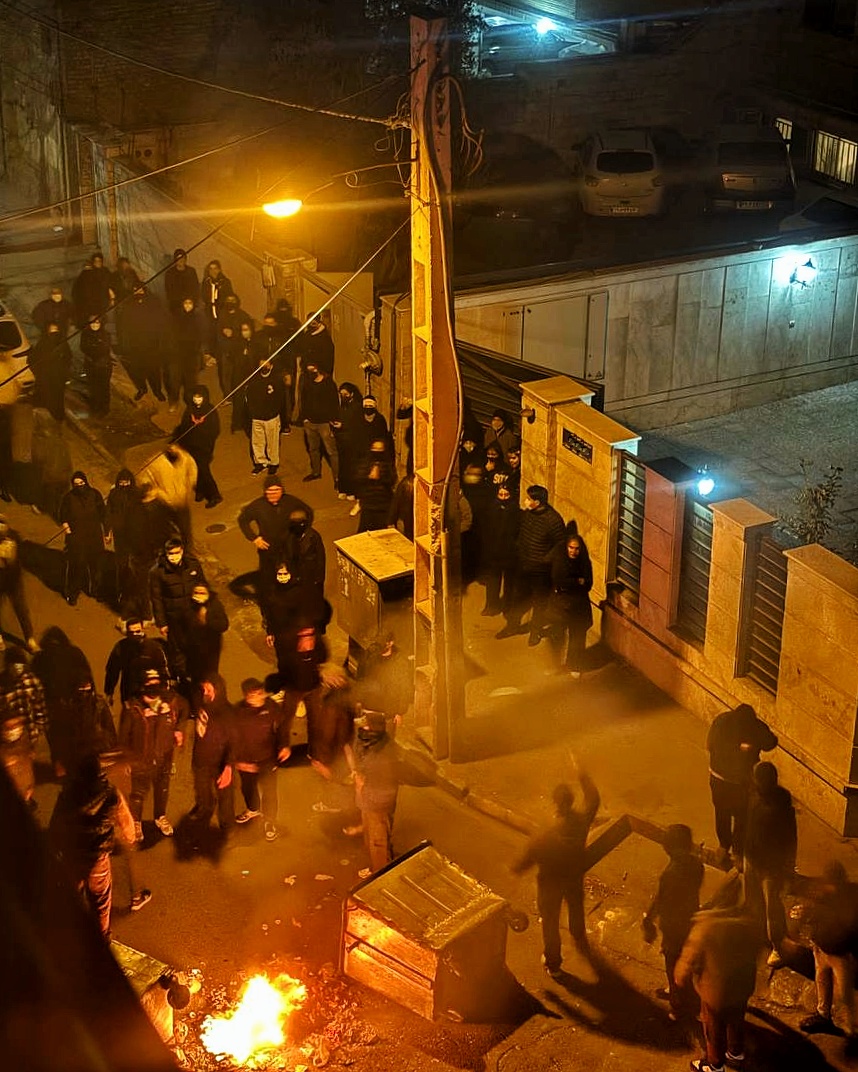
[Iran protests 8 January 2026. Photo from: Wikipedia]
For nearly three weeks now Iran has been in the throes of deep civilian unrest. The protests have turned violent, the Ayatollah-Islamic Revolutionary Guard Corps (IRGC)-led regime is cracking down with force. Fires are burning across cities and towns. The immediate trigger is the dire state of the economy, but discontent with the regime’s hardline policies has long been simmering. Iran’s foreign minister, Abbas Araghchi, claims that “the situation has come under total control”. Images of worsening violence across social media suggest otherwise. The regime faces its most dangerous threat yet—a scenario where it might collapse.
The threat posed by the protesters is regionally and globally disruptive; stability in Iran matters. Prolonged unrest would eventually draw in the world’s leading powers—the United States, China and Russia. Donald Trump is threatening military action, even before negotiations sought by the Iranian regime have begun. Tehran, in turn, has threatened attacks on Israel and on America’s regional bases should Trump intervene.
When an Internal Crisis Stops Being Internal
Instability in Iran could disrupt the Persian Gulf and the Strait of Hormuz, through which over 22% of global oil flows. One of the world’s most consequential gas fields lies in the Gulf, shared between Iran and Qatar. Qatar’s share, known as the North Dome, underpins some of the largest and most strategically important supply contracts with China, the European Union and India.
An unstable Iran would affect India’s regional ambitions. Not only could the India–Middle East Economic Corridor (IMEC) be delayed; so too could vital land routes to Central Asia and Russia, including the International North–South Transport Corridor (INSTC), the proposed Chabahar–Central Asia rail links and operations at Chabahar port itself.
Israel is watching closely and offering support. One of Iran’s many proxies, Hezbollah, sits across Israel’s borders in Syria and Lebanon. Hamas, another Iranian-backed group, has refused to disarm, leaving peace in Gaza distant. Yet another proxy, the Houthis, has created serious border-security problems for Saudi Arabia. A recent rift between the United Arab Emirates and Saudi Arabia over the Houthis underscores the strain.
Sources within the Iranian expatriate community say that Reza Pahlavi, the exiled son of Iran’s former shah, is playing a significant behind-the-scenes role in the protests. The 65-year-old Reza Pahlavi lives in the United States and hasn’t stepped in Iran since his father was deposed in 1979 by a combination of Islamic clerics led by Ayatollah Ruhollah Musavi Khomeini and left wingers. Khomeini, however, quickly disposed off the left-wingers and grabbed power creating a theocracy.
[Security Personnel Deaths. Map from: Institute for the Study of War]
Reza Pahlavi’s account on X and his website sets out detailed plans for Iran and guidance for protesters. He promises a secular democracy and has outlined an ambitious programme for political and economic transition.
He has also proposed a choice between a limited constitutional monarchy, like those in Britain or Spain, and a republican democracy. Chants of “Javid Shah” (“long live the king”) heard at protests suggest his message is resonating, at least in major cities such as Tehran. Demonstrators have also shouted “Death to Khamenei”, and statues of the supreme leader have been set alight.
Yet it remains unclear how much support Reza Pahlavi commands beyond urban centres. Nor is it easy to gauge the scale of violence. Internet and telecommunications shutdowns have made reporting from inside Iran scarce; access via Elon Musk’s Starlink has become one of the few reliable channels for information in recent days.
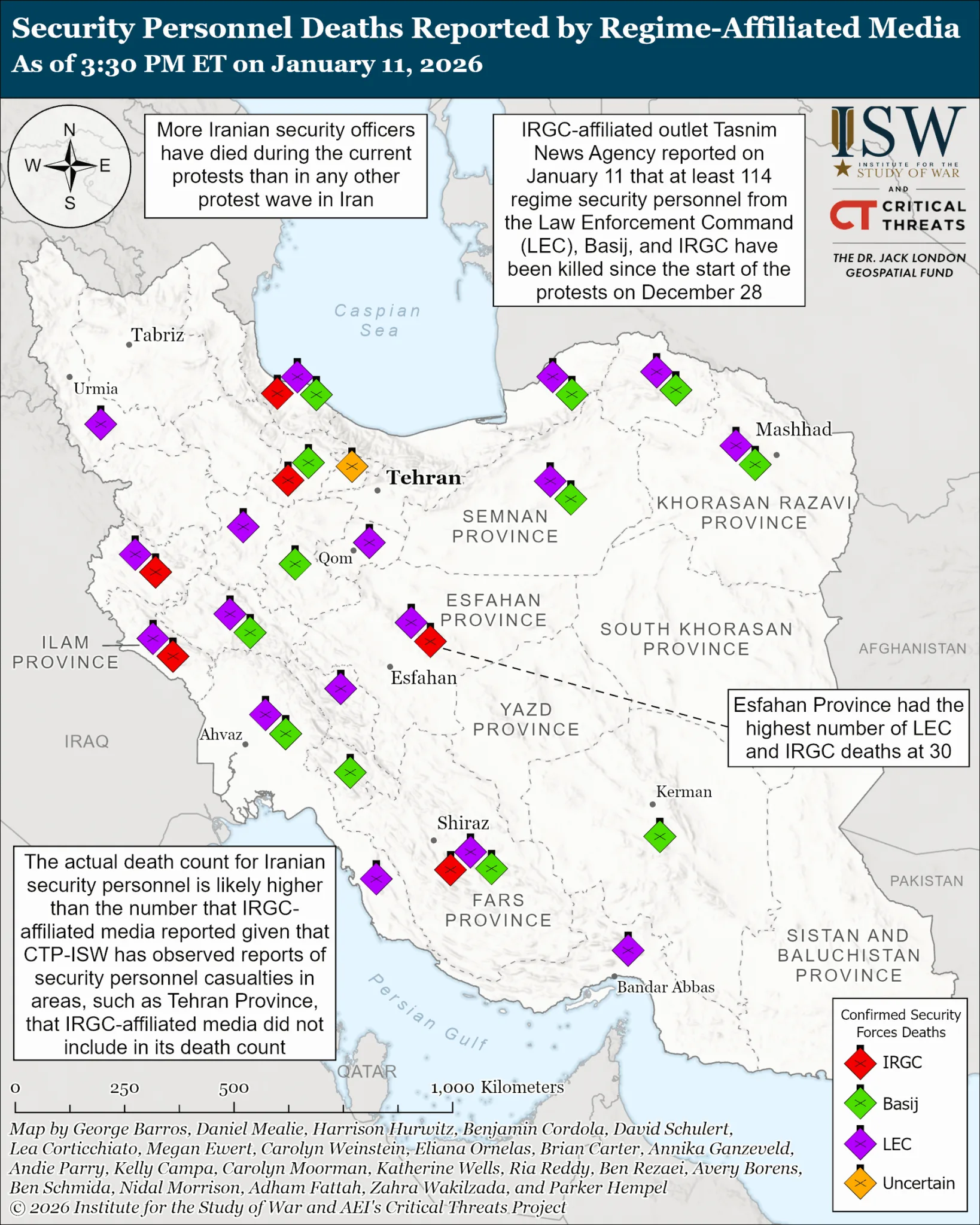
Al Jazeera reports widespread violence. The Institute for the Study of War (ISW) says unrest has spread to over 30 cities and towns nationwide. It reports that IRGC-affiliated media claimed on January 11th that at least 114 regime security personnel from the Law Enforcement Command, the Basij and the IRGC had been killed since protests began on December 28th. Reuters puts the total death toll at more than 500.
How This Unravels
Five scenarios stand out. First, the regime suppresses the unrest by force. Even if successful, this would be temporary. Discontent would persist beneath the surface, while outside actors such as Reza Pahlavi, Israel and the United States continue to apply pressure. Economic recovery is unlikely without sanctions relief. Russian and Chinese support has so far been limited. Washington might consider easing sanctions if Iran abandoned its nuclear ambitions and moderated its hostility towards Israel. But trust in the Ayatollah–IRGC regime is absent, and retreat would be politically perilous for it.
Second, unrest spreads in the coming weeks as resentment against the IRGC and security forces grows. The regime weakens from within. If that happens, and the regime falters, the risk of groups such as Hezbollah turning inwards in support of the regime rises, potentially triggering further internecine violence.
Third, the regime collapses. For this to happen, elements of the elite—industrialists, civic leaders and military officers—would need to ally with protesters. Severe damage to critical infrastructure could accelerate such a shift. Yet without a credible transition authority capable of managing the IRGC and Iran’s proxy groups, this outcome would be fraught with risk and uncertainty.
Fourth, disgruntled elites across industry and the armed forces rally behind Reza Pahlavi. Combined pressure from above and below brings down the regime. He returns to lead a transition government, with discreet backing from Washington and Tel Aviv. Much would then depend on his ability to manage rival factions and armed proxies. Proxies like the Hezbollah, alongside IRGC elements, can be expected to turn against his government.
Fifth, and most worrying, is premature American intervention. A war involving the United States and Israel would likely engulf much of the Arab world and the Gulf. Iran’s proxies would join in, turning the Persian Gulf into a war zone. Oil and gas supplies would be threatened. Under such conditions, Pahlavi’s return would be compromised, as would prospects for a stable transition. A distracted America would benefit Russia and China, in Ukraine and the East China Sea. A United States bogged down in the Middle East would be able to expend few military and diplomatic resources over the Russia-Ukraine war and the Taiwan question.