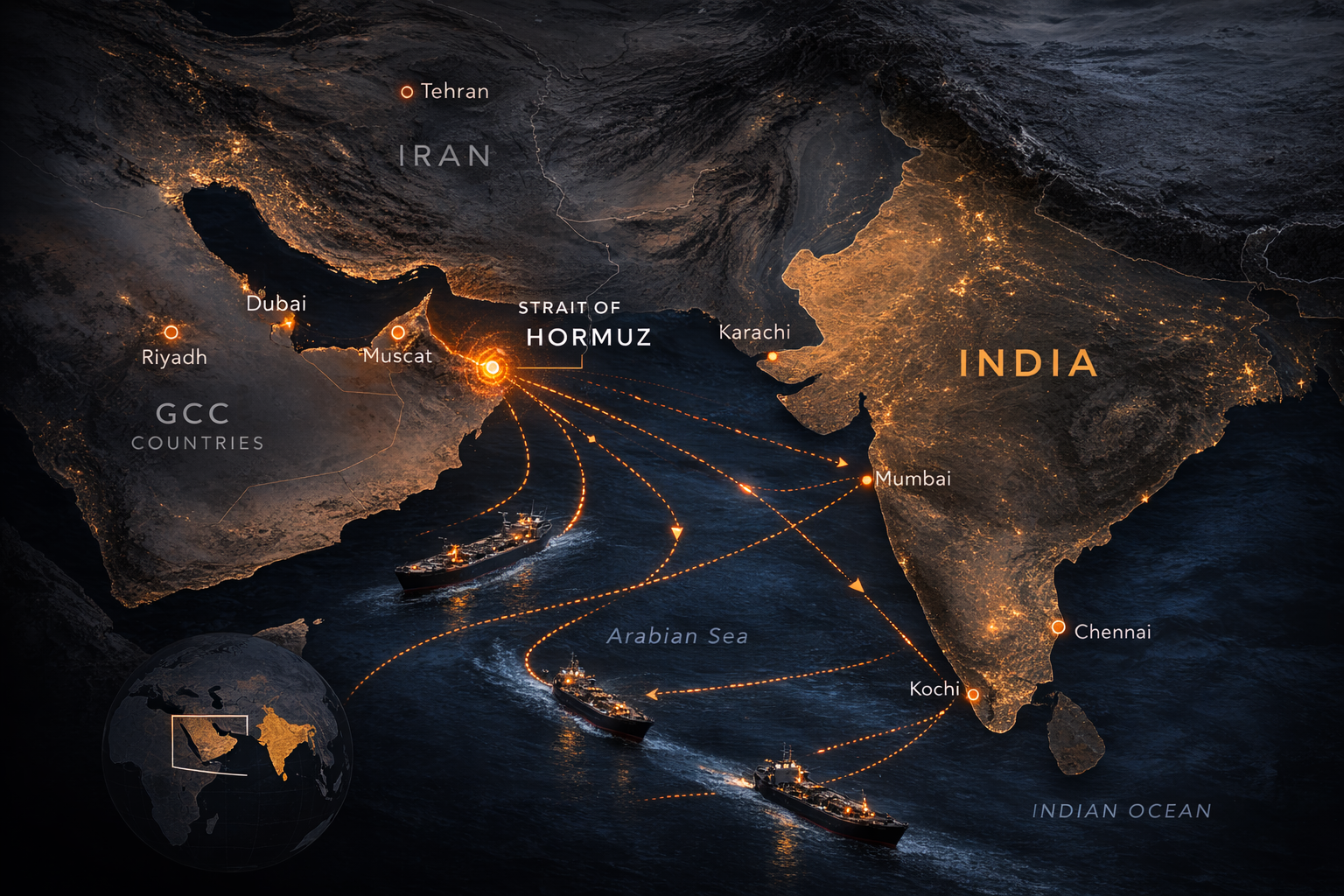
[Energy lifeline: A large share of India’s crude oil and LNG imports transit the Strait of Hormuz, making stability in the Gulf central to India’s economic and strategic security.]
Editor’s Note: In Part I of this series, Vivek Y. Kelkar examined how the US–Israel war on Iran is reshaping energy markets, Gulf security and the wider geopolitical order.
In this concluding essay, he turns to India—examining how the conflict could test New Delhi’s strategy of strategic autonomy through its impact on energy supplies, remittances, trade routes and regional diplomacy.
The war involving Iran is a stress test of the strategy that has quietly shaped India’s rise over the past decade—strategic autonomy through layered hedging. Instead of choosing sides in a fracturing global order, New Delhi has spread its bets. It has diversified trade agreements, energy suppliers, technology partners and diplomatic alignments so that no single power or region can dictate its choices. The result is a dense architecture of economic and strategic regional relationships stretching from the Gulf to Israel and beyond.
Yet that architecture rests on an uncomfortable geographic reality. West Asia remains the central artery of India’s external economy—supplying energy, absorbing exports, hosting millions of Indian workers and anchoring several of India’s most ambitious connectivity projects.
The Iran war exposes the paradox in this strategy. The very region that enables India’s strategic autonomy is also the one most capable of constraining it when instability erupts. India’s regional policy rests on what diplomats describe as de-hyphenation. It involves maintaining discrete, yet balanced, relationships with Israel, the Arab Gulf states and Iran without allowing tensions among them to dictate Indian diplomacy. The approach worked because economic and security ties with each partner could be compartmentalised. The Iran war tests whether that compartmentalisation remains possible.
“The Iran war exposes the paradox in India’s strategy of strategic autonomy.”
The broader learning is straightforward. Economic growth magnifies geopolitical exposure. As India’s trade networks widen and its energy consumption grows, stability in distant regions increasingly shapes domestic economic outcomes. West Asia is no longer merely a supplier of oil. It has become a dense ecosystem of trade, investment, labour migration and strategic partnerships. Conflict within that ecosystem reverberates across India’s political economy—from energy prices and trade logistics to currency stability and diplomatic positioning. Hedging works best when shocks are temporary. When instability becomes prolonged, the layers themselves could interact in unpredictable ways.
A triangular architecture
Nowhere is this more visible than in the structure of India’s trade relations with the region. Over the past decade New Delhi has steadily embedded itself in West Asia’s economic networks. The Gulf Cooperation Council has emerged as India’s largest trading partner bloc, with bilateral trade reaching roughly $178.56 billion in FY 2024–25. For Indian exporters and importers alike, the Gulf has become one of the most important external markets.
The region also sits at the centre of India’s import structure. Roughly 19% of India’s total imports originate in the Middle East, amounting to about $135 billion in goods trade. Several industries depend heavily on Gulf markets. Nearly 44% of India’s jewellery exports are shipped there, while close to a quarter of its automobile exports are destined for GCC countries. Petroleum products, food items and manufactured goods form another significant share of India’s exports to the region.
India has attempted to institutionalise these ties through trade agreements. Negotiations for a comprehensive free trade agreement with the GCC aim to provide predictable market access for businesses while expanding cooperation across sectors ranging from engineering goods and textiles to services and technology.
The recently concluded Comprehensive Economic Partnership Agreement with Oman reflects the same logic. The pact eliminates duties on more than 98% of tariff lines, effectively granting near-complete market access for Indian exports. Yet its significance goes beyond tariffs.
Oman sits at the mouth of the Strait of Hormuz, one of the world’s most important maritime chokepoints. Strengthening economic ties with Muscat therefore expands commercial opportunities while reinforcing India’s presence along a corridor through which a large share of the world’s energy flows passes.
Alongside these economic partnerships New Delhi has also deepened technological and defence cooperation with Israel. Prime Minister Narendra Modi’s recent visit elevated bilateral relations into a Special Strategic Partnership emphasising defence co-development, artificial intelligence collaboration and advanced technology initiatives.
Israel has become an increasingly important supplier of defence systems and innovation for India, complementing long-standing partnerships with the United States, France and Russia. The relationship reflects India’s broader effort to diversify its sources of advanced technology and reduce reliance on any single supplier.
Taken together, these relationships form a triangular architecture of engagement in West Asia. The Gulf monarchies anchor energy security and trade flows. Israel anchors defence technology and innovation partnerships. Iran historically provided continental access through the Chabahar port project and India’s connectivity ambitions toward Central Asia. The design was deliberate. By spreading its economic and strategic engagement across rival regional actors, India sought to preserve flexibility while avoiding dependence on any single alignment.
The energy dilemma
War, however, alters the geometry of hedging. The most immediate vulnerability appears in energy markets. India imports roughly 5.5 million barrels of crude oil per day, meeting close to 90% of its domestic requirement through imports. Nearly half these shipments transit the Strait of Hormuz—the narrow passage through which about one-fifth of the world’s seaborne oil flows.
This geographic concentration makes India acutely sensitive to disruptions in the Persian Gulf. Even without a full closure of Hormuz, the economic consequences are significant. Every $10 increase in global crude prices raises India’s annual import bill by roughly $13–14 billion. Higher energy prices widen the current account deficit, weaken the rupee and feed inflation into the domestic economy.
India’s vulnerability extends beyond crude oil. Around 60% of its liquefied natural gas imports also pass through Hormuz. Unlike crude oil, LNG markets offer limited flexibility because most shipments are tied to long-term contracts. Sudden disruptions cannot easily be offset through spot purchases.
The consequences would extend beyond energy markets. A significant share of the LNG used by Indian fertiliser plants is imported from suppliers such as Qatar. Disruptions to Gulf gas supplies could therefore tighten feedstock availability and raise input costs for fertiliser producers. The effects would quickly transmit to government finances because fertiliser prices are heavily subsidised. Over time, sustained gas disruptions could translate into both fiscal pressure and risks to agricultural supply chains.
India has attempted to reduce these risks through supply diversification. Since 2022 Russian crude has become a major component of India’s import basket, often sold at a discount to global benchmarks. The arrangement has helped cushion price volatility.
Yet diversification has limits. Russian production faces constraints from sanctions and Ukrainian drones. With Middle Eastern supplies under threat, the Trump administration could reconsider how strictly sanctions on Russian oil are enforced. Washington’s priority in such circumstances would be to prevent a prolonged supply shock that could push global prices sharply higher. One possibility would be quieter enforcement—allowing greater volumes of Russian crude to reach global markets through intermediaries or expanded shipping exemptions without formally lifting sanctions. Much will depend on how Trump wants to balance oil market stability with his stances over the Russia-Ukraine war.
For India the implication is clear. Diversification must be complemented by stronger strategic reserves. India currently maintains petroleum reserves of roughly 39 million barrels—equivalent to about 74 days of demand, according to Hardeep Singh Puri, the petroleum minister—a limited buffer against prolonged disruptions. China, by contrast, is estimated to hold reserves sufficient for nearly six months of imports, giving Beijing far greater insulation from sudden supply shocks. Strategic reserves therefore become not merely an energy policy tool but a pillar of geopolitical autonomy. As geopolitical risk becomes structural rather than episodic, a strategy to urgently expand India’s reserves becomes increasingly important.
The remittance issue
Energy markets, however, represent only one layer of India’s exposure to the region. Another vulnerability lies in remittance flows. India receives remittances of about $135 billion annually. Roughly 38% of these flows originate from Gulf Cooperation Council countries, where around ten million Indians live and work.
These transfers play a crucial macroeconomic role. They provide a steady stream of foreign exchange that helps finance India’s current account deficit and stabilise the rupee. If prolonged conflict dampens economic activity in Gulf economies—or reduces employment opportunities for migrant workers—remittance flows could weaken. That would erode one of the most stable pillars of India’s external financial position.
The consequences would extend beyond macroeconomic statistics. Remittances sustain household consumption across several Indian states, particularly Kerala and Telangana, making them an important socio-economic lifeline.
Iran and connectivity
The Iran war also introduces uncertainty into India’s long-term connectivity ambitions. For more than a decade the Chabahar port project in Iran has been central to India’s strategy of accessing Afghanistan and Central Asia while bypassing Pakistan. The port offers potential links to Eurasian markets and mineral resources critical for emerging industries.
War and sanctions risk complicating that strategy. India may increasingly prioritise the India–Middle East–Europe Corridor (IMEC), a proposed logistics network linking Indian ports with the Gulf, Israel and Europe through integrated maritime and rail infrastructure.
IMEC offers several advantages. It bypasses Iranian territory and strengthens economic integration with Gulf partners and Israel. Yet the project remains at an early stage, with financing structures and infrastructure agreements still evolving. Its future also depends on how broader regional initiatives, including the Abraham Accords, evolve in the aftermath of the conflict.
Chabahar, by contrast, already exists. India’s challenge will be to sustain both corridors simultaneously—preserving continental access to Central Asia while developing alternative trade routes through the Gulf.
Geopolitical challenges
The war also reshapes the wider geopolitical environment in which India operates. The US remains the dominant military actor in the Persian Gulf and a central architect of sanctions regimes that shape global energy flows. India’s partnership with Washington offers technological and security advantages but also requires navigating the complexities of American sanctions policy toward Iran.
China introduces another layer of competition. Beijing currently purchases around 90 % of Iran’s crude exports—roughly 1 to 1.5 million barrels per day. If those supplies disappear because of war or tighter sanctions enforcement, China could seek alternative crude from the same producers India relies upon, including Russia, Iraq and Saudi Arabia. Such competition would tighten global supply balances and reduce India’s bargaining power. China’s policies over its massive strategic reserves also need careful watching.
Pakistan’s role is more indirect but still relevant. Islamabad emphasises its ideological ties and has attempted defence and economic cooperation with several Gulf states. Shifts in alignments during the conflict could therefore influence the diplomatic environment in which India operates.
Risk scenarios
Ultimately the scale of the risk to India depends on the duration of the war.
If the conflict ends within roughly two months, the shock will remain largely financial. Oil prices will spike, shipping costs will rise and the rupee may weaken temporarily. Yet these disruptions would likely prove cyclical rather than structural.
If the conflict stretches to three or four months, the risks become more serious. Sustained volatility in energy markets could push crude prices above $100 per barrel, sharply increasing India’s import bill. Shipping disruptions would raise freight costs and strain export sectors that depend heavily on Gulf markets. As the war drags on, diplomatic balancing becomes more difficult. Pressure from global powers—including the US—could force India to make uncomfortable choices regarding sanctions, shipping insurance or military cooperation in the region. A 60–120-day war could therefore represent a strategic resilience test for India’s West Asia policy.
A conflict lasting over four to six months would carry structural consequences. Competition for alternative energy supplies would intensify, shipping routes could shift consequentially and remittance flows might weaken as Gulf economies slow. In such circumstances the war would expose the structural vulnerability of India’s geopolitical geography. The macroeconomic consequences for India would become increasingly serious. The geopolitical implications would be equally significant. A prolonged war would likely deepen great-power competition in the Middle East and India’s hedging strategy could come under greater pressure.
“Strategic autonomy, however carefully constructed, ultimately remains constrained by geography.”
The deeper learning is that instability across a dense regional economic ecosystem linked to energy flows, trade routes, labour migration, investment and strategic partnerships can reverberate through every layer of India’s political economy—from inflation and currency markets to trade logistics and diplomacy. The Iran war serves as a reminder that India’s growth is inseparable from stability across a wider Asia. Strategic autonomy, however carefully constructed, ultimately remains constrained by geography.
(This is the second and concluding part of Vivek Y. Kelkar’s two-part analysis on the US–Israel war on Iran and its strategic consequences.)
Dig Deeper: Vivek Y. Kelkar on the shifting geopolitics of the Middle East
A World Without Endgames
As conflicts from Ukraine to the Indo-Pacific drag on without clear resolution, Vivek Y. Kelkar explores how a world of prolonged instability narrows the strategic space for powers such as Europe, China—and India.
America’s Iran Trap Is Closing As nuclear deadlines, regional alliances and US military pressure converge, Washington may discover that every option—strike, sabotage or restraint—risks escalation.
From Gaza to Doha: How Israel’s Strike on Qatar Shook the Middle East
Israel’s strike on Doha marked a dangerous expansion of the Gaza conflict, revealing the contradictions within the US-Israel alliance and the fragility of the region’s security architecture.