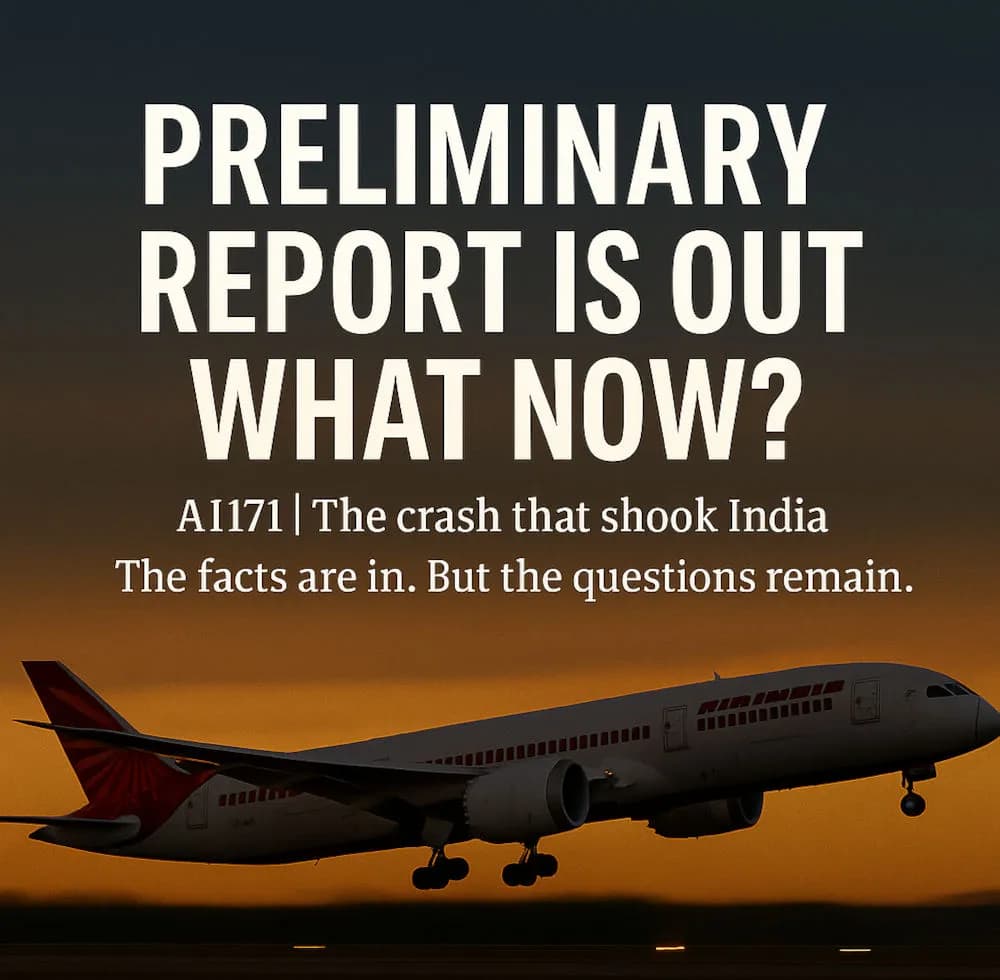
AI171: Human Error, Design Flaw, or Something Else?
The mystery lives on. But now we have facts
12 July 2025· 2 min read· 1 comments
TL;DR
The preliminary report into the Air India 787 crash presents a compelling mystery: fuel switches moved to 'CUTOFF' post-liftoff, despite requiring complex manual action. This incident transcends simple pilot error, offering crucial insights for business leaders. It highlights the profound implications of an airline's inaction on a non-mandatory FAA safety advisory concerning switch mechanisms. Leaders must re-evaluate the distinction between minimum compliance and a proactive 'safety-first' ethos, scrutinize design responsibilities, and assess their approach to non-mandatory risk directives. This case underscores how intricately interwoven design, compliance, and human factors are in preventing catastrophic failures and protecting organizational integrity.
By Indrajit Gupta and Anmol Shrivastava
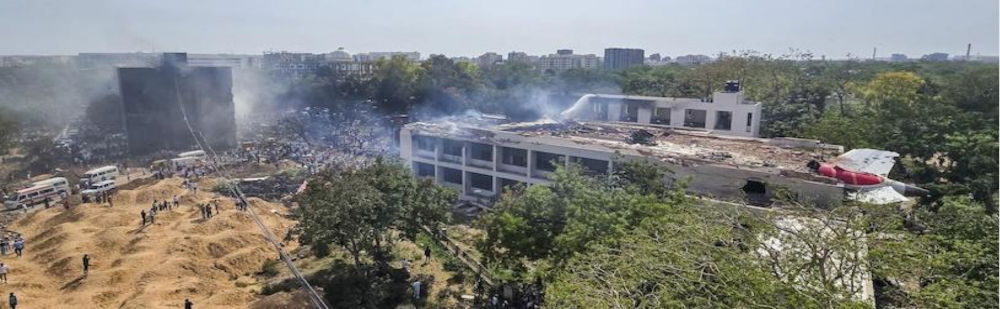
India’s AAIB released its 15-page preliminary report on the tragic Air India 787 Dreamliner crash in Ahmedabad, shortly after midnight today.

Crash summary
- Fuel switches on both engines moved from “RUN” to “CUTOFF” 3 seconds after liftoff, starving the engines of fuel.
- Pilots turned them back on after 10 seconds—but it was too late. The aircraft couldn’t climb and crashed into a medical hostel.

Cockpit confusion
- Cockpit voice reorder (CVR) audio captured one pilot asking, “Why did you cut off the fuel?”
- The other pilot denied it.
- The switches require manual lifting of an interlock latch, making accidental movement unlikely.

The big question: Why did the switches move?
This is now the heart of the investigation. These switches aren’t easy to move by mistake. So what happened?

Theory 1: Design or mechanical flaw
- On December 17, 2018, the FAA issued a Special Airworthiness Information Bulletin (SAIB) after reports that fuel control switch locks on some 737s were disengaged.
- The 787 was also covered in the advisory.
- But: It was non-mandatory. No Airworthiness Directive (AD) was issued.
- The AAIB confirms: Air India didn’t inspect the locking mechanisms on this aircraft.
If the final report pins the root cause on this issue, accountability may shift from crew error to design flaw.
Four tough questions arise:
- Why didn’t Air India act on the SAIB in keeping with a safety first philosophy?
- Why didn’t the FAA issue a mandatory directive?
- Should Boeing have redesigned the switch entirely?
- Why has the AAIB refrained from recommending any action to Boeing or GE?
“We shouldn't have to expect pilots to compensate for flawed designs.” — Capt. Chesley “Sully” Sullenberger

Theory 2: Pilot error
Why it’s considered:
- Rare human lapses do occur.
- Possible “muscle memory” from past aircraft or simulators.
Why it’s challenged:
- Fuel switches need 4-step motion to activate.
- Both engines shut down within 1 second of each other—suggesting improbability of simultaneous pilot error.
Deeper CVR mic analysis could offer clarity.

Theory 3: Deliberate action
Why it’s considered:
- The switches were manually turned off.
- Past cases of pilot suicide exist (Examples: here, here and here)
Why it’s challenged:
- Pilots sounded perplexed, attempted recovery.
- No cockpit struggle or nosedive.
- Impact angle was nose-up—not consistent with deliberate crash patterns.
Pilot psychology and motive still need probing.

Theory 4: Software or electrical fault
A software malfunction or control system failure remains a remote but real possibility.
Investigators will now review sensor data, full authority digital engine control (FADEC) behaviour, and cockpit logic systems.

What’s next
The hard part begins. Investigators will:
- Reconstruct pilot state of mind
- Deep analysis of cockpit voice from all microphones
- Examine switch design, tolerances, interlock integrity
- Study the FAA’s SAIB logic, Boeing’s response and Air India compliance with advisories
- Scrutinize relevant subsystems
- Rule out software or systemic failure or other possibilities

The goal:
Find the root cause. Prevent a repeat.
Exclusive: Anuradha Sengupta interviews Founding Fuel authors on the Air India AI 171 crash investigation series
Watch the full episode: Anuradha SenGupta x Founding Fuel
On her YouTube show @anuradhasays
In case you missed our 3-part series:
Part 1 – AI171: The Investigation That Could Redefine Aviation Safety
Read time: 5 mins
Part 2 – How Experts Are Reconstructing the AI171 Tragedy
Read time: 18 mins
Part 3 – Unraveling AI171: The Search for What Really Went Wrong
Read time: 10 mins

What readers are saying
“A must-read. Nothing has helped process the AI171 tragedy more.”
— Ambica Naithani, Educationist
“The finest reporting I’ve read on this tragedy.”
— Vivek Singh, Master Coach
“Brilliant. No sensationalism. Just sharp, nuanced journalism.”
— TN Hari, Executive Chairman, STEER World
“Outstanding. I could relate to the accuracy.”
— Group Capt KTN Rao (Retd), IAF
“Journalism that rises to the occasion.”
— Anuradha SenGupta, Senior Journalist

Founding Fuel is sustained by readers who value depth, context, and independent thinking.
If this essay helped you think more clearly, you may choose to support our work.

Founding Fuel is sustained by readers who value depth, context, and independent thinking.
If this essay helped you think more clearly, you may choose to support our work.
Join the conversation
Indrajit Gupta
Co-founder and Director | Founding Fuel
Indrajit Gupta is a business journalist and editor with over two decades of experience. He was the Founding Editor of the Indian edition of Forbes magazine. Within four years of its launch, Forbes India became the most influential magazine in its space.
He is the co-founder and director at Founding Fuel.
He has served in leadership positions at many of the leading media brands in the country. Before taking up the assignment to start up the India edition of Forbes magazine, Gupta was the Resident Editor of The Economic Times in Mumbai and before that, the National Business Editor of The Times of India.
Over the years, Gupta has built a reputation for grooming talent and creating highly energised and purposeful newsrooms. He has interviewed several leading global thought-leaders and business leaders including CK Prahalad, Ram Charan, Wayne Brockbank, Sumantra Ghoshal, Carlos Ghosn and Nitin Nohria, and also led cutting-edge joint research-based projects with McKinsey & Co, The Great Place to Work Institute, Boston Consulting Group, KMPG and Coopers & Lybrand.
He won the Polestar journalism award in 2010 and was awarded the Chevening fellowship by the British Foreign office in 1999. Gupta is an alumnus of the SP Jain Institute of Management and Research, Mumbai and a B.Com (Hons) graduate from St Xavier's College, Calcutta.
Gupta teaches a course on Business Problem Solving at his alma mater. He writes a column named Strategic Intent in Business Standard’s edit page. He lives in Mumbai with his wife and two young daughters.
Beyond the noise is the signal.
FF Insights: Sharpen your edge, Monday–Friday.
FF Life: Culture, ideas and perspectives you won't find elsewhere — Saturday.
Loading comments...



Readers also liked
·Technology & the Future
Not the Pilot’s Fault: Inside the First 61 Seconds of AI171
A small turbine and a flicker of light tell a different story.
IG
Indrajit Gupta
Co-founder and Director | Founding Fuel
Not the Pilot’s Fault: Inside the First 61 Seconds of AI171
A small turbine and a flicker of light tell a different story.
Co-founder and Director | Founding Fuel
·Technology & the Future
Part 3: Unraveling AI 171: The Search for What Really Went Wrong
The mystery is not just about what happened—but why? And how can it be prevented in the future? The third and concluding part of a three part series
AS

Anmol Shrivastava
Entrepreneur, strategist, and technology consultant
Part 3: Unraveling AI 171: The Search for What Really Went Wrong
The mystery is not just about what happened—but why? And how can it be prevented in the future? The third and concluding part of a three part series
Entrepreneur, strategist, and technology consultant
·Economy, Policy & Society
Part 2: How Experts Are Reconstructing the AI 171 Tragedy
Why the media frenzy around the air crash is starting to look like six blind men and the elephant. The second in a three part series
AS
Anmol Shrivastava
Entrepreneur, strategist, and technology consultant
Part 2: How Experts Are Reconstructing the AI 171 Tragedy
Why the media frenzy around the air crash is starting to look like six blind men and the elephant. The second in a three part series
Entrepreneur, strategist, and technology consultant
Explore more
Dive into other themes from our network.