
Inside Chennai’s Enduring Enterprises
A field report on family ownership, continuity, and the craft of building for the long term
18 January 2026· 13 min read
TL;DR
This field report from Chennai reveals a compelling blueprint for enduring business success. It highlights how the city’s family-owned enterprises, like GRT Hotels, cultivate remarkable scale through quiet confidence, deep roots, and genuine customer connection. These businesses prioritize building for the long term, embedding authenticity and continuity into their culture, reflective of Chennai’s grounded character. They demonstrate that sustained growth, nurtured by patient, intentional leadership, outperforms rapid expansion, ensuring generational endurance. Business leaders gain valuable insights into cultivating lasting value and market dominance by focusing on genuine connection and a long-term vision, rather than just speed.
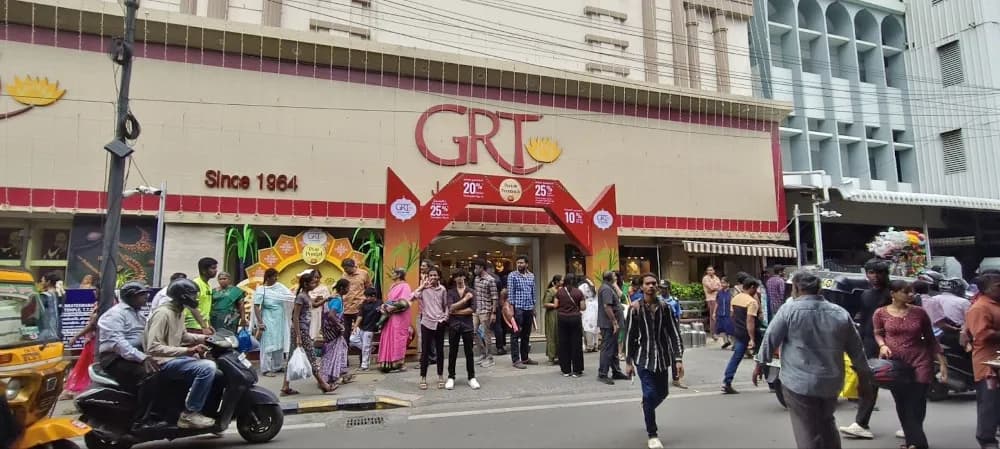
I landed in Chennai on a drizzly evening around 7.30 pm, a little later than scheduled. The drive from the airport took about an hour before I was dropped off at the GRT Grand Hotel, where I was staying.
As I got out of the car, I was greeted warmly by the doorman with a smile and a “Vanakkam.” I didn’t think much of it at the time, but something about that greeting stayed with me. There was a genuineness to it that felt out of the ordinary. Doormen in large hotels greet hundreds of guests every day, with a practised professionalism. This was different. It felt real.
I passed it off as a one-off—until two days later, on my way back to the airport, when I stopped at another GRT property for a meal. Once again, I was met with the same warmth, the same ease. My companions noticed it too. This was not incidental. It was a pattern.
By then, I had already met G.R. Radhakrishnan, one of the owners of GRT, and had begun to understand the mindset and processes that had shaped the organisation. That small moment at the hotel entrance seemed to reflect something deeper about how the business itself functioned.
A First Impression That Lingers
I was in Chennai with my students from SP Jain Institute of Management & Research, where I teach in the Family Managed Business programme. The visit was part of a Domestic Retail Immersion, aimed at understanding how family-run enterprises in India build scale, sustain themselves, and endure across generations.
Chennai was an obvious choice, though I had come to realise this only over time. A number of homegrown retailers across categories have built significant footprints here, expanding steadily across Tamil Nadu and beyond, often outpacing national chains. Their stores are large, their assortments vast, and their footfalls consistently strong. I happened to be visiting just after the festive season—a period when footfall typically drops—yet the stores were busy. This was retail at scale, and my students and I wanted to understand what lay beneath it.
I have also grown to appreciate Chennai as a city. Early in my career, I often came away feeling it was a backwater. It lacked the buzz of Mumbai or the energy of Bengaluru. Thirty years on, as those cities soar skywards in concrete and glass, they feel oddly drained—restless, aspirational, insecure. Chennai, by contrast, remains low-slung and grounded, rooted and confident. Over time, I have come to feel that the more a city is anchored in continuity, the less it needs to announce itself. It is enough to simply be.
As I would soon realise, that quality is reflected not just in the city, but in its businesses—and in the people who run them.
A City That Doesn’t Need to Announce Itself
It is difficult to describe the condition of roads in Mumbai today without sounding uncharitable. Against that backdrop, the roads in Chennai feel markedly better maintained. Traffic moves. Surfaces are smoother. The city appears to function with a degree of order. I realise many residents may disagree, but to an outsider the contrast is striking. Chennai feels like a city that works.
That sense of order extends beyond infrastructure. Chennai carries itself with a certain quiet confidence. It does not seek attention. It does not perform. There is a calm assurance to the place—an ease that comes from being comfortable in its own skin. And as I would soon realise, that quality is reflected in many of its businesses as well.
Learning from Those Who Have Endured
The meetings with retailers were arranged through a friend who knew several of the owners personally. Over the course of our visit, my students and I met with the leaders of three very different businesses: GRT, Pothy’s, and a smaller but distinctive retailer, Nuts & Spices. Each visit stretched over several hours, combining long conversations with detailed store walkthroughs.
At first glance, the three businesses could not have been more different. Yet what struck me was not their differences, but a shared temperament—one that echoed the city itself.
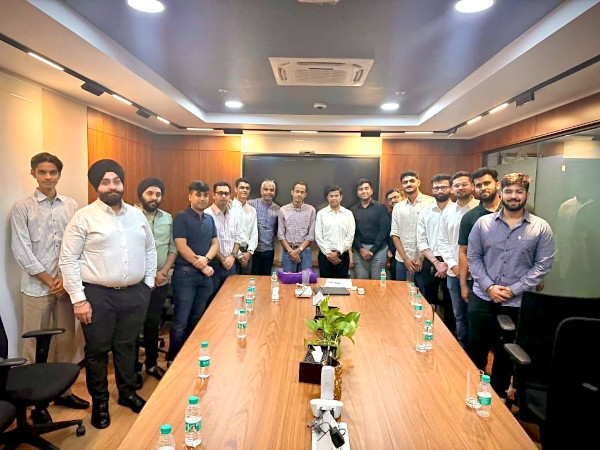
[Students and faculty during the retail field immersion in Chennai.]
Businesses Built on Clarity, Not Speed
GRT and Pothy’s are well-known retail brands. Nuts & Spices, by contrast, is a far younger enterprise. I hadn’t heard much about it and must admit I was in two minds about the visit. It was late in the day, we had already completed two long store visits, and I knew little about the retailer. Fortunately, something in me said we should go ahead. The students agreed later that we would have missed a great deal had we skipped it.
All three businesses, however different they may appear today, began from modest origins. G. Rajendran, the founder of GRT, was a gold appraiser. The company began as a single 500 sq ft jewellery store in Chennai in 1954.
Pothy’s traces its roots to the small town of Srivilliputtur in Tamil Nadu, where K. V. Pothy Moopanar started a textile weaving business in 1923. The first retail outlet opened a decade later, in 1933. Expansion began in earnest in 1986, when Ramesh Pothy, the founder’s grandson, opened a store in Tirunelveli. Growth accelerated only in 1999, with the launch of their first Chennai store.
Nuts & Spices has more recent antecedents. It was founded in 1999 by Sunil Saklecha, a first-generation entrepreneur, with a single store focused on a narrow but distinctive assortment.
Despite their different starting points, all three shared a defining characteristic: none had chased growth for its own sake. Expansion was deliberate, paced, and anchored in a clear sense of identity.
That clarity is visible in how each business has chosen to scale. GRT today operates around 60 large-format stores across southern India. Pothy’s runs fewer outlets, but on an enormous scale, with individual stores averaging 1.5 lakh square feet and new stores planned at nearly 5 lakh square feet. Nuts & Spices has taken a different route altogether—smaller stores, tighter focus, and a footprint of 33 outlets over 26 years. No overstretch. No leverage. Only profitable growth.
In each case, growth was not an end in itself. It followed from a clear sense of purpose.
“Growth followed clarity. It was never the other way around.”
That purpose begins with a precise understanding of the customer. GRT’s core clientele values tradition, trust, and above all, choice. Pothy’s appeals to middle-class families seeking breadth and familiarity. Nuts & Spices caters to customers who value quality and are willing to pay for it. In each case, the offering aligns closely with the customer’s expectations and self-image.
What struck me was the absence of unnecessary ambition. There was no attempt to be everything to everyone. Each enterprise had drawn clear boundaries around what it would—and would not—do. That restraint, more than anything else, has allowed these businesses to endure.
GRT’s success rests on a clearly defined mid-market proposition. Its stores emphasise traditional jewellery, both in design language and in depth of range. Customers value variety, and GRT delivers that in abundance. This stands in contrast to the more curated, minimal offerings of premium jewellery chains aimed at narrower, more urbane clientele. GRT’s strength lies in recognising this distinction and committing to it with consistency.
Pothy’s follows a similar logic. What began as an apparel store has evolved into an everything-under-one-roof format. Yet the underlying philosophy has remained unchanged. The focus has always been on accessibility and range for the middle-class family. The stores are expansive, the assortments wide, and the experience deliberately inclusive. Once again, this is scale with purpose.
Both GRT and Pothy’s are, in this sense, volume-driven businesses. Their success lies in attracting large numbers of customers and offering them variety at scale—not as a by-product, but as the result of deliberate choices sustained over decades.
The Discipline of Knowing What Not to Do
Conversely, Nuts & Spices is focused on a very different, more premium customer. It operates with great clarity: a gourmet food store built around two core categories—high-quality spices and dry fruits. The rest of the assortment is carefully curated around these anchors.
What matters as much is what the store does not stock. This is a conscious choice. Many premium retailers fall into the trap of setting up upscale supermarkets, charging high prices for everyday items such as vegetables, staples, and pulses without being able to justify the premium. The result is often customer dissatisfaction. Nuts & Spices has avoided this by staying away from categories where differentiation is difficult, and working only where quality, sourcing, and craft can be clearly established.
That discipline is central to its success. By limiting itself to categories where premium-ness can be credibly sustained, the business protects both its brand and its pricing power. It is a choice that prioritises coherence over scale, and depth over breadth.
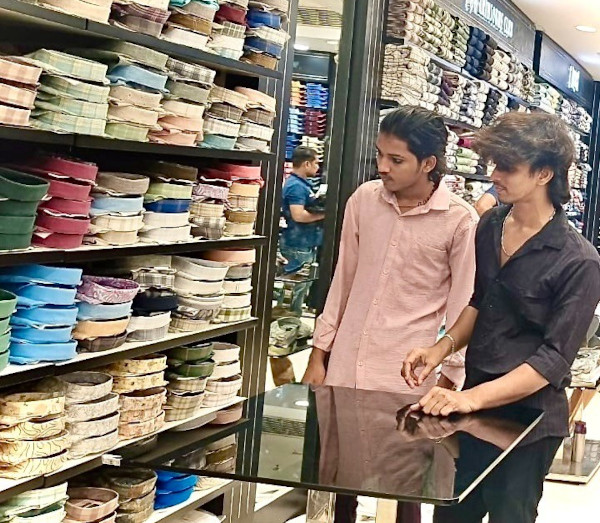
[Inside a Chennai retail store: range, rhythm, repetition.]
People Before Process
It was this clarity of purpose that seemed to shape the way the owners carried themselves. There was no sense of self-importance—only a quiet confidence that came from knowing who they were and what they stood for. That quality revealed itself most clearly in a moment that stayed with me.
As our meeting with GRT concluded, Mr. Radhakrishnan—who is roughly my age—refused my outstretched hand and instead bent to touch my feet. I was taken aback, almost embarrassed, but deeply moved. The gesture was instinctive and unselfconscious. It spoke not of hierarchy, but of humility.
That moment captured, in a single act, the ethos I was beginning to observe across the organisation: authority that does not announce itself, and dignity expressed quietly.
GRT has a practice that I found particularly telling. Floor staff are encouraged to remove their footwear before stepping onto the shop floor. It is a small gesture, but one layered with meaning. It treats the workplace as a space deserving of respect. At a practical level, it also ensures cleanliness. More importantly, it signals a culture in which care and attention are integral, not optional.
Across the organisations we visited, this emphasis on dignity was consistent. Authority was clear, but it did not rely on distance. In an industry where relationships between management and frontline staff are often transactional, what stood out here was a more considered approach—grounded in mutual respect rather than hierarchy.
Most of these businesses provide dormitory-style accommodation for a significant portion of their workforce, with meals typically included. This serves a practical purpose in cities where housing is expensive, but it also creates stability. For employees, it reduces uncertainty; for employers, it supports continuity. It is a pragmatic arrangement, but also a humane one.
There was also a clearly visible pathway for growth. The manager who took us around the GRT store had begun his career as a housekeeper. Over time, he moved through sales and supervisory roles before becoming a store manager. Now in his mid-thirties, he oversees a cluster of five stores. This progression did not feel exceptional or symbolic; it felt structural. The organisation had made room for it.
Building and sustaining such a culture is not easy. Retail is physically and emotionally demanding, with long hours and constant customer interaction. As alternatives expand, the sector struggles to attract and retain young talent.
Yet these businesses appear to have found a balance between expectation and empathy. What stood out was a deliberate investment in people—not as a slogan, but as a long-term strategy. The result is a workforce that feels anchored rather than transient, engaged rather than transactional.
That sense of continuity—of people growing with the organisation rather than merely passing through it—may be one of the most important reasons these enterprises have endured.
Growing Without Losing One’s Centre
As these businesses grow, new challenges inevitably emerge. Chief among them is how to integrate professional management without diluting the founding ethos—a transition that many family-run enterprises struggle to navigate.
At GRT, the two brothers who lead the organisation have divided responsibilities between them, creating clarity and accountability. Professional CEOs oversee day-to-day operations, while strategic decisions remain with the family. The arrangement appears to work well, balancing continuity with competence.
There is also a distinctive feature to this structure. Oversight responsibilities between the two brothers are periodically reversed. This rotation is unusual, but quietly effective. It equalises authority, distributes responsibility, and reduces the possibility of rivalry. In doing so, it reinforces collaboration over competition.
Pothy’s follows a different path. The founding family remains closely involved, while the next generation has begun to assume more prominent roles. Here too, the transition has been measured rather than abrupt. One visible outcome has been a renewed focus on systems and technology. Varun Pothy, the son of the Managing Director, acknowledged that inventory control had long been a challenge. With his entry into the business, that has begun to change. A home-grown enterprise resource planning system is now in place, bringing greater visibility and discipline, even if complete control remains a work in progress given the scale and complexity of the operation.
What stayed with me most, however, was not a particular organisational structure or management practice, but a way of being. A sense that dignity was not something performed, but lived. Respect—for people, for work, for continuity—was not articulated as a value so much as embodied in everyday conduct. It revealed itself in small gestures, in how responsibility was carried rather than announced.
That sensibility runs deep in these enterprises. It shapes how they think about growth, how they treat employees, and how they imagine their place in the world. There is ambition here, certainly—but it is ambition tempered by restraint, by an understanding that endurance matters more than speed. In a business environment often obsessed with scale and spectacle, this quieter confidence feels almost radical.
The future will, of course, pose fresh tests. Customer habits may change, particularly as younger generations grow up in different cities, with different expectations and loyalties. Long-standing relationships—especially in categories such as jewellery—cannot be taken for granted. At the same time, the next generation within these families will have to find ways to remain rooted to origins they may not have personally experienced.
How these businesses navigate both transitions—external and internal—will determine how they endure.
An Enduring Image
On the final day of our visit, after a morning meeting at Pothy’s, the students split into two predictable groups for lunch: vegetarians and non-vegetarians. I joined the latter, following Google Maps toward our chosen destination. Along the way, we passed Nalli’s Silks’ flagship store in T Nagar and decided, almost on impulse, to step in.
Housed in a converted residence, the store retains a gracious old-world charm. As we walked through its cavernous spaces, we noticed an elderly gentleman seated at a counter, chatting amiably with customers. He was Nalli Kuppuswami Chetti, the son of the founder, now 85 years old. A Padma Bhushan and Padma Shri awardee for his contributions to the textile industry and philanthropy, he is present at the store every day. Eschewing a formal office, he sits at the same counter, meeting customers as he always has.
That image stayed with me. It captured, in a single frame, what makes Chennai’s retailers endure: continuity without nostalgia, authority without display, and success worn lightly. It is an image I will carry with me for a long time.

Founding Fuel is sustained by readers who value depth, context, and independent thinking.
If this essay helped you think more clearly, you may choose to support our work.

Founding Fuel is sustained by readers who value depth, context, and independent thinking.
If this essay helped you think more clearly, you may choose to support our work.
Join the conversation
Upamanyu Bhattacharya
Professor of Retail | S P Jain Institute of Management & Research
After a 30-year corporate career in retail and ecommerce, with companies like Hindustan Unilever, Future Group, eBay and Shoppers Stop, Upamanyu Bhattacharya now works as a strategic consultant, helping small retail businesses to grow and find their niche in their markets.
He is also a Professor of Retail at S P Jain Institute of Management & Research where he teaches Retail and Ecommerce courses at the Family Managed Business program.
Upamanyu is also a voracious reader across subjects, and loves travelling, especially if it involves eating good food.
He can be reached at upamanyu@gmail.com
Beyond the noise is the signal.
FF Insights: Sharpen your edge, Monday–Friday.
FF Life: Culture, ideas and perspectives you won't find elsewhere — Saturday.
Loading comments...
More by Upamanyu Bhattacharya
Readers also liked

·Business & Strategy
My five summer business books
A history of GDP; pursuing social value; inside Samsung; how longer life is redefining life, learning and work; the four-day work week
DS

D Shivakumar
Operating Partner | Advent International
My five summer business books
A history of GDP; pursuing social value; inside Samsung; how longer life is redefining life, learning and work; the four-day work week
Operating Partner | Advent International

·Business & Strategy
Making space for loonshots
How to make both loonshots and franchises successful inside an organisation
FF

Founding Fuel
Making space for loonshots
How to make both loonshots and franchises successful inside an organisation

·Business & Strategy
The ‘inside-out’ mindset for digital transformation
In “digital transformation”, transformation comes before technology. And the process begins with looking inside at your strengths and aligning them to the transformation process
FF
Founding Fuel
The ‘inside-out’ mindset for digital transformation
In “digital transformation”, transformation comes before technology. And the process begins with looking inside at your strengths and aligning them to the transformation process
Explore more
Dive into other themes from our network.