The 10-Minute State
Why the next leap in digital governance is about certainty, not speed
23 October 2026· 5 min read
TL;DR
The article posits that the next evolution in digital governance must prioritize certainty and predictability over mere speed. While private sector services offer instant updates and transparency, government interactions often remain opaque, leaving citizens uncertain about application status, timelines, or accountability. Despite India's advanced digital infrastructure like UMANG and DigiLocker, simply digitizing antiquated paper processes isn't enough. True reform demands redesigning services to provide clear requirements, predictable progress updates, and defined consequences for delays. Legislation like Right to Public Services aims to foster this accountability, but consistent implementation is crucial. The ultimate goal is to move beyond digital access to a reliably transparent and predictably managed public service experience.
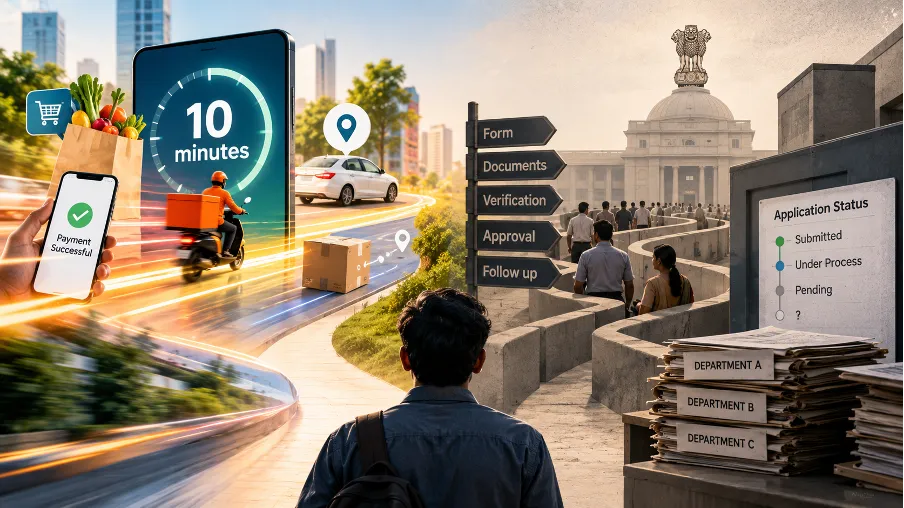
A grocery order can arrive at our door in ten minutes. A cab can be tracked to the metre. A payment moves instantly, and a parcel comes with a delivery window, a map and a mechanism to complain if it does not show up. The private sector has spent the last decade teaching us to expect convenience, transparency and speed as ordinary features of daily life.
Yet a routine interaction with the government can still feel like a journey into a different age. A certificate, a licence renewal, a correction in a public record or a simple application may involve unclear requirements, repeated follow-ups and uncertainty about who is responsible for moving it along.
The problem is not always that the government takes too long to make a decision. Often, it is that the citizen cannot tell what is happening, why it is taking so long, or what to do next.
This is where the comparison with modern commerce becomes interesting. The lesson is not that the government should deliver everything in ten minutes. It is that even when a service takes time, the process should be predictable. Citizens should know what is required, how long it should take, where their application stands and what happens when the system fails to deliver.
India has built much of the digital infrastructure needed to make public services easier to access. Many services are available online. Documents can be stored digitally, and applications can be submitted without standing in a queue. Platforms such as UMANG and DigiLocker have made government services and records more accessible, while ServicePlus provides a framework for managing applications and service delivery.
These are important achievements. But digitising a process is not the same as redesigning it. A paper form uploaded to a portal is still a paper form in spirit. A queue that has moved to a screen remains a queue.
The more difficult question is what happens after an application is submitted.
A citizen may receive an acknowledgement number and a confirmation message. But the application could still pass through several offices, each responsible for a different part of the process. One official verifies the documents, another checks the records, and a third grants approval. If something is missing, the application may simply remain pending until someone notices or the citizen follows up.
Each department may be following its own procedures. Yet nobody may be responsible for ensuring that the citizen's task is completed within a reasonable time.
This is a fundamental difference between providing digital access and delivering a reliable public service.
India has already recognised part of this problem. Several states have enacted Right to Public Services legislation that establishes timelines for notified government services. Maharashtra's 2015 law, for instance, provides for designated officers, appeals and penalties for failures to deliver services within stipulated timelines.
The principle is important: a citizen should not have to depend entirely on the discretion or goodwill of an individual official to obtain a routine service.
But legislation and digital platforms do not, by themselves, guarantee a better experience. Much depends on how services are organised, whether timelines are realistic, whether officials have the authority to resolve problems and whether delays have consequences. The question is how consistently these statutory promises translate into the citizen's actual experience.
China offers a useful, if imperfect, comparison. Shanghai's Suishenban app and its wider Government Online-Offline Shanghai platform bring a large range of public services into a common interface. The city reports substantial adoption of its integrated public-service system and is pursuing further reforms to simplify procedures, connect departments and expand one-stop services.
Its plans also include a '15-minute government service circle', combining digital access with nearby physical service centres and remote assistance. This recognises that convenience is not merely about having an app. It is also about ensuring that people can obtain help without navigating a complicated administrative system.
The lesson is not that India should copy China's political or administrative model. It is that technology becomes more useful when accompanied by a willingness to reorganise the machinery behind it. The larger ambition is to organise services around the task a person needs to complete, rather than around the department that owns each step.
And that is where the comparison with quick commerce offers another insight.
A quick-commerce platform is not successful merely because it has a warehouse close to the customer. It depends on standardised processes, clear responsibilities, visibility into fulfilment and the ability to intervene when something goes wrong. The customer knows what has been ordered, what is happening and when delivery can be expected.
The system is designed around completion, not merely acceptance of the order.
The government has a different purpose and different obligations. Some decisions require verification, consultation, discretion or due process. Matters involving public safety, competing rights or the law cannot be treated like grocery deliveries.
But a large class of routine government services should be capable of operating with similar discipline.
The difficulty is that government is usually organised around departments and administrative responsibilities, not the citizen's end-to-end experience.
A service may require coordination between multiple offices, each with its own rules, records and reporting structures. An official may have little incentive to take responsibility for delays outside their immediate jurisdiction. In some cases, the consequences of approving something incorrectly may be far greater than those of leaving an application pending.
These are institutional problems, not simply technological ones.
A common portal can make the front end look seamless. But unless the underlying procedures are simplified and responsibilities clarified, the citizen may still be left navigating the same fragmented system.
The practical agenda is not especially glamorous.
Every routine service should have a clearly stated list of requirements, a realistic turnaround time and a single application number that works across the process. Applicants should be told promptly if something is missing, rather than discovering it after weeks of silence. Status updates should mean something more than 'under process'.
More importantly, someone must be accountable for the final outcome. If a deadline is missed, the system should trigger an escalation rather than leave the citizen to chase the application. Rejections should state the reasons and provide a clear route to appeal.
Where the law permits, certain routine approvals could have stronger default timelines or deemed outcomes. Where that is inappropriate, delays should at least be visible, explained and subject to review.
Artificial intelligence could make the experience simpler. A citizen should be able to ask, in an ordinary Indian language, which documents are needed, whether an application is complete or why it has been returned. AI could help identify errors before submission and guide people through services spread across departments.
But a chatbot cannot compensate for a broken process behind it. If departments do not share information, officials lack clear responsibility or approvals remain needlessly sequential, a more conversational interface merely makes the frustration easier to access.
The objective is not to make citizens more efficient at navigating the government. It is to make the government easier to navigate, whichever channel a person uses.
There is also a risk in measuring the wrong things.
Governments can count portals launched, services listed and transactions processed. These numbers are useful, but they tell us relatively little about the quality of the citizen's experience.
A better measure would ask how many applications were completed within the promised time, how often people had to resubmit documents, how many visits were avoided and how quickly errors or disputes were resolved.
It would also examine the effort citizens must expend to obtain a service. A process that takes fifteen days but requires no follow-up may be considerably better than one that promises completion in five days but forces the applicant to make repeated calls and visits.
Nor should the answer be an app-only state. Digital convenience must not become another barrier for people who lack reliable connectivity, digital confidence or easy access to documents. Assisted service points, accessible interfaces and human recourse remain essential.
The objective is not to make citizens more efficient at navigating the government. It is to make the government easier to navigate, whichever channel a person uses.
There is a larger institutional opportunity here.
India has demonstrated that it can build digital infrastructure at population scale. But building the infrastructure for transactions is not the same as building institutions that take responsibility for completing them.
That requires more than investment in technology. It calls for process redesign, clearer ownership, better coordination across departments and a willingness to measure performance from the citizen's side of the counter.
It may also require a change in administrative culture: from treating an application as a file to be processed to treating it as a service commitment that must be fulfilled.
The benefits would extend beyond convenience. Predictable public services reduce the time and money citizens spend dealing with administration. They limit the opportunities for unnecessary intermediation and strengthen trust in public institutions.
The ambition need not be a government that does everything in ten minutes. It should be a government that makes citizens wait only when there is a good reason to.
In an economy where convenience has become ordinary, perhaps the next frontier of governance is a simpler promise: routine services should be predictable, timelines should mean something, and citizens should not have to chase the state to get a straightforward job done.
Join the conversation
Ajay Chacko
Director | Keya Foods International
Ajay Chacko is a business leader, board member, and author with over three decades of experience across media and consumer businesses. He is a Director at Keya Foods International, co-founder of the digital media platform Arré, and a former COO of the Network18 group. He also serves as an independent director on the boards of listed companies. His reading and writing interests span economics, culture, philosophy, and literary fiction.
Beyond the noise is the signal.
FF Insights: Sharpen your edge, Monday–Friday.
FF Life: Culture, ideas and perspectives you won't find elsewhere — Saturday.

Founding Fuel is sustained by readers who value depth, context, and independent thinking.
If this essay helped you think more clearly, you may choose to support our work.

Founding Fuel is sustained by readers who value depth, context, and independent thinking.
If this essay helped you think more clearly, you may choose to support our work.
Loading comments...


Readers also liked

·FF Life
My 10 Best Business Books of Summer 2026
The best books of the year so far—on disagreeing constructively, culture, strategic subtraction, genius, China's advantage, an India you think you know, creativity, establishment paralysis, imposter syndrome, and reimagining your career
DS

D Shivakumar
Operating Partner | Advent International
My 10 Best Business Books of Summer 2026
The best books of the year so far—on disagreeing constructively, culture, strategic subtraction, genius, China's advantage, an India you think you know, creativity, establishment paralysis, imposter syndrome, and reimagining your career
Operating Partner | Advent International

·FF Life
The 10 Best Durga Puja Pandals from Kolkata, 2025
An exploration on the art of Kolkata during Durga Puja
RR

Ronaan Roy
Former Deputy General Manager | Mahindra
The 10 Best Durga Puja Pandals from Kolkata, 2025
An exploration on the art of Kolkata during Durga Puja
Former Deputy General Manager | Mahindra

·Leadership & Organisation
My 10 best business books of summer 2025
On what makes a leader, how to stop wasting energy on the wrong things, speaking well, the history of attention, understanding India’s economic planning, and more
DS
D Shivakumar
Operating Partner | Advent International
My 10 best business books of summer 2025
On what makes a leader, how to stop wasting energy on the wrong things, speaking well, the history of attention, understanding India’s economic planning, and more
Operating Partner | Advent International
Explore more
Dive into other themes from our network.