The Water Opportunity Is Real. Building a Good Business Is Harder
Eight listed Indian companies show why a growing market doesn't guarantee durable value—and how some are finding ways around the difficult economics of water infrastructure.
30 September 2026· 6 min read
TL;DR
India's burgeoning water infrastructure market presents a significant opportunity, yet building durably profitable businesses within it proves challenging. Traditional Engineering, Procurement, and Construction (EPC) models often suffer from competitive low-bid contracts, extensive project delays due to land acquisition, and long working capital cycles, especially in civil works.
However, the article highlights companies that thrive by circumventing these pitfalls. Success lies in specialization (e.g., Jash Engineering's specified components), technology leadership and global reach (VA Tech Wabag), or integrating proprietary solutions for industrial clients (Apex Ecotech). Ultimately, capturing value means moving beyond basic infrastructure and focusing on higher-margin, specialized contributions rather than solely competing on lowest price.
India’s water business is attracting attention. At least five water-treatment companies have listed in the past five years, as investment in water and wastewater infrastructure has increased.
But a large opportunity does not automatically produce good businesses.
That gap is what this essay is about.
The first part of this series looked at how the economics of wastewater are changing as scarcity makes assured, long-term access to water more valuable. That raises another question: which parts of the water business actually capture that value?
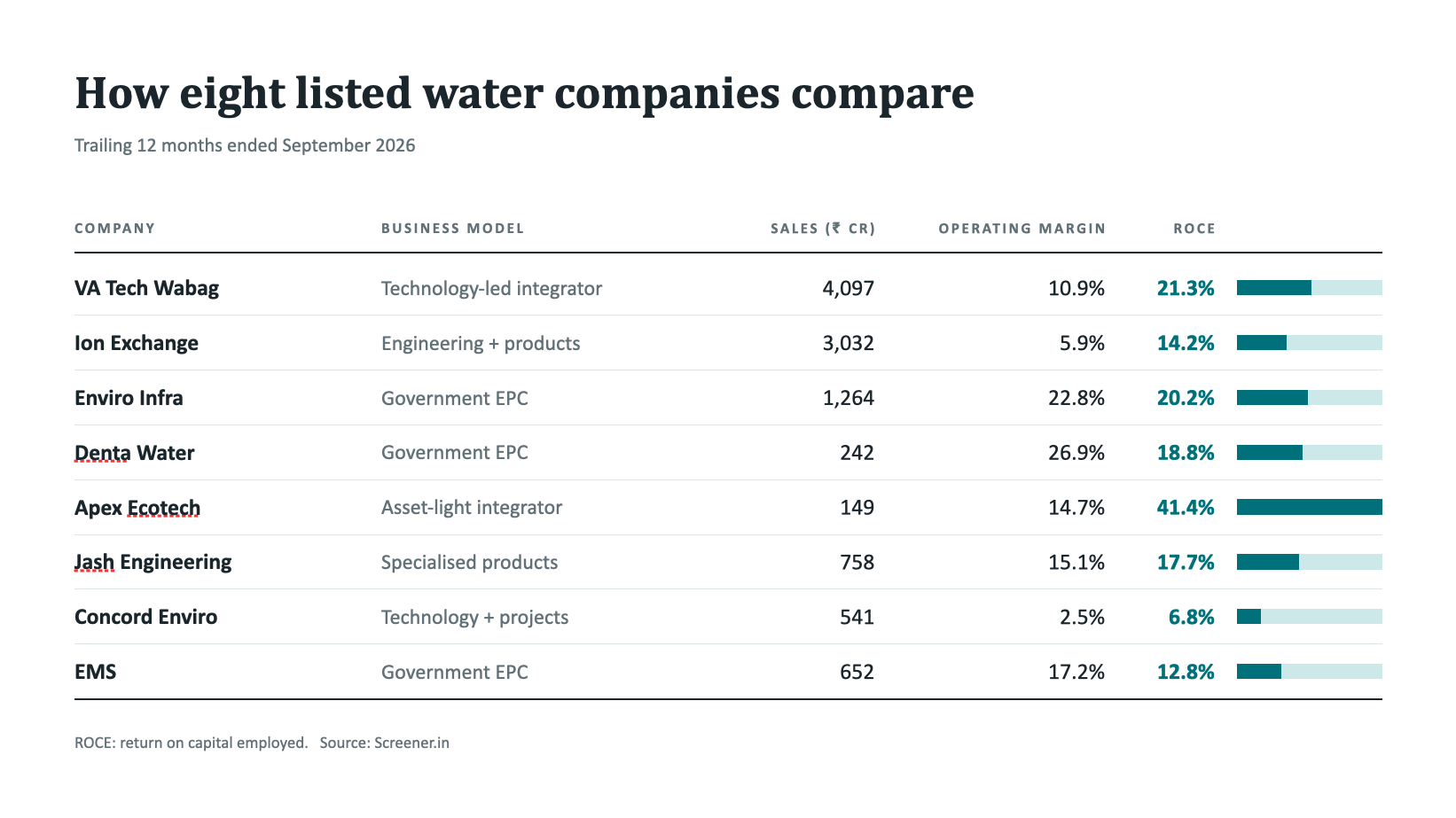
Eight listed Indian water companies offer some clues.
They operate very different businesses. Jash Engineering makes gates, screens and valves that sit inside other companies’ treatment plants. VA Tech Wabag is a technology-led systems integrator running treatment and desalination projects across India, the Middle East, Africa and Asia. Ion Exchange combines engineering, procurement, and construction (EPC) with a large resins, chemicals and membranes business. Concord Enviro owns proprietary zero-liquid-discharge technology. Enviro Infra Engineers, Denta Water and EMS Ltd are largely government contractors building sewage and water-treatment infrastructure. Apex Ecotech is a small integrator that buys technology from global partners and works mainly with industrial customers.
Taken together, they reveal something about where value is—and isn’t—being created in the water business.
Why water is a difficult business
A water project physically moves through three stages: getting raw water to a treatment plant, treating it, and moving the treated water back out to users.
The first and third stages—pipes, civil infrastructure, transmission and distribution—are where projects often run into trouble. Not because the engineering is particularly difficult, but because they depend on land acquisition, right-of-way and approvals that no company controls.
Delays are routine. And the escalation clauses written into contracts rarely cover their full cost. The developer usually absorbs the difference.
The treatment plant itself is different. It is one part of the project where a company can compete on something other than being the lowest bidder.
Every water project still has to be constructed, which makes engineering, procurement and construction, or EPC, integral to the industry. But EPC comes in many forms. Some companies are largely contractors, laying pipelines and doing civil work. Others use EPC to get access to a customer and then sell specialised equipment, technology, consumables or operations and maintenance services.
Two problems, however, run across much of the industry. Projects are often awarded to the lowest bidder. And long working-capital cycles mean that reported profits can take a year or more to turn into cash.
How companies deal with these two constraints helps explain why their economics can look so different.
Three ways to escape the EPC trap
Three companies—Jash Engineering, VA Tech Wabag and Apex Ecotech—illustrate quite different ways of reducing their exposure to conventional EPC economics.
Jash does it by owning a specialised piece of the project rather than the whole project.
It makes more than 60 products—gates, screens and valves—across six factories in India, the US and the UK. Roughly 60% of its revenue now comes from outside India, built partly through acquisitions that bought brand, approvals and market access rather than simply revenue.
More importantly, Jash products are often specified in a tender before an EPC contractor even bids. That means the company is less exposed to lowest-price competition.
The difference shows up in the numbers. Jash has an operating margin of 15.1% and return on capital employed (ROCE) of 17.7%. Margins show profitability, while ROCE measures the return generated on the capital invested in the business—and therefore how efficiently that capital is being used. Jash’s stock has returned 37.9% over five years and 24.3% over three years, although performance has been more volatile recently.
The journey has not been without setbacks. When steep US tariffs hit orders that had already been priced this year, Jash chose to absorb the additional cost rather than strain customer relationships. At the same time, it began building up its UK and Saudi businesses.
Wabag has taken a different route.
It still undertakes large treatment and desalination projects across India, the Middle East, Africa and Asia. But with more than 125 patents, it describes itself as a “technology system integrator, not an EPC organisation”.
Its operating margin, at 10.9%, is not remarkable. But its ROCE is 21.3%, and both profitability and cash conversion have improved as its international business has grown and payment terms have become clearer. The market has noticed: Wabag has delivered the strongest multi-year stock performance among the eight companies, with returns of 42.7% over five years and 63.6% over three years.
That discipline was learnt the hard way. A ₹300 crore write-off in the past made payment security a strict filter for bidding. Wabag has also said it will not take on sanctioned work in conflict zones around its Middle East projects.
If Jash has tried to escape EPC through products, and Wabag through technology, scale and project discipline, Apex Ecotech has taken almost the opposite route.
It has chosen not to chase scale.
Apex is a much smaller, asset-light business. It avoids government tenders, sources technology from global partners such as Veolia and Grundfos, and works with a small set of blue-chip industrial customers on contaminated-water reuse. Rather than manufacture equipment itself, it sells integration, judgement and customer relationships.
Its operating margin, at 14.7%, is not exceptional. But its ROCE, at 41.4%, is by far the highest among the eight companies. Since its listing, the stock has returned 76.1%. Management has also pulled back from expansion in the Gulf, choosing discipline over scale.
There is an important caveat. Apex has sales of just under ₹150 crore. What works at that size may look very different as the business grows.
Jash owns a specialised product. Wabag combines technology with scale and tighter control over the projects it takes on. Apex stays asset-light and deliberately avoids parts of the market where the economics are least attractive.
Three very different models, but all address the same problem: how to participate in a growing water market without allowing the economics of construction to define the economics of the company.
Having the right pieces isn’t enough
If products, technology and recurring revenues offer a way out of EPC economics, Ion Exchange should be well placed.
It is the oldest and most diversified company in this group. Alongside engineering and EPC, it has substantial businesses in resins, chemicals and membranes. These product businesses are far more profitable than engineering, with chemicals earning margins several times higher than the engineering business. Ion Exchange also has a leading position in the domestic resin market and is adding capacity for exports.
Yet those businesses have not changed the economics of the company as a whole.
Ion Exchange has an operating margin of 5.9%, well below what its stronger product franchises might suggest. The low margin needs some context: Its engineering business has historically diluted the stronger margins of its chemicals franchise, although engineering itself generated margins of about 10% in FY21 and FY22. More recently, legacy projects and execution delays have weighed on engineering profitability, pulling down the company’s overall margin. Its stock has returned 12.1% over five years, while its three-year return is negative.
The problem appears to be the mix. The higher-margin product businesses sit alongside a large, lower-margin engineering business. Having attractive businesses inside the company is not enough if they are not yet large enough to change the economics of the whole.
Concord Enviro complicates the picture further.
It has proprietary zero-liquid-discharge technology and has built several businesses around it—from systems and plants to consumables, spares and operations and maintenance. More recently, it has added membranes, compressed biogas and water-as-a-service. It has also expanded overseas, taking international revenues from roughly 24% of sales in FY23 to around 39% in FY25.
But as Concord expanded internationally, its revenue mix also became more project-heavy. Larger projects brought greater lumpiness, and delays and international volatility hit margins sharply. With less scale than Wabag, Concord has had less room to absorb those shocks.
Its operating margin has fallen to 2.5% from over 15% in two years, and ROCE declined from over 16% to 6.8%. The low figures are partly because the international expansion has tied up capital that is yet to generate commensurate returns. Its stock has fallen 49.7% since listing.
Concord is now trying to build operations and maintenance (O&M), spares, consumables and newer technology businesses around the project business, making revenues more recurring and less dependent on the timing of large projects.
There is another experiment underway as well.
Concord offers water-as-a-service, where the customer buys water under a long-term arrangement rather than owning the treatment plant. That connects directly to the shift explored in the first essay: from selling treatment technology to assuring the long-term availability of water.
But it is too early to know whether water-as-a-service will remain a small part of Concord’s business or eventually change its economics.
Ion Exchange and Concord offer a useful caution. Moving beyond EPC does not automatically create a better business. Products, proprietary technology, consumables and recurring services matter only when they become large and profitable enough to change the economics of the company as a whole.
When construction remains the business
Enviro Infra Engineers, Denta Water and EMS Ltd sit closer to the conventional end of the water business.
All three are largely government contractors, building pipelines, sewage and water-treatment plants and, in some cases, irrigation infrastructure. Unlike Jash or Apex, they have not yet built a substantial product, technology or recurring-services business around that core.
On the surface, the economics can look attractive. Enviro Infra has an operating margin of 22.8% and ROCE of 20.2%. Denta’s operating margin is even higher, at 26.9%, with ROCE of 18.8%. EMS reports an operating margin of 17.2% and ROCE of 12.8%.
But the P&L tells only part of the story.
Construction-led government EPC ties up cash in receivables and project working capital even as companies report profits. Growth requires more capital, while delays in payments or execution can quickly change the economics of a project.
Their share prices have struggled since listing: Enviro Infra is down 23.6%, Denta 33.1% and EMS 37.4%. They are all relatively recent listings, so those returns say little about their long-term prospects. But they are a reminder that healthy margins and a large order book do not necessarily translate into strong cash conversion—or reduce dependence on winning the next tender.
What if the answer is not to be a water company?
Kirloskar Brothers offers another possibility.
It does not sit among the eight companies examined here for a simple reason: it is not fundamentally a water company. It is a diversified pump manufacturer. Water and irrigation are important markets, but so are power, oil and gas, industry, buildings, marine and defence.
Rather than respond to the difficult economics of water by doing more EPC or building adjacent businesses within water, Kirloskar has taken its core technology across several industries. Products and services built around its installed base allow it to participate in the growth of water without making the company dependent on water infrastructure alone.
Kirloskar Brothers delivers ROCE of over 20%, while its stock has compounded at around 28% annually over the past three years. There has, however, been some volatility more recently.
Sometimes the way to capture value from a difficult infrastructure market is not to chase more of it, but to build a business that is exposed to several markets instead.
The opportunity in water is real. The harder question is who can turn that opportunity into a good business.
Join the conversation
Bharti Krishnan
Founder | Finetrain
Bharti Krishnan, CFA, is the founder of Finetrain, where she works with climate startups on raising equity, debt, and grants. Her work sits at the intersection of finance and climate tech across energy, water, and materials. She spends most of her time meeting founders and helping them think through capital decisions.
Beyond the noise is the signal.
FF Insights: Sharpen your edge, Monday–Friday.
FF Life: Culture, ideas and perspectives you won't find elsewhere — Saturday.

Founding Fuel is sustained by readers who value depth, context, and independent thinking.
If this essay helped you think more clearly, you may choose to support our work.

Founding Fuel is sustained by readers who value depth, context, and independent thinking.
If this essay helped you think more clearly, you may choose to support our work.
Loading comments...
More by Bharti Krishnan


Readers also liked
·Entrepreneurship, Startups & Innovation
The Business of Wastewater Is Changing
The biggest competitive advantage in India's wastewater industry may no longer be better treatment technology. It may be the ability to finance, own and operate long-term water infrastructure.
BK

Bharti Krishnan
Founder | Finetrain
The Business of Wastewater Is Changing
The biggest competitive advantage in India's wastewater industry may no longer be better treatment technology. It may be the ability to finance, own and operate long-term water infrastructure.
Founder | Finetrain

·FF Life
The Happiness We Keep Postponing
A reflection on joy, and why the ordinary day may be enough
HC

Haresh Chawla
Investor | Entrepreneur
The Happiness We Keep Postponing
A reflection on joy, and why the ordinary day may be enough
Investor | Entrepreneur

·Leadership & Organisation
The Blind Spots of India Inc
Disability inclusion, leadership imagination, and the limits of intent
SS

NJ
Subhashis Sinha & Nikunj Kumar Jain
The Blind Spots of India Inc
Disability inclusion, leadership imagination, and the limits of intent
Subhashis Sinha & Nikunj Kumar Jain
Explore more
Dive into other themes from our network.