What My Body Was Trying to Tell Me
A conversation with a sports medicine doctor—and an unexpected health scare—changed the way I think about exercise, ageing and what it means to stay strong
17 July 2026· 7 min read· 2 comments
TL;DR
This article reframes our understanding of exercise, asserting that the human body is intrinsically designed for continuous movement, a fundamental truth often overshadowed by modern, sedentary living. Dr. Ruchira Tendolkar highlights that what we call "exercise" is often a necessary compensation for the "movement deficit" civilization has inadvertently created. A key insight reveals that aging isn't a sudden decline, but a progressive slowing of the body's remarkable regenerative and recovery processes, becoming particularly noticeable from the mid-forties onward. Embracing this perspective means fitness should focus on restoring natural motion, supporting the body's innate expectation to stay robust and resilient.
It was such a simple sentence that I heard it and almost moved on. “The body is made to move.” Of course the body is made to move. What else would it be made to do? But the more I thought about it, the more I realised how radically different that idea is from the way most of us think about exercise.
We treat exercise as an intervention. Something to be prescribed when the blood sugar rises, when the weighing scale refuses to cooperate or when the annual health check throws up an unpleasant surprise. We think of it as medicine. Something we consume in measured doses because the doctor says we should.
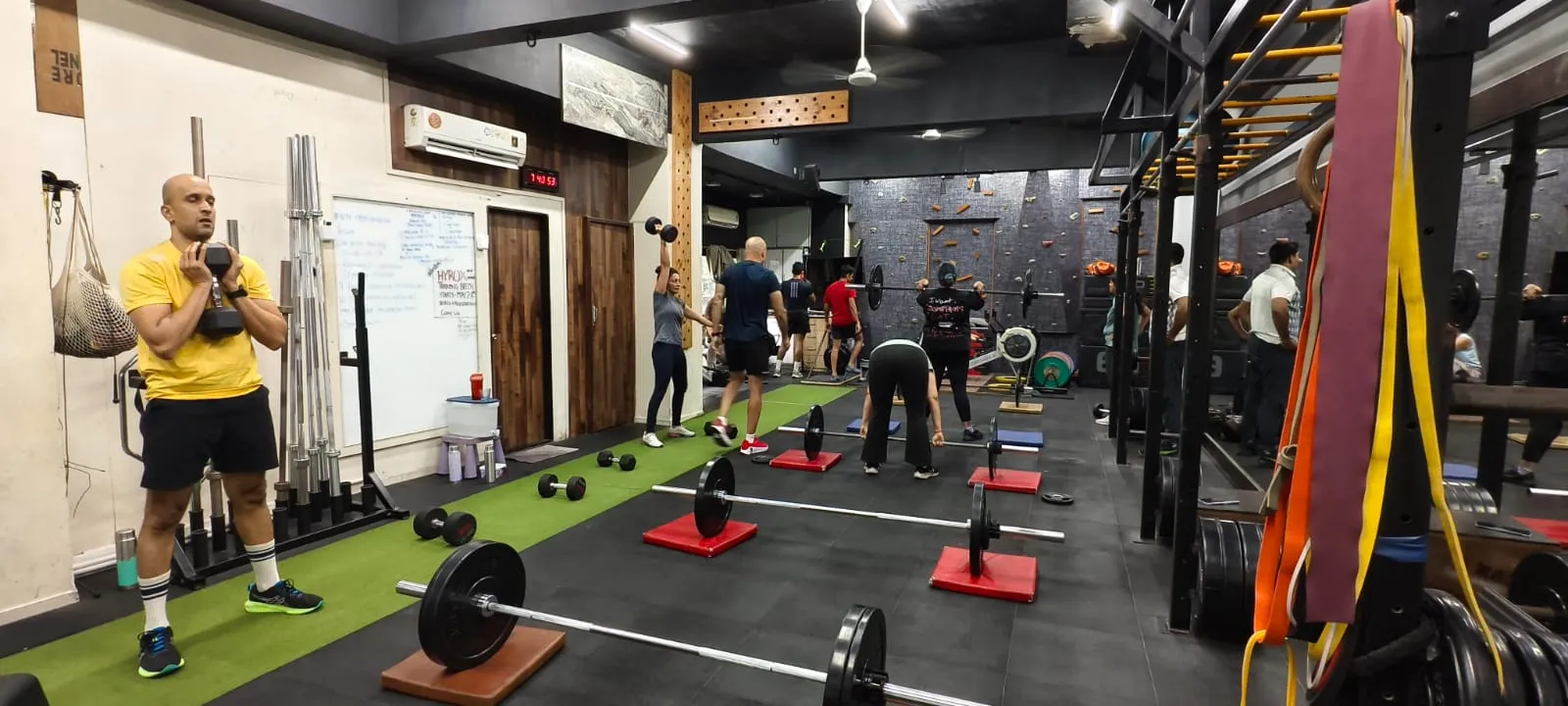
Dr Ruchira Tendolkar was asking me to look at it from the other end. The sports medicine doctor and co-founder of Akhada, the gym I am a regular at, and I were in conversation. We agreed that the human body is an astonishing collection of joints, muscles, tendons and ligaments, assembled into an intricate system of levers. It evolved to squat, climb, lift, carry, reach, crawl and run. Movement wasn’t recreation for our ancestors. It was survival. Every meal demanded it. Every journey required it. Every day depended on it.
Then civilisation got very good at removing movement from our lives. We sit through work. We summon lifts instead of climbing stairs. Groceries arrive at our doorstep. Food appears after a few taps on a screen. We drive distances our grandparents would have walked without thinking twice.
“Our physiology,” Ruchira said, “hasn’t caught up with our lifestyle.” That one sentence explains why so many conversations around fitness begin in the wrong place.
The question isn’t whether we should exercise. The question is how much movement modern life has quietly stolen from us. Exercise, in that sense, isn’t a lifestyle choice. It is an attempt to compensate for a deficit that didn’t exist for most of human history. It also explains why the body responds so gratefully when we begin moving again.
The Ageing Body
I hadn’t become a different person over those two years that I practised at the gym. I wasn’t dramatically stronger. I didn’t look noticeably different in the mirror. What changed was far more fundamental. I had begun giving my body back something it had always expected but had stopped receiving.
The obvious question, then, is this: if movement is so natural, why does it begin to feel so much harder after fifty? The answer, Ruchira said, isn’t what most of us think. It isn’t that the body suddenly starts falling apart. It isn’t even that we become dramatically weaker. “The body is renewing itself all the time,” she said. “Every cell, every tissue, every system is constantly repairing and replacing itself.”
That process begins slowing much earlier than most people realise. By our late twenties, regeneration has already started tapering. We barely notice because the body continues to recover with astonishing efficiency. We exercise, wake up a little sore, and by the following day we’re ready to do it all over again.
The slowing is gradual enough to escape notice until somewhere between our mid-forties and mid-fifties. Then the mathematics changes.
You don’t suddenly become old. You simply stop recovering the way you once did.
In women, menopause often accelerates the transition. The hormonal changes are abrupt and affect far more than the reproductive system. Muscles, tendons, ligaments, the nervous system, sleep, even the body’s ability to recover from effort are caught up in the same shift. In men, the decline is less dramatic but no less real. Hormones ebb more slowly. Recovery becomes less forgiving.
“You don’t suddenly become old,” she said. “You simply stop recovering the way you once did.” It is a deceptively simple distinction. Most conversations about fitness after fifty revolve around performance. Build more muscle. Improve endurance. Increase bone density. Lift heavier. Walk faster.
Ruchira kept returning to a different word. Recovery. The more we spoke, the more I realised that recovery isn’t what happens after exercise. Recovery is part of the exercise. That changes almost everything.
When we’re twenty-five, poor sleep is an inconvenience. At fifty-three, it may determine the quality of the next day’s workout. A stressful week at work isn’t merely a mental burden. It shows up in the body. Long flights, irregular meals, illness, emotional strain—they all walk into the gym with us, whether we acknowledge them or not.
“The one hour you spend exercising,” Ruchira said, “is shaped by the other twenty-three.” That sentence explained something I had experienced without ever understanding. There were mornings when I felt inexplicably sluggish. I assumed I lacked motivation. Or discipline. Perhaps neither was true. Perhaps my body was simply keeping a more honest account than my mind. If recovery is the new constraint, then the rules of exercise have to change.
This is where many of us go wrong. We assume that the workout that got us fit at thirty will somehow work again at fifty. We join a gym with the enthusiasm of a convert, determined to erase years of neglect in a matter of months. Every session becomes an act of redemption. The body doesn’t negotiate that way.
Ruchira illustrated the point with an analogy from competitive powerlifting, a sport she took up only two years ago. A younger athlete, she explained, is often willing to accept greater risk for a marginal gain. An extra five per cent on a lift may justify pushing closer to the edge. Recovery is quick. Injury, if it happens, is usually temporary.
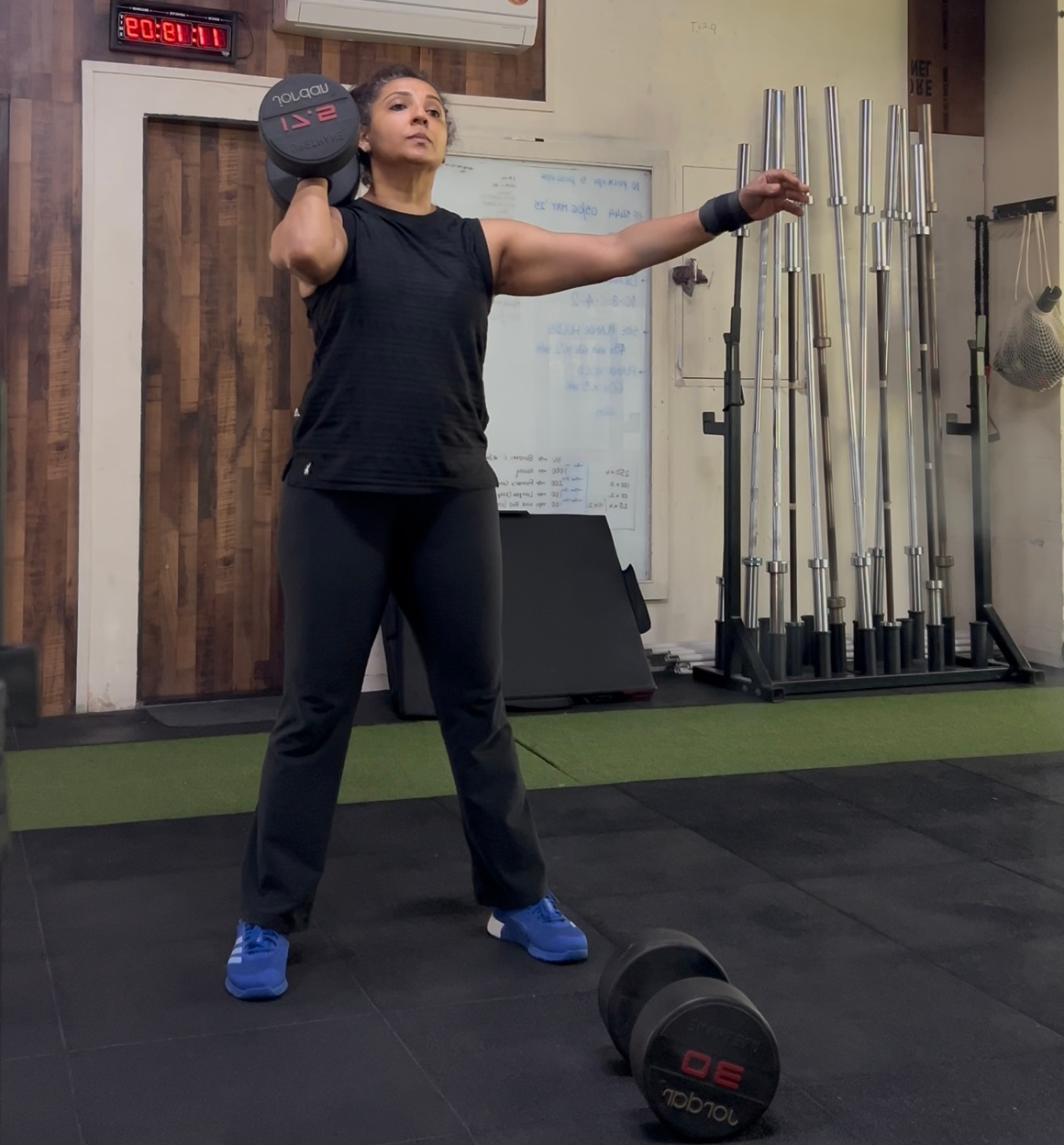
The calculation changes with age. “If you’re fifty,” she said, “that extra five per cent isn’t worth the additional risk.” The sentence stayed with me because it runs against almost everything we admire.
We’re taught that progress comes from pushing harder. From refusing to settle. From squeezing out one more repetition, one more kilometre, one more hour.
Yet the older body rewards a different virtue. Judgment. Knowing when to push. Knowing when to hold back. Knowing that stopping one repetition earlier today may allow you to return tomorrow. Continuity begins to matter more than intensity.
That’s not an argument for lowering expectations. It is an argument for redefining success.
What is the right question to ask?
The twenty-five-year-old asks, How much stronger can I become? The fifty-year-old asks, Can I still be doing this ten years from now?
They’re not the same question. Nor do they produce the same decisions.
The goal is no longer to survive today’s workout. It is to make sure today’s workout doesn’t prevent tomorrow’s. That, more than anything else, changed the way I began looking at the hour I spent in the gym.
I stopped thinking about individual sessions. I started thinking about accumulation. Three sessions this week. Forty this year. Four hundred over the next decade.
Fitness, I realised, wasn’t built in spectacular mornings when everything clicked. It was built on ordinary Tuesdays when I showed up despite the negotiator in my head insisting that missing one day wouldn’t matter.
Because, of course, it never does. Until it does. Spend enough mornings in the same gym and you stop noticing the equipment. You begin noticing people. Not because they’re extraordinary athletes. Most aren’t. But because each one reveals a different relationship with the body.
The different bodies
Shailesh Shetty, the head coach, is the easiest to watch and the hardest to imitate. He has the kind of movement that makes you realise how much energy the rest of us waste. Every squat is measured. Every lift begins and ends exactly where it should. There is no flourish, no unnecessary effort, no attempt to impress. Watching him, you understand that strength is not the absence of effort. It is the absence of waste.
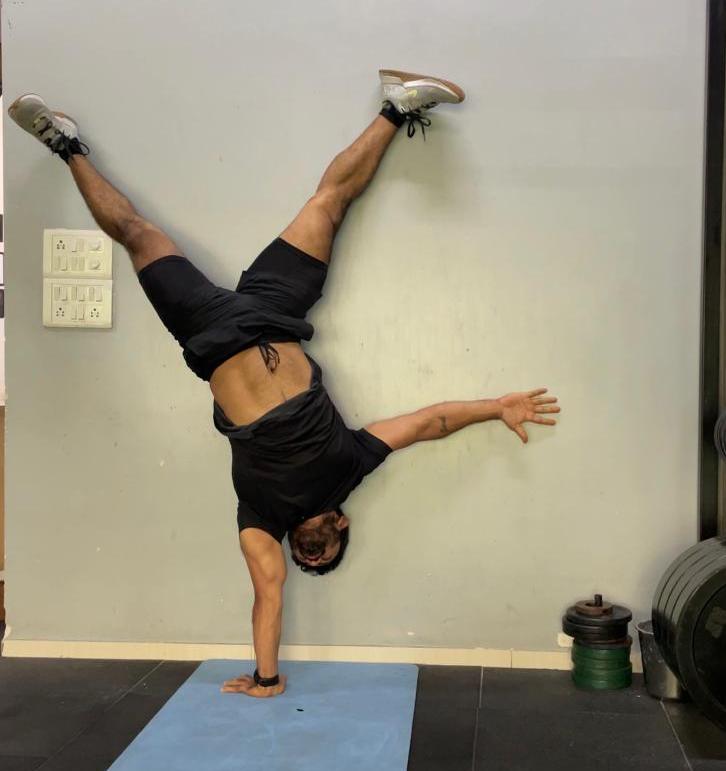
Then there is Shashank. There are people who make difficult things look difficult. Shashank has the irritating habit of making them look routine. The bar leaves the ground almost reluctantly, as though it has quietly accepted that resistance is futile. While the rest of us celebrate completing a movement correctly, he has already moved on to the next one. Effortlessness, you realise, is often the visible reward for years of invisible work.
Akash is another reminder that appearances deceive. He is almost always the last to arrive, looking as though he has rolled out of bed with barely enough time to make it to class. There is no elaborate warm-up ritual, no performance before the performance. And yet, a few minutes later, while some of us are still coaxing our shoulders and hips into cooperation, he is moving through the workout with the casual ease of someone who has forgotten that the rest of us are finding it hard.
Ashok, Shailesh’s assistant, inhabits the gym differently. Some people work in a place. Ashok belongs to it. He is there before the first class gathers and often after the last one leaves. He signs up for competitions with the enthusiasm of someone who simply enjoys testing himself. He celebrates other people’s victories almost as enthusiastically as his own. The body everyone notices is merely evidence of something less visible: consistency.
For a long time I thought I was watching four very different people. Ruchira helped me see something else. Each of them had learnt to negotiate with the body differently. Shailesh had refined movement until it became almost economical. Shashank had learnt that repetition eventually masquerades as talent. Akash reminded me that youth often forgives mistakes that age no longer can. Ashok embodied what happens when discipline stops feeling like discipline and becomes identity.
The gym floor, I realised, wasn’t full of people doing the same workout. It was full of people solving different problems. That is why no two bodies are trained in exactly the same way.
The exercise may look identical. The learning never is.
Then, earlier this year, my body called my bluff.
What I learnt
It happened without warning. One day I was doing what I had always done. The next day I was in surgery to deal with an emergency. The gym disappeared from my routine. There was the strange experience of discovering that the body you have inhabited all your life can suddenly become unfamiliar territory.
Nothing prepares you for that conversation with yourself. The instinct is to ask one question. How quickly can I get back? Ruchira persuaded me that it was the wrong question. The better question was: what exactly am I getting back to?
There is a peculiar impatience that accompanies recovery. Every day spent resting feels like a day lost. Every kilogram that disappears from the bar feels like a personal defeat. You begin measuring yourself against the person you were before illness interrupted the story.
The body, however, has no interest in nostalgia. It starts from where it is. Not from where your memory insists it ought to be.
When I eventually returned to the gym, the temptation was to reassure myself that nothing had changed. Lift what I used to lift. Move the way I used to move. Convince myself that the interruption had merely been an inconvenience.
Consistency isn’t built by winning arguments with the body. It is built by listening to it.
Instead, something else happened. The workouts became conversations. Movements I had once performed almost automatically now demanded attention. Breathing mattered. Technique mattered. Recovery mattered. Some mornings the body was willing. On others, it wasn’t. I was learning, perhaps for the first time, that consistency isn’t built by winning arguments with the body. It is built by listening to it. That is harder than it sounds. Because now, I had to stay content with doing less on the floor. And sticking to basic movements.
Most of us have spent our professional lives being rewarded for overriding discomfort. We push through deadlines. We push through fatigue. We push through illness. We admire resilience almost to the point of recklessness.
Exercise after fifty demands a different temperament. It asks for patience instead of urgency. Curiosity instead of ego. Judgment instead of bravado. That is not an easy transition for people who have spent decades believing that success belongs to those who simply push harder.
Ruchira put it more simply. “The movement survives,” she told me, “only if the recovery survives.” I kept returning to that sentence. Not because it applies only to exercise. Because it applies, with uncomfortable precision, to almost everything else that matters.
Relationships survive only if they recover from conflict. Businesses survive only if they recover from setbacks. Careers survive only if they recover from failure.
Our bodies are no different. Recovery isn’t the pause between periods of progress. Recovery is what makes progress possible. Recovery deserves as much respect as effort. That is why I’m on a short break now.
I now know how to pay attention. To recognise the difference between discomfort and damage. To understand that ageing is not the same as decline. To accept that wisdom, in the gym as in life, lies less in pushing harder than in knowing when to stop, when to recover and when to begin again.
Join the conversation
Charles Assisi
Co-founder and Director | Founding Fuel
Charles Assisi is an award-winning journalist with two decades of experience to back him. He is co-founder and director at Founding Fuel, and co-author of the book The Aadhaar Effect. He is a columnist for Hindustan Times, one of India's most influential English newspaper. He is vocal in his views on journalism and what shape it ought to take in India. He speaks on the theme at various forums and is often invited by various organizations to teach their teams how to write.
In his last assignment, he wore two hats: That of Managing Editor at Forbes India and Editor at ForbesLife India. As part of the leadership team, his mandate was to create a distinctive business title in a market many thought was saturated. When Forbes India was finally launched after much brainstorming and thinking through, it broke through the ranks and got to be recognized as the most influential business magazine in the country. He did much the same thing with ForbesLife India where he broke from convention and launched the title to critical acclaim.
Before that, he was National Technology Editor and National Business Editor at the Times of India, during the great newspaper wars of 2005. He was part of the team that ensured Times of India maintained top dog status in Mumbai on the face of assaults by DNA and Hindustan Times.
His first big gig came in his late twenties when German media house Vogel Burda marked its India debut with CHIP a wildly popular technology magazine. He was appointed Editor and given a free run to create what he wanted. During this stint, he worked and interacted with all of Vogel Burda's various newsrooms across Europe and Asia.
Charles holds a Masters in Economics from Mumbai Universtity and an MBA in Finance. Along the way he earned the Madhu Valluri Award for Excellence in Journalism and the Polestar Award for Excellence in Business Journalism.
In his spare time, he reads voraciously across the board, but is biased towards psychology and the social sciences. He dabbles in various things that catch his fancy at various points. But as fancies go, many evaporate as often as they fall on him.
Beyond the noise is the signal.
FF Insights: Sharpen your edge, Monday–Friday.
FF Life: Culture, ideas and perspectives you won't find elsewhere — Saturday.

Founding Fuel is sustained by readers who value depth, context, and independent thinking.
If this essay helped you think more clearly, you may choose to support our work.

Founding Fuel is sustained by readers who value depth, context, and independent thinking.
If this essay helped you think more clearly, you may choose to support our work.
Loading comments...


Readers also liked

·FF Life
What Quiet Men Teach Us About Love
How men learn—and unlearn—the language of emotion
CA

Charles Assisi
Co-founder and Director | Founding Fuel
What Quiet Men Teach Us About Love
How men learn—and unlearn—the language of emotion
Co-founder and Director | Founding Fuel

·Artificial Intelligence
What Appears to Be AI Is Not
Beneath the chatter about chatbots, a deeper contest is unfolding—between nations, companies, and scientists racing to build the AI that will control life itself
SW

Sundeep Waslekar
President | Strategic Foresight Group
What Appears to Be AI Is Not
Beneath the chatter about chatbots, a deeper contest is unfolding—between nations, companies, and scientists racing to build the AI that will control life itself
President | Strategic Foresight Group

·Leadership & Organisation
My 10 best business books of summer 2025
On what makes a leader, how to stop wasting energy on the wrong things, speaking well, the history of attention, understanding India’s economic planning, and more
DS

D Shivakumar
Operating Partner | Advent International
My 10 best business books of summer 2025
On what makes a leader, how to stop wasting energy on the wrong things, speaking well, the history of attention, understanding India’s economic planning, and more
Operating Partner | Advent International
Explore more
Dive into other themes from our network.