
When Stories Move Faster Than Systems
Why AI-accelerated narratives are exposing leadership and capability gaps across organisations
4 January 2026· 3 min read
AB

Arjo Basu
Systems thinker & technologist | Entrepreneur
DM

Debleena Majumdar
Entrepreneur & business leader | Author
TL;DR
In an AI-accelerated era, narratives now move faster than organizational systems, exposing critical leadership and capability gaps. The article powerfully illustrates how ambitious external stories, unsupported by robust internal operations, swiftly lead to public strain and trust erosion. AI amplifies this, dramatically shortening the distance between narrative creation and belief, enabling both true and false accounts to gain rapid traction before systems can adequately respond.
For business leaders, this demands a fundamental shift: recognize narrative as a core structural element, not mere communication. Proactively aligning internal capabilities with public perception is paramount. Systems must absorb unprecedented narrative velocity to safeguard operational truth, credibility, and trust. This strategic foresight is now essential for organizational resilience.

“If one does not know to which port one is sailing, no wind is favourable.” — Seneca
Seneca’s warning about direction and preparedness feels uncannily modern.
Since early December last year, Indian aviation offered a reminder of how quickly a public story can outrun the systems beneath it. Flights operated by an airline with over 60 percent market share were delayed or cancelled without warning. Airports filled with stranded passengers as videos of confusion and distress spread rapidly across social media.
Only later did operational context emerge. New crew flight-time regulations—two years in the making—had collided with the realities of complex rostering systems in a highly scaled airline. Internal strain had been building long before passengers felt the impact. This is not a forensic account of what went wrong. It is a familiar leadership pattern: the story moves fast; the system responds slowly.
Narratives as Leading Indicators
Every organisation carries a narrative about who it is becoming. The safest airline. The most trusted bank. The most agile technology partner. These stories take years to earn and seconds to lose.
Often, they signal ambition before infrastructure is fully in place. When capability evolves alongside the story, the narrative pulls the organisation forward. When capability stagnates or runs into unacknowledged constraints, the same story becomes a source of strain. Processes bend. People stretch themselves to protect promises the system can no longer reliably keep. Infrastructure designed for yesterday’s load is asked to deliver tomorrow’s expectations.
Stories, in this sense, are leading indicators. They move first. Capability must follow. The dark side appears when narrative velocity begins to outrun system readiness.
The Age of AI and the Speed of False Narratives
There is a second, more dangerous form of narrative acceleration. AI has not changed human psychology, but it has dramatically shortened the distance between creation and belief—and lowered the cost of persuasion.
A short video, a fabricated image, or an AI-generated voice can now circulate at national scale before anyone pauses to verify whether it is real. Research led by Soroush Vosoughi, Deb Roy and Sinan Aral at MIT, examining over 126,000 news cascades, showed that false but emotionally resonant information spreads several times faster than verified facts—a pattern that more recent reporting continues to confirm.
In December 2025, AI-generated deepfake videos featuring real doctors endorsing unverified health treatments spread across major platforms, accumulating millions of views before fact-checkers could intervene. By the time verification arrived, belief had already formed.
True narratives can outpace capability. False narratives can outpace verification. In both cases, systems are forced into response mode after the story has already taken hold.
The Crucial Tension Leaders Must Recognise
Leaders today are judged not only on operational truth, but on the speed and coherence of the narratives surrounding them. Some narratives are earned. Others are assumed. Some are wrong. All of them have velocity.
Leaders are increasingly judged in public time, even when systems operate in private time.
The question that matters is whether the system beneath the story can absorb that velocity without breaking.
Narrative as a System, Not a Script
This requires a shift in how leaders think about storytelling. A narrative is not a script delivered to the outside world. It is a structural element of the organisation itself.
It shapes how employees interpret performance, how customers form expectations, how regulators respond to deviations, and how the media frames events. Narrative functions like a load-bearing beam: when it accelerates, everything beneath it feels the strain.
Treating narrative as communication alone misses the point. Narrative is part of the operating system.
Patterns Leaders Need to Notice
When stories begin to outrun systems, breakdowns rarely look identical. But a few recurring patterns tend to appear.
When speed becomes fragility.
The ability to move rapidly from idea to demo has never been greater. Practices such as rapid prototyping and AI-assisted coding compress experimentation timelines dramatically. But production environments demand a different kind of capability: operational ownership, testing discipline, resilience and depth. When the story of speed runs ahead of production readiness, systems often fail at the moment of scale.
When external promise exceeds internal readiness.
A compelling public narrative does not automatically translate into internal capability. Teams operate under different incentives and constraints. Management systems lag. Early warning signals—fatigue, workaround behaviour, operational shortcuts—are often visible internally before they surface externally. The recent airline disruption made this gap visible when a public story of reliability collided with private operational strain.
The response is not to slow the story. Narrative velocity is a fact of modern leadership. What leaders must do instead is build the discipline to read narrative and system together—to detect drift early, before it becomes rupture.
When Story and Capability Advance Together
UPI offers a powerful counterpoint.
When the idea of seamless digital payments was first articulated, it sounded aspirational in a largely cash-driven economy. But capability rose deliberately alongside ambition. Aadhaar created identity infrastructure. Banks integrated payment rails. Affordable data reshaped behaviour. QR codes enabled merchant adoption.
UPI grew from roughly 21 million monthly transactions in 2016 to over 12 billion in the years that followed. The ambition was bold, and capability was built patiently to match it. Alignment turned narrative into infrastructure.
The Leadership Question Now
One story exposed a capability gap in a single week. Another reshaped national infrastructure over years. Both point to the same leadership challenge.
In an age where stories travel fast on unseen winds, leadership is no longer about telling the best story. It is about telling only those stories the system beneath can carry—and knowing when the gap between the two is becoming dangerous.
That discipline may matter more than storytelling skill in the age of AI.

Founding Fuel is sustained by readers who value depth, context, and independent thinking.
If this essay helped you think more clearly, you may choose to support our work.

Founding Fuel is sustained by readers who value depth, context, and independent thinking.
If this essay helped you think more clearly, you may choose to support our work.
Join the conversation
Arjo Basu
Systems thinker & technologist | Entrepreneur
Arjo Basu is a systems thinker, technologist, and entrepreneur working at the intersection of narrative, data, and AI. He believes the future of work, and leadership, depends on how well we humanize technology while building structures that can scale trust, clarity, and opportunity.
With over 25 years of experience across data strategy, enterprise architecture, and AI-led product innovation, Arjo has spent his career designing systems that bridge people, platforms, and purpose. His work is guided by a simple belief: systems thinking, when paired with the right technology and a clear narrative, leads to sustained impact.
He founded Moksho, an AI-powered interview intelligence platform reimagining how we hire and how we prepare to be hired through simulated scenarios, sharp feedback, and credibility-building certifications.
He is the co-founder and CTO of stotio, an AI-powered Narrative OS built to help businesses distil strategy into connected and clear growth narratives across moments that shape outcomes be it fundraising, sales, brand evolution, and leadership reviews. stotio blends structured storytelling frameworks with a context-driven intelligence layer, so organizations build narrative consistency across stakeholders and decisions.
Previously, Arjo served as a Principal Data Architect and Strategist for global financial services firms in the United States, where he led high-performance teams across geographies, built enterprise-grade data platforms on Snowflake and Databricks, and created the Data Maturity Framework, now used by multiple organizations to guide scalable, insight-led transformation.
Alongside his technology work, Arjo writes fiction, poetry, and essays that explore identity, memory, and belonging, often mirroring the same questions he engages with in systems and strategy: how structure shapes behaviour, how silence carries meaning, and how humans navigate complexity.
Across technology, narrative, and design, his work reflects a commitment to building systems with structure, clarity and momentum.
Debleena Majumdar
Entrepreneur & business leader | Author
Debleena Majumdar is an entrepreneur, business leader and author who works at the intersection of narrative, numbers, and AI. She believes that in a world where AI can generate infinite content, the differentiator is not volume, it’s meaning: the ability to connect strategy to a coherent story people can trust, follow, and act on.
She is the co-founder of stotio, an AI-powered Narrative OS built to help businesses distil strategy into connected and clear growth narratives across moments that shape outcomes be it fundraising, sales, brand evolution, and leadership reviews. stotio blends structured storytelling frameworks with a context-driven intelligence layer, so organizations build narrative consistency across stakeholders and decisions.
Debleena’s foundation is deeply rooted in finance and investing. Over more than a decade, she worked across investment banking, investment management, and venture capital, with experience spanning firms such as GE, JP Morgan, Prudential, BRIDGEi2i Analytics Solutions, Fidelity, and Unitus Ventures. That grounding in capital and decision-making continues to shape her work today: she is drawn to the point where metrics end and decisions begin and where leaders must translate complexity into conviction.
Alongside business, Debleena has been a published author, with multiple fiction and non-fiction books. She contributed data-driven business articles, including contributions to The Economic Times over several years. She loves singing and often creates her own lyrics when she forgets the real ones. Humour is her forever panacea.
Across roles and mediums, her learning has been to use narrative with numbers, as a clear strategic tool that makes decisions clearer, communication sharper, and growth more aligned.
Beyond the noise is the signal.
FF Insights: Sharpen your edge, Monday–Friday.
FF Life: Culture, ideas and perspectives you won't find elsewhere — Saturday.
Loading comments...
More by Arjo Basu
Readers also liked

·Leadership & Organisation
When AI Raises the Average, Who Protects the Breakthrough?
Artificial intelligence is superb at optimisation. But transformation still comes from the deviations leaders choose to back.
DM
Debleena Majumdar
Entrepreneur & business leader | Author
When AI Raises the Average, Who Protects the Breakthrough?
Artificial intelligence is superb at optimisation. But transformation still comes from the deviations leaders choose to back.
Entrepreneur & business leader | Author
·Leadership & Organisation
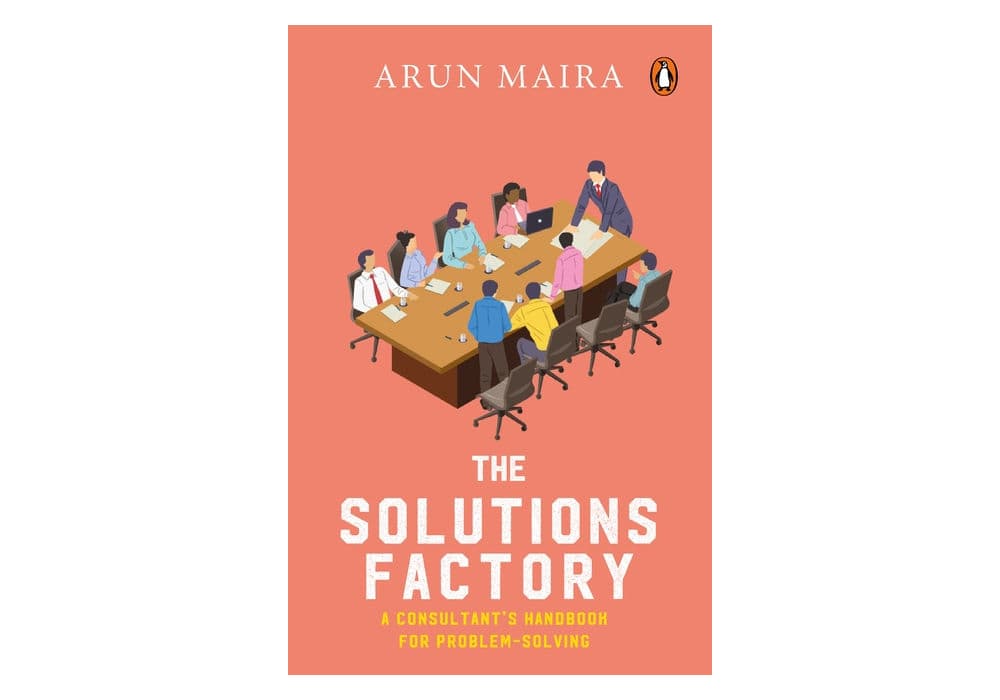
When is a consultant’s job done?
The fees they earn is not a measure of how well a consultant has served the client. These three stories of change—of BP’s turnaround, Mexico City’s municipal workers, and of young consultants who want to make a real difference—show what a consultant's job really is. Extracted from Arun Maira’s latest book, ‘The Solutions Factory: A Consultant’s Handbook for Problem-solving’
AM
Arun Maira
Former Chairman, BCG India | Member, Planning Commission
When is a consultant’s job done?
The fees they earn is not a measure of how well a consultant has served the client. These three stories of change—of BP’s turnaround, Mexico City’s municipal workers, and of young consultants who want to make a real difference—show what a consultant's job really is. Extracted from Arun Maira’s latest book, ‘The Solutions Factory: A Consultant’s Handbook for Problem-solving’
Former Chairman, BCG India | Member, Planning Commission

·Business & Strategy
When Data Is Right but Decisions Go Wrong
Strategy fails not from lack of information, but from outdated assumptions about what it implies
DM
Debleena Majumdar
Entrepreneur & business leader | Author
When Data Is Right but Decisions Go Wrong
Strategy fails not from lack of information, but from outdated assumptions about what it implies
Entrepreneur & business leader | Author
Explore more
Dive into other themes from our network.