What Happened to Just Being Stupid?
The young professionals who don't want AI to think for them
31 July 2026· 6 min read
TL;DR
Young professionals, despite proficiency, express hesitation about AI. Their apprehension isn't rooted in denial or job loss, but from a fear that AI preempts vital learning and skill development. Researcher Ayesha highlights how AI's instant processing bypasses experiential learning critical for developing judgment. Marketer Yash echoes this, fearing AI's pervasive convenience erodes creativity and essential human skills. This marks a new anxiety: not merely AI replacing labour, but the forfeiture of opportunities for human learning and growth.

For most of my working life, nearly two decades now, technology followed a predictable script: the youngest people got there first. Teenagers embraced social media while their parents worried that the new currency notes contained smart chips that tracked ‘black money’. Younger people adopted smartphones almost overnight. Every technological shift seemed to reinforce the same idea: if you wanted to know where technology was headed, watch the youngest people in the room.
Which is why a series of recent conversations about AI caught me off guard.
The hesitation I wasn't expecting
Over the last few weeks, I’ve been speaking to Gen Z researchers, artists and creative professionals about AI. I was working on something else when I began hearing comments that didn't fit the dominant narrative around AI. A creator describing AI tools as something that “gives me the ick”. A young researcher sounding distinctly uncomfortable about a technology that was supposedly making her job easier.
The obvious explanation would be that younger people are in denial, or that they don't understand it yet because it’s changing every day, and because, as headline after headline suggests, it’s coming for their jobs. But on closer examination, that didn’t ring true. Most of the people I spoke with use AI regularly and often more fluently than their older colleagues. They use Claude, ChatGPT, NotebookLM—whatever their organisations have rolled out—and plenty more that they’ve mastered on their own. They know where it’s useful and how to get good results from it. And yet there’s a hesitation that feels different from simple resistance to change.
What if AI takes away the learning?
I was speaking with Ayesha, a 28-year-old New Delhi-based researcher working in programme evaluation, whose organisation has been actively integrating AI into its workflow. Documents that once took weeks to analyse can now be processed in minutes. Large volumes of reports can be summarised almost instantly, and theory of change documents that once required weeks of reading can now be generated in a matter of minutes. Listening to her describe it, it was hard not to be impressed. Then she said something that shifted the conversation.
“If the task is from the beginning being done by AI, as a new person in the field, you don't also understand at times what is right and wrong, right?”
Five years ago, a new researcher read the reports, got things wrong, and a senior explained why they were wrong. Over time, they learned how to judge what mattered and what didn’t. Ayesha’s concern wasn't that AI was doing the work but that it was increasingly doing the part she wanted to learn from.
I asked Yash, a Mumbai-based social media and digital marketing professional, how does he see his career shaping up over the next three decades? He dug up this image from the animation movie WALL-E: a morbid vision of a future defined by optimisation and convenience.
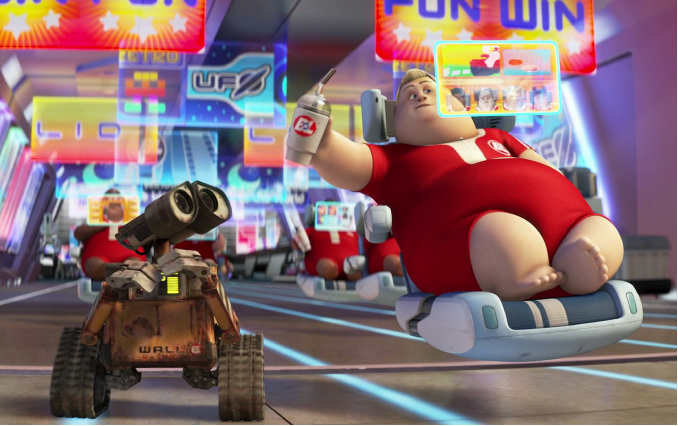
“You’ve seen WALL-E? That’s us in 100 years,” says Yash. “You don’t even have to move from your space. Everything will be served to you on a platter. And that’s just going downhill. What a human takes maybe two-three days to create, AI can do it in seconds. So where do we stand? What value do we have? It’s there to make your life easier, right? But not so much that you’ll start forgetting your own judgment, your own creativity, your own communication skills. If you are that dependent on AI, then you might as well just stop working. And tell the organisation to get a premium subscription for an AI channel instead.”
I found myself wondering whether we’re looking at a very different kind of anxiety from the ones previous generations had about technology—not around replacing labour, but a fear of losing the chance to gain experience. How do you develop judgement if somebody, or something, is constantly handing you conclusions before you’ve learned how to arrive at them yourself? Interestingly, these were the very concerns teachers had about students using AI in schools—a theme I explored in an article I co-authored last year. Today I see them mirrored in young professionals who were being told that using AI was the “smarter way”.
The value of struggle
A different conversation led me to a surprisingly similar place. I was speaking with Pablo, an animation professional in Mumbai. Unlike the stereotype of the artist resisting technology, he uses AI regularly for mood boards, visual references, summaries and ideation. He described it as “like having an intern”, which felt like a useful description, because an intern can help save time and pick up the tedious work that no one else in the office wants to do. But it would be pretty unusual for an intern to be able to dig deeper and tell you the deeper story behind something.
I want to go through that struggle.
At one point, we started talking about character design, specifically about designing a sword for a character. AI, he said, could generate fifty swords in seconds, but if you wanted to understand why this particular sword belonged to this particular character, the lore and history behind it, its provenance, and what it said about the person holding it, that’s a process full of friction. One word kept resurfacing: struggle. "I want to go through that struggle,” he said.
It's an odd thing to say in a culture obsessed with efficiency, where most of the technologies we celebrate are designed to remove friction and eliminate effort where possible. Pablo looked at struggle not as a barrier but as part of the value. The redrafts, the uncertainty, and that halfway moment when you realise your original idea probably wasn’t very good and needs a gear shift.
None of them were arguing against AI. It’s deeply integrated into their lives. Ayesha relies on it to make sense of large volumes of information; Pablo uses it for reference and ideation. Their discomfort lay in the growing assumption that if something can be automated, it should be.
A new kind of AI literacy
Another thing I hadn’t expected was how quickly AI literacy had evolved. For years we’ve treated AI literacy as the ability to use these tools well, but some of the young people I spoke with defined it differently. Yash told me that after spending enough time around AI-generated content, he could spot it almost instantly. Claude had a visual language, ChatGPT had its own writing tics. The output wasn’t bad, but had become recognisable.
A few years ago, it was novel to create something with AI. Today, for some young professionals, the ability to recognise AI-generated content is a form of media literacy. Once you know what it looks like, and start seeing it everywhere, it loses its ability to impress.
“The first thought that goes through my mind is that this is lazy work,” Yash said. Not poor work, not unethical work, just lazy work.
One phrase came up repeatedly during these conversations: “AI se kar lena.” Just get AI to do it. Interestingly, both people who used it associated that phrase with older managers and senior colleagues. That got me wondering about whether the divide here is about AI at all.
What worries them is that they don’t have the chance to go through the rigour that shaped their bosses’ and managers’ generation. Automatic efficiency and getting to the ‘answer’ matters less to them, because some parts of the work feel valuable precisely because they’re difficult. But Gen Z hasn’t even had the chance to build confidence through trial and error.
“What happened to just being stupid?” the researcher asked.
I don't want to wake up one day and not know what to do if AI disappears.
There was another anxiety lurking underneath some of these conversations, particularly among those only a few years into their careers: dependency.
Vedant, a 25-year-old graphic designer, put it bluntly: "I don't want to wake up one day and not know what to do if AI disappears… AI is just giving the end result. But where is the learning about the process?”
Vedant adds: “If you don't have a perspective on how the visual hierarchy should flow, you end up handing all of those decisions to AI. And over time, your own mind starts adapting to that. You begin thinking, ‘This looks good, so I'll do it this way too.’ Eventually, you become convinced that because the AI produced it, it must be the best solution. That's where your own creative ability starts to decline. Because the thinking has already been done for you, you stop thinking on your own.”
If AI writes the copy, suggests the visual hierarchy, generates the first draft and structures the thinking, what exactly are you becoming better at over time? That’s a very different question from the one most organisations seem to be asking: how can something be done faster or cheaper?
Proof of human
The strongest reactions emerged when we discussed creative work. Not judging people for using AI, but the joy of seeing something ‘made by a human’. Riya described AI-generated art thus: “Art has always been about the process. AI is just creating the end product.”
This wasn’t just about creators, but also about audiences. Yash described how quickly AI-generated content had moved from being impressive to being background noise.
“Earlier it used to be fun seeing what different things people can come up with. But now you go on any platform, you scroll Instagram, you see AI slop. It’s everywhere. People nowadays value authenticity. Recently I'm seeing those proper art channels coming back up, people actually sitting and fast forwarding the video of making a sketch, maybe travel blogs that went down for a while—but now it's starting back up again.
“Now there’s a new stunt. Anything you make in AI videos, a car jumping off a bridge, a guy doing multiple back flips. People do a stunt themselves. People think that it’s AI, but it's not. That is something you’re surprised to see. Like a proof that it’s human in a way.”
That’s significant, because if AI is flooding content, audiences may be responding by looking for evidence that somebody was actually there, that a human being made choices, that something really happened.
Pablo approached the same idea from a different angle. He told me about visiting the Louvre as a teenager and seeing paintings he’d already encountered countless times in books and magazines. But standing in front of the originals felt different.
"There was just something about the whole 'it is made by a dude' that I couldn't feel when I was seeing it in the magazine.”
The more I think about these conversations, the less convinced I am that we're witnessing a backlash against AI. This generation understands AI, and yet is unwilling to simply hand everything over to it. They’re trying to draw boundaries around what they want technology to do on their behalf. And they’re very clear that there are parts of being human that are really worth keeping.
Note: Some names have been changed to protect identities.
Join the conversation
Ipsita Bandyopadhyay
Head of Research and Strategy | Quipper Research
Ipsita Bandyopadhyay is a consumer insights professional working with Quipper Research. She is interested in issues concerning culture, society, gender and politics. She is an alumna of SOAS, University of London and St. Xavier’s College, Mumbai.
Beyond the noise is the signal.
FF Insights: Sharpen your edge, Monday–Friday.
FF Life: Culture, ideas and perspectives you won't find elsewhere — Saturday.

Founding Fuel is sustained by readers who value depth, context, and independent thinking.
If this essay helped you think more clearly, you may choose to support our work.

Founding Fuel is sustained by readers who value depth, context, and independent thinking.
If this essay helped you think more clearly, you may choose to support our work.
Loading comments...
More by Ipsita Bandyopadhyay
Readers also liked
·Leadership & Organisation
Who Owns the Fire?
A leader can light the spark. The harder question is what happens to the fire afterwards?
SP

Satish Pradhan
Independent Consultant
Who Owns the Fire?
A leader can light the spark. The harder question is what happens to the fire afterwards?
Independent Consultant

·Technology & the Future
The Race to Reinvent Nuclear Power
A Danish startup wants to take a faster road to thorium and manufacture nuclear reactors by the thousands. Its audacious bet raises a question for India: what happens if the nuclear world changes before Homi Bhabha’s long-term vision is complete?
SR

S. Raghotham
Journalist and strategic analyst
The Race to Reinvent Nuclear Power
A Danish startup wants to take a faster road to thorium and manufacture nuclear reactors by the thousands. Its audacious bet raises a question for India: what happens if the nuclear world changes before Homi Bhabha’s long-term vision is complete?
Journalist and strategic analyst

·FF Life
Who Gets to Decide What Happens at the End of Your Life?
Living wills remain on the fringes, but they are forcing India to confront family power, cultural taboo, and the realities of end-of-life care—signalling a profound shift in how the country thinks about dignity and medical decision-making
SB

Sveta Basraon
Editor and Head of Operations | Founding Fuel
Who Gets to Decide What Happens at the End of Your Life?
Living wills remain on the fringes, but they are forcing India to confront family power, cultural taboo, and the realities of end-of-life care—signalling a profound shift in how the country thinks about dignity and medical decision-making
Editor and Head of Operations | Founding Fuel
Explore more
Dive into other themes from our network.