Return on Character
By Fred Kiel

Insights on leadership, the character of leaders and executive teams from Fred Kiel's book - Return on Character.
By Fred Kiel
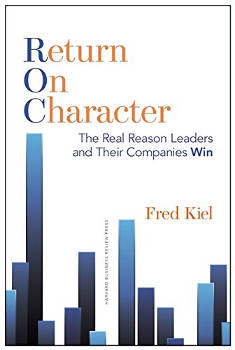
The author hopes to inspire a movement where people demand character-driven leadership because it delivers higher value to all stakeholders.
A leader should stay legal, but beyond that, it's the person who is hard-nosed, doesn't succumb to soft HR practices and ruthlessly controls costs who creates the most value.
People demonstrate character through habitual behaviours; they can develop the habits of strong character and 'unlearn' the habits of poor character.
Human character encompasses much more than honesty and truthfulness. It is also about loyalty or integrity, of fairness etc.
Character is about distinguishing right from wrong, it is about not misleading others, it is about self control, it is about co-operation and forgiveness, it is about compassion.
Finding a balance wherein our behaviours promote the most good for the most people is the ongoing task of all principled people of strong character.
| Head | Heart |
| Integrity: Telling the truth, acting consistently with principles, values and beliefs. Standing up for what is right, keeping promises. | Forgiveness: Letting go of one's mistakes, letting go of others' mistakes, focusing on what's right vs. what's wrong. |
| Responsibility: Owning one's personal choices, admitting mistakes and failures. Expressing a concern for the common good. | Compassion: Empathizing with others, empowering others, commitment to others' development. |
There are virtuoso CEOs and self-focused CEOs. Self-focused CEOs are weak characters who are out to help themselves, no matter what the cost to others.
Virtuoso CEOs are skilled business people, their employees see them as individuals of strong character and they select and build a team of strong character.
Self-focused CEOs can't be trusted to keep promises, often pass blame to others, frequently punish well-intentioned people for making mistakes, and are poor at caring for people.
The foundation of a leader's decision making rests on creating a vision for the future, maintaining a strategic focus, and creating a culture of accountability.
Human beings are born with five personality dimensions: openness, conscientiousness, extroversion, agreeableness and risk aversion or fear. Think of each of these traits as having a slider which goes from 0 to 100.
John Lennon, the famous Beatle, once said: "Life is what happens to you while you are busy making other plans."
All human beings have a well-honed skill of denial. The benefit of this is that individuals are optimistic; the downside is that they get blinded and believe their own lies.
No matter how much reflection we practise, we need to get feedback from other people in order to become truly self aware.
Virtuoso leaders developed strong character habits and adopted positive beliefs about human nature, organizational life and their own sense of purpose.
1. They create a vision or a plan
2. Set the strategic focus and key initiatives to achieve them
3. Build a talented team
4. Enforce a culture of accountability.
1. They make a decision and seek confirming data
2. Allow short-termism to override long-term decisions
3. Make impulsive decisions
4. Place undue importance on decision and its impact on their career
5. Get unduly influenced by the last person they speak to
6. Rely on their gut rather than collect careful analysis
Leaders with strong character are more likely to be anchored in the kind of disciplined decision making processes that result in clearer organizational vision and a stronger culture of accountability.
The most effective teams share the following: goals, roles, processes, informal interactions.
Workforce engagement killers include unfair hiring, unfair promotion and compensation policies.
A workforce that believes that sycophancy is the best route will never be engaged with company purpose or goals.
The keystone leadership behaviour traits include: keeping promises, following through on commitments, owning up to mistakes, forgiving people for mistakes, and treating people as people.
A workforce that feels cared for is more productive than one that is neglected in terms of development, listening, etc.
Changing your character is hard work. It takes a lot of energy and personal resolve. Willpower alone cannot do it.
Your brain views change as a threat, because your brain thrives on routine.
Leading and guiding an organization through a change process when the future is uncertain needs virtuoso leadership from the leader and the executive team.
Few leaders understand the shared nature of their voyage. They must realize that their safe passage depends on the safe passage of every member of their team.
The Real Reason Leaders and their companies win
By Fred Kiel

Founding Fuel is sustained by readers who value depth, context, and independent thinking.
If this essay helped you think more clearly, you may choose to support our work.

Founding Fuel is sustained by readers who value depth, context, and independent thinking.
If this essay helped you think more clearly, you may choose to support our work.
FF Insights: Sharpen your edge, Monday–Friday.
FF Life: Culture, ideas and perspectives you won't find elsewhere — Saturday.
Insights from Indra Nooyi’s memoir ‘My Life in Full’, on leadership in a world “where authority and brilliance, to many people, still look like an older gentleman”
Author
Insights from Indra Nooyi’s memoir ‘My Life in Full’, on leadership in a world “where authority and brilliance, to many people, still look like an older gentleman”
Author
In their book, ‘Character Carved in Stone’, Pat Williams and Jim Denney talk about the values the United States Military Academy at West Point cultivates to make strong leaders
Author
In their book, ‘Character Carved in Stone’, Pat Williams and Jim Denney talk about the values the United States Military Academy at West Point cultivates to make strong leaders
Author
In their book ‘The Founder’s Mentality’, Chris Zook and James Allen, partners in Bain & Company, talk about what leaders can do for sustainable and profitable growth
Author
In their book ‘The Founder’s Mentality’, Chris Zook and James Allen, partners in Bain & Company, talk about what leaders can do for sustainable and profitable growth
Author
Dive into other themes from our network.