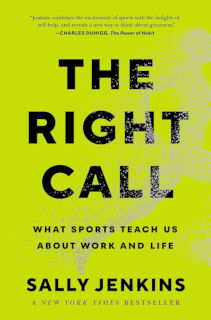
The Right Call:
What Sports Teach Us About Work and Life
By Sally Jenkins
Insights from sportswriter Sally Jenkins’ book ‘The Right Call: What Sports Teach Us About Work and Life’
By Sally Jenkins
Sally Jenkins worked with The Washington Post for more than 20 years. She has authored 12 books. She has covered 10 Olympic games. She graduated from Stanford University and now lives in New York.
2 of 41
Elite athlete skills are not a matter of natural talent but attainment.
3 of 41
“Champions summon their best when they most need it” - Rod Laver
4 of 41
The laziest seeming pro athlete works far harder than the average person.
5 of 41
People who bet on themselves tend to win.
6 of 41
“Real excellence cannot co-exist with self-indulgence” - Pete Sampras.
7 of 41
Professionalism is how you bring out your best when you don’t feel it’s there.
8 of 41
Men are not data. They can fail to execute.
9 of 41
“A good decision is the ability to sort through dynamic and shifting factors to make a specific commitment to action”- Mintzberg
10 of 41
One virtue all great players have is frankness. They are candid with themselves and one another.
11 of 41
High performers perform well because of their acquaintance with failure and the extent to which failure shaped them.
12 of 41
25% of the American NFL coaches get fired every year.
13 of 41
Leadership is about other people and without that people connection, there is no leadership.
14 of 41
Champion Chess players’ heart rate is 3 times more when they are playing a tough game.
15 of 41
Stress is what happens when you meet a demand that you are not conditioned to comfortably handle.
16 of 41
“Don’t mistake activity for achievement” - John Wooden
17 of 41
Discipline is not petty militaristic enforcement.
18 of 41
Over-flexing of authority is not discipline and it fails.
19 of 41
65% to 75% of employees at work report that their biggest problem is their immediate boss.
20 of 41
Hogan says the most important question to ask of potential leaders is, can we trust you enough not to abuse the privilege of authority?
21 of 41
If you want obedience at work, have a child.
22 of 41
Discipline is the voluntary regulating of behaviour that drives repetitive excellence.
23 of 41
Leaders had better be an example of personal discipline themselves if they want their decisions to work.
24 of 41
Set habits lead to a more predictable and favourable outcome.
25 of 41
Elite athletes are very disciplined in the right things, while corporate executives are disciplined in the wrong things.
26 of 41
Disciplined people are not average. Because of their discipline they might be alone at the top.
27 of 41
Poor workplaces are full of vague statements and corporate euphemisms.
28 of 41
For the best coaches, player assessment is best when they separate the person from the performance.
29 of 41
Often high performers will interpret silence from a coach or in a meeting as disapproval.
30 of 41
The language of leadership has four characteristics:
31 of 41
Culture is a word that can drive one crazy through its overuse and vagueness.
32 of 41
The organizational scientist Paul C Nutt has estimated that 50% of all corporate decisions fail.
33 of 41
Champions are good losers.
34 of 41
Great leaders fail with a more organized sense.
35 of 41
Coaches are as insecure as players. The average tenure of a coach across baseball, basketball, football and hockey is between 2.6 and 3.2 years.
36 of 41
Do you learn from winning or losing?
If you lose all the time, it becomes a bad habit.
If you win all the time, you get overconfident and complacent.
You need to learn from both, the correct way.
37 of 41
The trouble with stardom for athletes is that they start getting invites from Donald Trump, they do endorsements, they spend too much time outside their craft.
38 of 41
The chances that a manager who is strongly disliked will be perceived as a good leader is 1 in 2,000.
39 of 41
All great leaders have a fundamental sense of reliance on others.
40 of 41
In any pursuit of success, you need LUCK.
41 of 41
By Sally Jenkins


Founding Fuel is sustained by readers who value depth, context, and independent thinking.
If this essay helped you think more clearly, you may choose to support our work.

Founding Fuel is sustained by readers who value depth, context, and independent thinking.
If this essay helped you think more clearly, you may choose to support our work.


FF Insights: Sharpen your edge, Monday–Friday.
FF Life: Culture, ideas and perspectives you won't find elsewhere — Saturday.

Insights from the book ‘Say It Well’ by Terry Szuplat, Barack Obama’s speechwriter
Author
Insights from the book ‘Say It Well’ by Terry Szuplat, Barack Obama’s speechwriter
Author

Insights from Martin Reeves and Bob Goodson’s new book, ‘Like’
Author
Insights from Martin Reeves and Bob Goodson’s new book, ‘Like’
Author

Insights from The Economist’s report ‘The World Ahead 2025’
Author
Insights from The Economist’s report ‘The World Ahead 2025’
Author
Dive into other themes from our network.