That’s Not How We Do It Here
By John Kotter and Holger Rathgeber
Discipline and maverick ideas—both are necessary for dealing with rapid change and coming out ahead, say John Kotter and Holger Rathgeber in their book ‘That’s Not How We Do It Here’
By John Kotter and Holger Rathgeber
This story is about important issues all of us face—the rate of change is going up, and that fact can be hard to see clearly or to deal with well.
This story is set like a fable, where the clan is the organisation.
We need clarity on how organisations can rise and grow once again, fulfil their mission and create jobs.
We also need to see the role of discipline, planning, reliability and efficiency in the story.
There is always the issue of management versus leadership.
Change is a part of life whether you have a drought or a rainy season.
Today is not the past, it is a new day.
Rules tell you what to do and what not to do, they don't tell you how to do it.
For most rules, we have learned how to perform the task in the best way.
Employees always want creativity and fun and mistake that for a good empowered culture.
There are more important matters than fun and creativity. Rules and procedures help you achieve the most for your clan/company.
If there are attacks on the clan/organisation, you need to prepare a new training plan for the whole clan.
In a challenging situation, companies and leaders get to a more command and control mode.
When a company gets into a more command and control mode, jobs in the company become demanding and exhausting.
When too many meetings happen in an organisation, the rank and file wonder what the bosses are doing in so many meetings.
In organisations, some people care only for themselves.
The rank and file get tired of endless talk about who is to blame.
People are sick of those wanting to change and help being pushed back by leaders.
In such companies, there is no hope. When there is no hope, life is unacceptable, and people move to a new clan/organisation.
One must measure the speed with which new important ideas were created, supported, and made to happen.
The enthusiasm, the degree of co-operation and the energy level are important in an organisation.
You cannot fail in an organisation, unless you fail to try.
Organisations need to deal with new and unknown challenges at astonishing speed.
Most organisations in trouble think they are healing, but they don't change fast enough.
One worry is the increasing concern with basic work not being done, or that it is not done reliably every day.
Everything that requires a co-ordinated effort is not done reliably or is debated endlessly in groups. This increases the frustration level of those who want to do good work for the company.
In a new age organisation, employees are friends first, and each one is a leader and a servant. In such an organisation, there is a desire to show up every day and be the best we can be.
In an organisation undergoing change, the old employees will glorify the good old days when everyone was truly cared for.
They tend to blame the problem either on the new leader or on people who have newly joined.
In organisations that fail, many people talk smart, but don't show up to do real work.
The circle of leaders in a company need to have a lot of energy, passion, the spirit of volunteering, the sense of vision, the willingness and ability to create change, and the sharing.
If enough people believe and create a truly better, stronger and safer organisation, that organisation thrives.
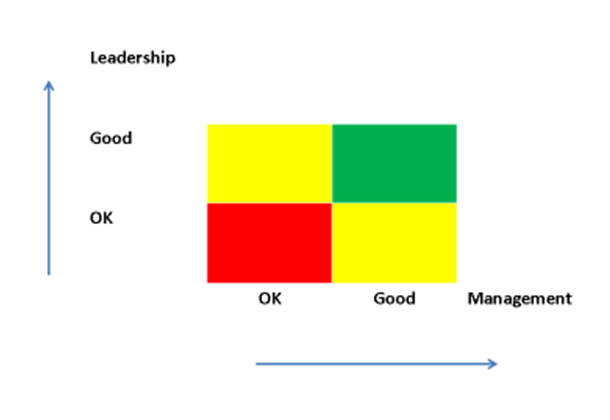
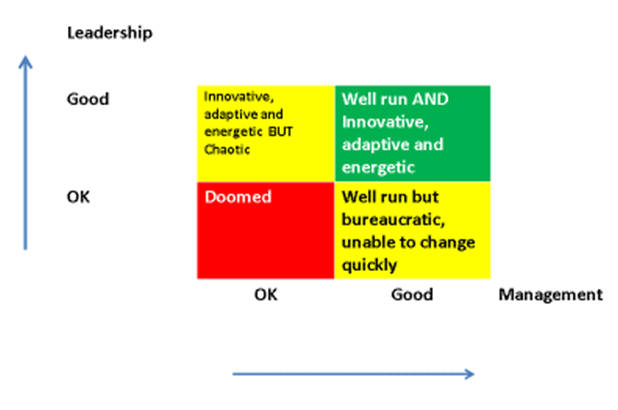
Management and leadership are not the same thing. Both are needed for success in an organisation.
They are very different in terms of actions, processes and behaviour. Management is inherently clunky, bureaucratic and command-control.
|
Management |
Leadership |
|
|
In a large organisation, in a protected world that changes little, good management is overwhelmingly important, and in a way sufficient.
In an organisation where change is a constant, you need more leadership.
It is not a matter of one or the other, we need both management and leadership.
The size and complexity of a company requires demanding management, while the incredible technology changes and other forces create a need for demanding leadership.
The newer companies create an ecosystem. They don't try to do it on their own; they enlist effective partners.
They engage the workforce through constant communication, and they try to grow their people both on capability and leadership.
True urgency around initiatives, felt by a large section of people, intellectually as well as emotionally, drives change.
The vast majority of people spend time in good management but poor leadership companies and hence tend to have many questions about where the organisation is going.
By John Kotter and Holger Rathgeber

Founding Fuel is sustained by readers who value depth, context, and independent thinking.
If this essay helped you think more clearly, you may choose to support our work.

Founding Fuel is sustained by readers who value depth, context, and independent thinking.
If this essay helped you think more clearly, you may choose to support our work.


FF Insights: Sharpen your edge, Monday–Friday.
FF Life: Culture, ideas and perspectives you won't find elsewhere — Saturday.

What makes Elon Musk tick? Insights from the biography by Walter Isaacson
Author
What makes Elon Musk tick? Insights from the biography by Walter Isaacson
Author

Insights from sportswriter Sally Jenkins’ book ‘The Right Call: What Sports Teach Us About Work and Life’
Author
Insights from sportswriter Sally Jenkins’ book ‘The Right Call: What Sports Teach Us About Work and Life’
Author

Google’s Eric Schmidt, Jonathan Rosenberg and Alan Eagle share what they learnt from their mentor, legendary coach Bill Campbell, in their book ‘Trillion Dollar Coach’
Author
Google’s Eric Schmidt, Jonathan Rosenberg and Alan Eagle share what they learnt from their mentor, legendary coach Bill Campbell, in their book ‘Trillion Dollar Coach’
Author
Dive into other themes from our network.