Founding FuelFounding Fuel

What makes a winner

Insights from Larry Weidel’s book ‘Serial Winner: 5 Actions to Create Your Cycle of Success’

8 May 2016· 1 min read

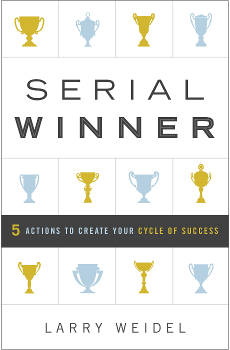
Serial Winner

5 Actions to Create Your Cycle of Success

Larry Weidel

Slide

How serial winners stay on course

To most of us, serial winners are confounding. They seem to have the ability to shed the negatives in life and attract the positives. How do they find the energy or the time?

Serial winners leverage a cycle of action—they do something every day that puts them or keeps them on course for the things they want in life.

Winning traits

  • Serial winners bounce back, move on, and win anyway. And they do it through action.
  • The cycle of winning is about deciding, overdoing, adjusting, finishing and improving.
  • Winners keep things simple, and where winners start is with the fundamentals.

They keep moving forward

If you want to win, you have to keep moving forward. If you want to move forward, you have to make decisions.

Shed doubt

Serial winners do not let little things like doubt and uncertainty stand in their way.

With fear comes paralysis and with paralysis comes certain failure.

There are no automatic passes

No advantage like a good family or a good college degree is a guarantee that you will win. No lack of advantage is a guarantee that you will lose.

People do not get an automatic pass to the boardroom because they graduated from Harvard.

Be persistent

Persistence and determination are key to serial winners.

Have intellectual curiosity

The most privileged students at the best colleges aren’t being taught to think. They have little intellectual curiosity and follow meekly in the same direction.

Everyday people with fewer advantages outperform and outthink those with a more advantaged background.

What makes winners great

What makes winners great is what’s in their minds and hearts.

We can only be great doing things we really want to do, for our own reasons.

Winners dig in on their ideas, they talk about them, they connect, they ask questions.

What to overdo and what not to

There is planning and there is over planning. Over planning is a form of doubt.

Winners overdo doing and learning.

Action counts

Winners take what they know right now and choose the best course of action they can.

Focus on what you control

Winners manage success by focusing on what they control. Others get beaten by letting their minds wander on things they cannot control.

Achievement brings confidence

The best form of confidence is the confidence that comes from achievement.

Maximum effort, maximum effect

Nothing happens with minimum effort. It is the energy and effort that you put that takes you to success.

Serial winners put it all on the line and drive themselves to exhaustion over a goal.

Have a big goal

Without a big goal, you really don’t have a goal.

Push yourself

Pushing yourself to uncomfortable limits makes it possible for you to handle bigger challenges tomorrow.

Don’t quit, adjust

Effort fully realises its reward when a person refuses to quit.

People who have a pattern of quitting never get ahead in life.

Serial winners don’t quit. They will adjust and start racing in a new and better direction.

Dealing with adversity

The key to your character is in how you face adversity.

People who have led easy lives often lack the stomach for conflict.

Whining will not change anything. We all face challenges. The more important the goal, the more likely you will face challenges.

There’s no easy way

Nothing of value in life comes easy. The only way is to work for it.

Good things do not come out of half-hearted actions.

Don’t let emotion override reality

Serial winners are driven, positive, expectant, but not delusional.

They resist the temptation to let emotion override logic.

Don’t play the blame game

Serial winners do not play the blame game, they turn their sights to overcoming rather than blaming.

Adapt

We adapt to the world, the world doesn’t adapt to us.

Stay informed

Serial winners go after the answers they need and they stay informed to improve their decision making.

Develop a system for staying informed. It is a lot of effort, but winners know how to do it.

Keep it simple

The difference between complicated and simple is the difference between winning and losing.

The best way forward is to keep things simple. It will be a fight, but keep it simple.

Don’t fear failure

No one wins all the time, but we can fight to win all the time.

Finishing is a moment of truth for winners

Finishing is how you win the things in life—trust, respect, loyalty, opportunity and even money.

Don’t live in the past

Serial winners do not count on past accomplishments.

Limit negative stress

Serial winners limit negative stress whenever possible.

Make your own luck

Winners make their own luck through hard work and preparation.

They win by focusing on the right things until the job is done.

Don’t settle, keep improving

When you improve, you improve your ability of judgement and instinct.

Stay balanced

Serial winners see winning and losing patterns in every conversation, in every meeting. They stay balanced.

Greatness can be taught

Fundamentals must be taught, so also greatness.

Learn to say no

Limit distractions and eliminate time wasters.

Serial winners are good at saying no.

It begins with a decision

Self-management is grounded in the desire and then the decision to make your life count, to accomplish big things, to make a big contribution to the world. And serial winners do it again and again.

Serial Winner: 5 Actions to Create Your Cycle of Success

By: Larry Weidel

Buy it on Amazon

Founding Fuel is sustained by readers who value depth, context, and independent thinking.

If this essay helped you think more clearly, you may choose to support our work.

Illustration of supportersIllustration of supporters
Loading comments...

Readers also liked

Does your team have runners or passive riders?
·Leadership & Organisation

Does your team have runners or passive riders?

In his book ‘Move Your Bus’, Ron Clark talks about the different kinds of people companies typically have—high performers, the dependables, average workers and deadweights—and what leaders can do to get the best out of their teams

AU

Author