
TL;DR
A distant Gulf conflict is profoundly reshaping India's economic landscape, directly challenging the resilience of "India-only" portfolios. With critical oil flows through the Strait of Hormuz disrupted, India's high import dependence is triggering cascading effects: surging crude prices, a weakening rupee, and investor exits. This serves as a potent reminder that in an interconnected world, no geopolitical shock is truly "faraway." For astute investors, the takeaway is clear: proactive, strategic diversification—across investments and markets—is not an optional improvisation during a crisis, but an indispensable foundation for mitigating risk and ensuring long-term resilience against global uncertainties.

Editor’s Note: Indian investors are already making a concentrated bet—whether they realise it or not. Your life is long India. Chances are, your portfolio is too.
This week, that bet is being tested.
A war in the Gulf has pushed oil higher, weakened the rupee to 93.7, and unsettled markets. As of Thursday (March 19), the Nifty 50 was down about 9% in March, while foreign investors pulled out Rs 89,916 crore from Indian stocks over a 15-session stretch till March 19. What looks like distant geopolitics is now showing up, quietly and relentlessly, in Indian portfolios.
In this weekend essay, Anindya Dutta traces how that transmission works—from the Strait of Hormuz to currencies, capital flows, and asset prices. It is a reminder that in an interconnected system, there is no such thing as a “faraway” shock.
Read alongside Abhishek Raghunath’s recent argument on why your portfolio shouldn’t be long India, it sharpens a harder point: diversification is not something you improvise in a crisis. By then, the repricing has already begun.
We are in the throes of a war that some would suggest was unnecessary—many would say unimaginative. Be that as it may, a foreseeable crisis, fired off unilaterally, has now spilled across a world that was never consulted. Allies are only now being summoned after the fact to join a war they never wanted and don’t support. For now, it is to escort tankers through a Strait everyone knew would be weaponised the moment Iran was hit, and in the long term, clean up the mess that will long survive its creation. Perhaps an unlikely solution will be found soon. At this stage, even a pyrrhic declaration of victory on social media, with cessation of hostilities, would be welcomed by a world that is shaken, geopolitically and economically. Until then, the economic shockwaves will continue to hit distant shores.
Across the Arabian Sea, the alarm bells are ringing louder. While the epicentre of the current crisis may be in the Gulf, the impact is already showing up in Indian investors’ portfolios, colliding with simmering global risks in private credit and artificial intelligence to create a system with far more fragility than headline indices suggest.
A Predictable Strait, an Avoidable Shock
Look at the sequence. Airstrikes on Iran, followed by an “effective” closure of the Strait of Hormuz, have choked the artery through which about one-fifth of the world’s oil flows. Brent crude has surged past $106 a barrel after brushing $120, and the benchmark has now strung together multiple weekly gains as markets absorb the reality that this is not a short, surgical skirmish.
Then comes the punchline. Pleas have gone out for a naval coalition to reopen the Strait, warning NATO partners that there will be “consequences” if they don’t send their ships. For oil-importing nations like India, which had no voice at the table when the bombs started falling, this is geopolitics as fait accompli. We weren’t consulted when the mess was created, but we’re expected to help mop up the spill.
India: Collateral Damage in Someone Else’s War
For India, this is the worst possible theatre for a conflict. More than 80% of our crude needs are imported, and a large chunk of that flows—or flowed—through Hormuz. Each $10 rise in crude can shave roughly half a percentage point off GDP growth, and we’re not talking about theoretical scenarios anymore—we’re living through the spike.
The numbers tell a simple story: oil up, rupee down, yields higher, equities rattled.
The rupee has crashed through one psychological barrier after another, trading above 93 to the dollar and now being talked about as a candidate for 95 if the war drags on. It is Asia’s worst-performing currency this year, punished by rising oil prices, the threat to remittances from the Middle East, and foreign investors heading for the exits on both equity and debt. The “India shining” macro narrative has run straight into the hard wall of geography. When your growth story rides on imported oil, this is exactly the conflict you cannot afford.
The Rupee: Death by a Thousand Cuts
For Indian investors, the war is not just a headline or a TV ticker. It is a silent mark-to-market on everything we own. The rupee’s slide past 93 is not a one-off event risk. It is the latest step in a long march of depreciation, now supercharged by conflict. Analysts estimate that for every 10% rise in oil, the dollar gains 0.5–1% against the rupee, and that rule of thumb is playing out in real time as the currency struggles to find a floor.
Indian households are overwhelmingly rupee-native. Over 90% of wealth sits in INR—real estate, domestic equity, rupee debt, fixed deposits. These are precisely the structures most vulnerable when imported inflation and currency weakness hit together. If your child’s university fees, your medical bills, your smartphone, or your retirement travel are in foreign currency, every step the rupee takes downward is a quiet haircut on your future—even if your mutual fund statements still show green ink.
A System Wired for Shock: War, AI, and Private Credit
If this were “just” an oil shock, it would be bad enough. It is not. As financial risk expert and author Richard Bookstaber, who warned about the build-up to the 2008 financial crisis, argued recently in The New York Times, we are now in an environment where multiple fault lines—artificial intelligence, a two-trillion-dollar private credit complex, stretched equity valuations, Taiwan, and now Iran—are all wired into the same financial circuitry. The danger is not any one of these in isolation, but that they transmit stress through the same channels at the same time.
Private credit is already flashing amber. Over the past decade and a half, companies have increasingly borrowed from institutional investors rather than banks, and those loans do not trade frequently. Nobody really knows what they’re worth when the music stops. Retail fundraising into private credit products has slowed, with withdrawals rising as investors question the stability of the structure.
Layer on top of that the AI boom. Data centres, high-end chips, and digital infrastructure—the physical backbone of AI—are heavily financed by private credit and concentrated in a handful of tech giants. An energy shock that pushes up power prices or restricts supply directly hits those data centres. It squeezes margins and ripples through the companies that dominate global indices. Add a Taiwan semiconductor shock into this mix, and you get a system where a war in the Gulf can, via electricity prices and chip shortages, hit AI, hit private credit, and then hit every investor who owns an index fund heavy on big tech.
For Indian investors, this is the part that is easiest to underestimate. You don’t have to own Iranian bonds or US private credit funds to be in the blast radius. You just have to own “the market”.
Indian Portfolios: Beautifully Concentrated, Terribly Exposed
The typical Indian portfolio is a study in concentration. Domestic equities, rupee bonds, bank deposits, real estate, a bit of gold. Almost everything is denominated in INR and tied to the same domestic growth story. In benign years, that concentration feels efficient. In a year like this, it reveals itself as fragility.
Equities have already taken a hit as the Middle East war knocked sentiment, with foreign investors selling and benchmark indices whipsawing in response to each new headline. Bond markets are jittery as well. Higher oil threatens inflation, inflation threatens rate stability, and rate uncertainty threatens bond prices. Gold is a partial hedge—but only partial. It cannot offset the combined blow of imported inflation, currency depreciation, and global growth concerns.
Meanwhile, the rupee’s weakness ensures that even when nominal returns on domestic assets look acceptable, real international purchasing power erodes. For NRIs who have loaded up on Indian assets without hedging currency exposure, this war-induced slide is a reminder that “India returns” and “global returns” are not the same thing.
The Temptation to Flee Abroad—and Why This May Be the Worst Time
In moments like this, the natural impulse is to get out. Move money abroad. Buy US ETFs. Buy global funds. Buy anything that doesn’t have a rupee in it. On paper, that sounds like textbook diversification. In practice, in March 2026, it risks being a panic trade into an already unstable global structure.
Consider what you are walking into. US and European markets are struggling to price not just the war and the oil shock, but the embedded leverage in private credit, the dependence of AI infrastructure on cheap energy and Taiwan-made chips, and the possibility that the next wave of selling will begin in the large, liquid tech names that anchor global indices.
When private credit investors need cash in a crisis, they won’t be able to sell illiquid loans. They will sell what they can—big, publicly traded tech stocks that global retail investors are being urged to buy. On top of that, the cost of hedging foreign currency exposure has risen, eating into returns.
Under the Liberalised Remittance Scheme, individuals can move up to $250,000 abroad each year. But if those flows are driven by fear rather than a plan, they risk being mistimed and mispriced. You sell Indian assets after they’ve fallen, buy overseas assets after they’ve run up, and then watch the global correction arrive on schedule.
This is not diversification; it is changing deck chairs on a ship sailing into the same storm.
A Hard-Nosed Playbook for Indian Investors
So what does a prudent Indian investor do when dragged into a war they did not choose, a currency slide they cannot control, and a global system whose plumbing looks increasingly suspect?
A few disciplined principles suggest themselves:
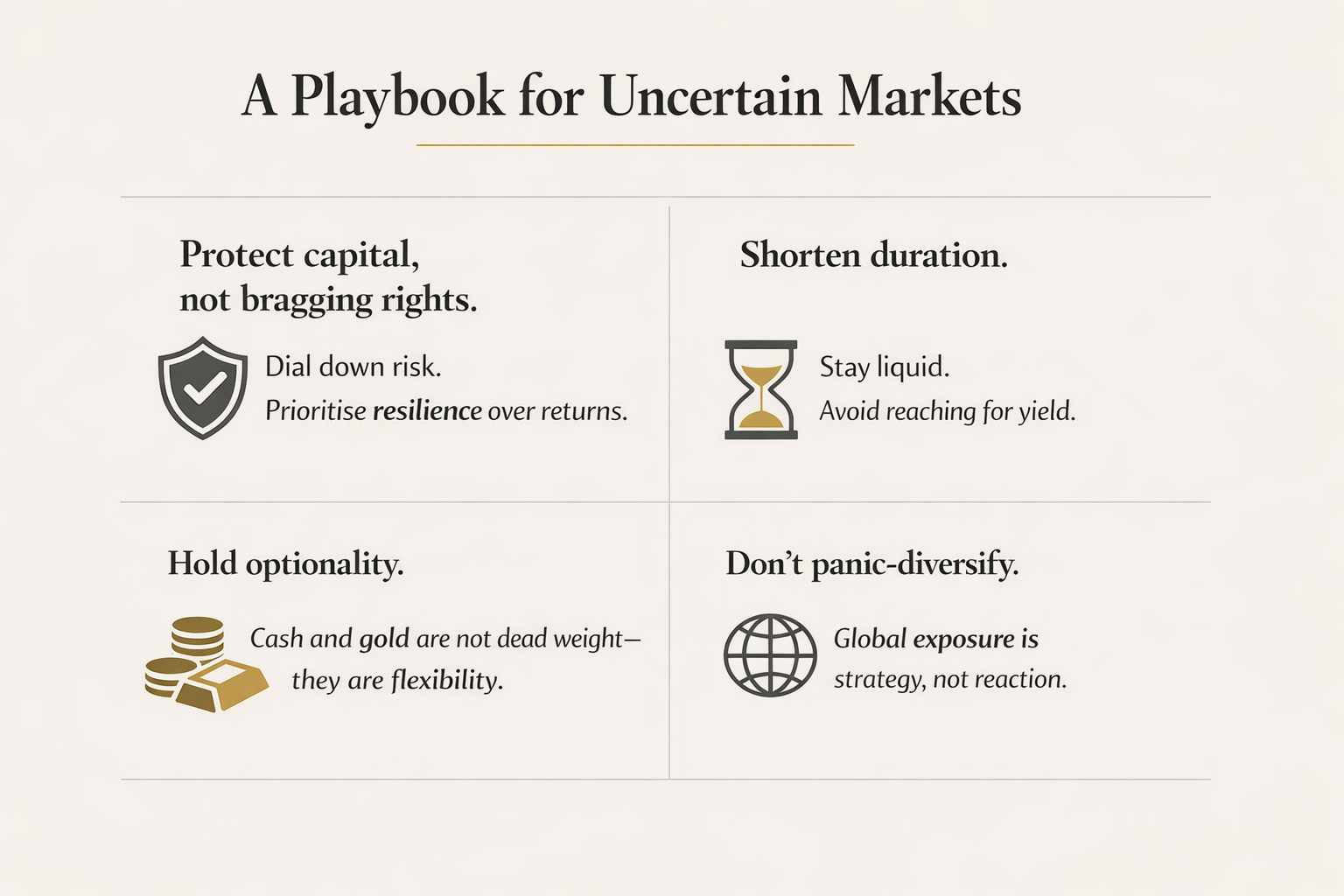
- Protect capital, not bragging rights. In this phase, survival matters more than “beating the market”. Reduce exposure to high-beta cyclicals and richly valued midcaps. Shift towards stronger balance sheets, defence, select pharma, and essential consumption.
- Shorten duration, raise resilience. On the fixed-income side, shorter-duration debt and high-quality credit become more attractive as rate and inflation uncertainty rise. Avoid stretching for yield in exotic credit.
- Let gold and cash do some heavy lifting. A higher allocation to gold and cash-like instruments is not cowardice—it is sensible. Cash at 20–25%, combined with 15–20% in gold, gives you the flexibility to act when assets are genuinely mispriced.
- Treat overseas diversification as strategy, not escape. If you do not have a well-thought-out global allocation framework, now is not the time to improvise one. The time to build foreign exposure is during relative calm, not while markets are repricing risk.
Underneath all the drama of missiles, oil tankers, and warships, the core message is simple. A war that should have been avoided has exposed how interconnected and fragile the financial system has become—and how concentrated Indian household risk already was.
You cannot change the decisions that led us here. You can, however, refuse to compound them with panicked ones of your own.
Join the conversation
Anindya Dutta
Founder | Two Roads and author
Anindya Dutta is a former banker who spent three decades in Global Markets leadership roles across Mumbai, Hong Kong, Singapore, and London. He now runs Two Roads, a Singapore-based Leadership and Capital Markets Consulting firm. His alter ego is an award-winning author of several books reflecting his twin passions for sport and history.
Beyond the noise is the signal.
FF Insights: Sharpen your edge, Monday–Friday.
FF Life: Culture, ideas and perspectives you won't find elsewhere — Saturday.

Founding Fuel is sustained by readers who value depth, context, and independent thinking.
If this essay helped you think more clearly, you may choose to support our work.

Founding Fuel is sustained by readers who value depth, context, and independent thinking.
If this essay helped you think more clearly, you may choose to support our work.
Loading comments...
More by Anindya Dutta

Readers also liked

·Leadership & Organisation
The Battle Cry in the Boardroom
What looks like motivation—war footage, heroic narratives, calls to crush the competition—is often something else entirely: a system of thinking that rewires how organisations see markets, customers, and themselves
KA

Kavi Arasu
Leadership and Talent Development Professional
The Battle Cry in the Boardroom
What looks like motivation—war footage, heroic narratives, calls to crush the competition—is often something else entirely: a system of thinking that rewires how organisations see markets, customers, and themselves
Leadership and Talent Development Professional

·Economy, Policy & Society
The War in Iran: The Illusion of Decisive Force
One month in, the limits of conventional military power are being laid bare. As a “dual chokehold” on global energy flows emerges, the old security umbrella of the Gulf states is being dismantled. It is forcing a permanent re-pricing of both regional and global risk.
VK

Vivek Y. Kelkar
Researcher, Analyst & Columnist on Geo-economics, Geopolitics and Sustainability
The War in Iran: The Illusion of Decisive Force
One month in, the limits of conventional military power are being laid bare. As a “dual chokehold” on global energy flows emerges, the old security umbrella of the Gulf states is being dismantled. It is forcing a permanent re-pricing of both regional and global risk.
Researcher, Analyst & Columnist on Geo-economics, Geopolitics and Sustainability

·Economy, Policy & Society
The US–Israel War on Iran: The Risks to India’s Strategic Hedging
Energy dependence, remittance flows and trade corridors reveal how deeply India’s economy is tied to stability in West Asia. Part II of a two-part series.
VK
Vivek Y. Kelkar
Researcher, Analyst & Columnist on Geo-economics, Geopolitics and Sustainability
The US–Israel War on Iran: The Risks to India’s Strategic Hedging
Energy dependence, remittance flows and trade corridors reveal how deeply India’s economy is tied to stability in West Asia. Part II of a two-part series.
Researcher, Analyst & Columnist on Geo-economics, Geopolitics and Sustainability
Explore more
Dive into other themes from our network.