
India looks stable. But trust is becoming conditional
A generation of Indians appears to be shifting from inherited faith in institutions to a running audit of their performance. That change could outlast any government—and reshape the risks facing anyone making long-term bets on the country.
7 September 2026· 4 min read
TL;DR
India is witnessing a profound shift in citizen trust, moving from an inherited faith in institutions to a conditional, performance-based audit. This transformation, termed "calculative obedience," signifies that while outward compliance remains, underlying trust is constantly reassessed. The swift rise of the Cockroach Janta Party, galvanising anger over job insecurity and examination irregularities, demonstrated how accumulated grievances can rapidly coalesce around a symbol, forcing political concessions. This incident signals a deeper generational change where governmental legitimacy is no longer assumed but earned. Conventional stability metrics may overlook this subtle yet significant re-evaluation, introducing new, harder-to-measure risks for India's long-term future and anyone making substantial investments in the nation.
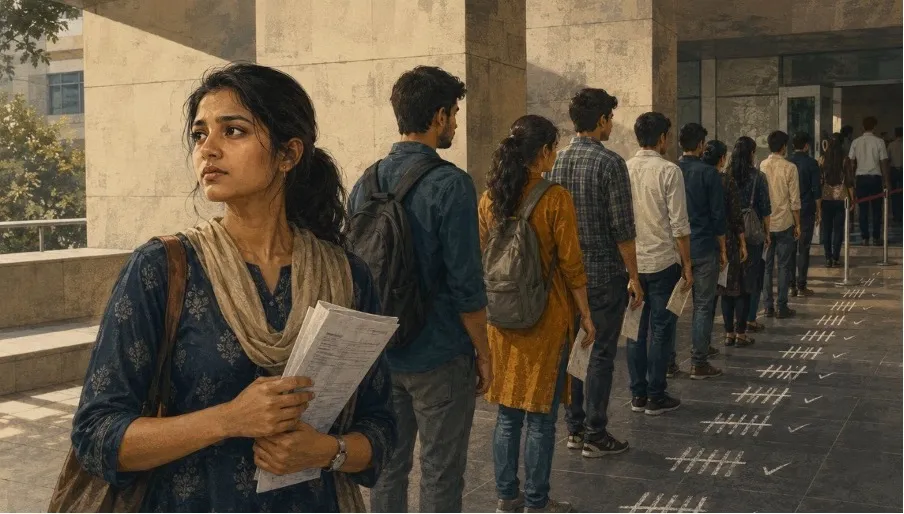
It took ten weeks for a joke to help remove a cabinet minister.
The Cockroach Janta Party (CJP) began as a satirical response after India’s Chief Justice compared a section of unemployed young people to cockroaches and parasites. But it quickly became a rallying point for years of anger over examination irregularities, recruitment delays and the lack of secure jobs. By July, thousands were marching on Parliament. Five days later, Education Minister Dharmendra Pradhan resigned.
The speed of that escalation is striking. Earlier examination scandals had produced no comparable political response. This time, a symbolic insult brought accumulated grievances together—and turned them into a cost the government could not ignore.
The question, therefore, is not simply why India’s young people became angry, or what the episode means for Narendra Modi’s government. It is what had already changed in the relationship between citizens and the state—and whether that change will outlast the government.
Two kinds of obedience
An elected government needs citizens to do more than follow the law. It needs them to accept decisions they may dislike, tolerate occasional failures and continue to believe that the system is worth participating in.
Citizens may accept that authority in two different ways. The first might be called normative obedience.
This is what happens when people broadly accept the system as legitimate. They may dislike a leader or disagree with a policy. Institutions may fail and politicians may disappoint. But these are seen as failures within a system that remains worth trusting.
Such trust can absorb a great deal. A failed examination, a corrupt official or an unpopular decision may cause anger without changing a citizen's underlying relationship with the state.
The other possibility is calculative obedience.
Citizens still obey the law, vote, pay taxes and accept election results. But their trust is no longer automatic. It depends increasingly on what institutions do and is reassessed after every success or failure.
The calculation becomes: I will give the system the benefit of the doubt, but only as long as it continues to earn it.
This change is difficult to see because outward behaviour may remain the same. People continue to participate in the system. But they are also keeping score. When disappointments accumulate, an incident that might once have been treated as an isolated failure can bring many older grievances together.
That is why the CJP episode matters. It does not prove that a wider political shift is underway. But it shows how accumulated grievances can quickly gather around a symbol, mobilise people outside established political organisations and force the state to respond.
The important divide, then, is not simply between Indians who trust the government and those who do not. It is between citizens who broadly assume that the system is legitimate and those for whom that legitimacy has become conditional. Conventional measures of political stability may not capture the difference.
What measures of stability miss
Several measures track the health of India’s democracy. The V-Dem Institute, for example, classifies India as an electoral autocracy and tracks changes in freedom of expression and the space available to opposition and civil society.
Those measures matter, but they answer a different question. V-Dem tracks what is happening to institutions. Election results tell us who won. Economic data tells us how fast the country is growing. None captures the changing relationship between citizens and the system producing those outcomes. A ballot cast out of habit and one cast after careful calculation look identical on a tally sheet.
A ballot cast out of habit and one cast after careful calculation look identical on a tally sheet.
That makes India's political system harder to read than the headline indicators suggest. It may be more resilient than its critics believe and more fragile than its supporters assume. A state can retain considerable capacity even as it loses the trust that allows citizens to absorb failure without acting collectively. It can keep winning elections while more citizens stop giving it the benefit of the doubt. The events of 2026 have made that possibility harder to ignore.
Growth without arrival
CJP did not represent all these young people. Many were not at Jantar Mantar and may never have followed its hashtag. The wider question is whether its success showed others that collective pressure could make the state respond.
India's growth over the past decade has been strong by international standards; this is not a story of national economic decline. What has not kept pace is the creation of secure, formal employment that might justify years spent preparing for examinations. The India Employment Report 2024, published by the International Labour Organization and the Institute for Human Development, found that people aged 15–29 accounted for nearly 83% of India's unemployed population in 2022. The problem was especially acute among educated young people.
Economists call this jobless growth: an economy expands without creating enough of the work its newest entrants need. For a young person who has already experienced a leaked examination paper or a recruitment drive that went nowhere, this is not an abstract policy failure. It can feel like further proof that the system is not working fairly.
What this means for future governments
It is tempting to read this as a story about one government, one Chief Justice’s poor choice of words or one party heading into a difficult election. That would miss the larger possibility.
Citizens do not begin keeping score because of one event. The habit can grow through repeated experiences—in examination halls, job markets and everyday encounters with a state whose delivery falls short of its promises. Nor does it automatically disappear when a government changes.
The next government may therefore inherit young citizens who have learnt that sustained public pressure can move the state. If this is more than a passing expression of anger, future governments will not be able to win cooperation through one successful campaign and then assume it for years. They will have to keep earning it.
Can trust be rebuilt?
None of this means that weakened trust cannot be rebuilt. Visible institutional reform—and a sustained narrowing of the gap between what the state promises and what citizens experience—can begin to restore it. But that takes more than announcing a change of policy or government.
What investors may be missing
Pradhan’s resignation can be read as evidence that the system worked. The government responded, the protesters secured several concessions, CJP ended its sit-in and the system continued.
But the episode also showed how quickly accumulated grievances can become politically costly when people stop treating institutional failure as an exception. The attitudes and organising habits revealed by the movement may outlast the present government.
None of this points to an uprising or supports a narrative of collapse. India’s institutions retain substantial capacity, and its economy continues to grow rapidly by the standards of other large economies.
The question for investors is therefore not simply whether India is stable. It is what kind of stability they are buying—and whether a more conditional relationship with authority will persist under whoever governs next.
Investors already track GDP growth, inflation, fiscal policy, infrastructure spending, election results and India’s growing role in global supply chains. What they are less able to measure is how much institutional failure people will tolerate before they stop giving the system the benefit of the doubt.
When trust becomes conditional, a familiar failure can suddenly trigger a protest, boycott or demand for accountability. The immediate cause may be only the latest entry in a ledger that has been building for years. This does not necessarily destabilise a country. But it can make its politics—and therefore its business environment—less predictable.
India may remain stable for years. But anyone making a decade-long bet on the country should ask more than how stable it looks today. How much of that stability still rests on trust—and how much now rests on a calculation that a new generation has only just learnt it can make?
Join the conversation
Arjo Basu
Systems thinker & technologist | Entrepreneur
Arjo Basu is a systems thinker, technologist, and entrepreneur working at the intersection of narrative, data, and AI. He believes the future of work, and leadership, depends on how well we humanize technology while building structures that can scale trust, clarity, and opportunity.
With over 25 years of experience across data strategy, enterprise architecture, and AI-led product innovation, Arjo has spent his career designing systems that bridge people, platforms, and purpose. His work is guided by a simple belief: systems thinking, when paired with the right technology and a clear narrative, leads to sustained impact.
He founded Moksho, an AI-powered interview intelligence platform reimagining how we hire and how we prepare to be hired through simulated scenarios, sharp feedback, and credibility-building certifications.
He is the co-founder and CTO of stotio, an AI-powered Narrative OS built to help businesses distil strategy into connected and clear growth narratives across moments that shape outcomes be it fundraising, sales, brand evolution, and leadership reviews. stotio blends structured storytelling frameworks with a context-driven intelligence layer, so organizations build narrative consistency across stakeholders and decisions.
Previously, Arjo served as a Principal Data Architect and Strategist for global financial services firms in the United States, where he led high-performance teams across geographies, built enterprise-grade data platforms on Snowflake and Databricks, and created the Data Maturity Framework, now used by multiple organizations to guide scalable, insight-led transformation.
Alongside his technology work, Arjo writes fiction, poetry, and essays that explore identity, memory, and belonging, often mirroring the same questions he engages with in systems and strategy: how structure shapes behaviour, how silence carries meaning, and how humans navigate complexity.
Across technology, narrative, and design, his work reflects a commitment to building systems with structure, clarity and momentum.
Beyond the noise is the signal.
FF Insights: Sharpen your edge, Monday–Friday.
FF Life: Culture, ideas and perspectives you won't find elsewhere — Saturday.

Founding Fuel is sustained by readers who value depth, context, and independent thinking.
If this essay helped you think more clearly, you may choose to support our work.

Founding Fuel is sustained by readers who value depth, context, and independent thinking.
If this essay helped you think more clearly, you may choose to support our work.
Loading comments...


Readers also liked

·Business & Strategy
Why India’s Universities Struggle to Build Great Business Schools
A look at why standalone institutions continue to dominate postgraduate management in India, and what schools of management inside multidisciplinary universities must do if they hope to compete
SV

S. Ramakrishna (Rama) Velamuri
Strategic Growth & Innovation Expert | Visiting Professor
Why India’s Universities Struggle to Build Great Business Schools
A look at why standalone institutions continue to dominate postgraduate management in India, and what schools of management inside multidisciplinary universities must do if they hope to compete
S. Ramakrishna (Rama) Velamuri
Strategic Growth & Innovation Expert | Visiting Professor

·Artificial Intelligence
India’s AI Moment
As major powers turn artificial intelligence towards science and national security, India must widen its AI vision beyond inclusion and productivity
PS

Pankaj Saran
Convenor | NatStrat
India’s AI Moment
As major powers turn artificial intelligence towards science and national security, India must widen its AI vision beyond inclusion and productivity
Convenor | NatStrat

·Artificial Intelligence
India’s AI Gambit: The Choices That Will Define Power
Speed is not strategy. The real battle is over sovereignty, science and state capacity
FF

Founding Fuel
India’s AI Gambit: The Choices That Will Define Power
Speed is not strategy. The real battle is over sovereignty, science and state capacity
Explore more
Dive into other themes from our network.