
Naam, Namak, Nishan, Izzat and Josh: The Human Test of Military Reform
India is changing how its soldiers serve, how its forces are commanded and how wars will be fought. The question is whether these changes will strengthen the military community on which fighting power depends.
9 November 2026· 5 min read
TL;DR
India's military reforms, particularly the Agnipath scheme, are prompting a profound re-evaluation of the Armed Forces' core identity. The article posits that beyond an organisational structure, the military is a living community defined by values like Naam, Namak, Nishan, Izzat, and Josh – reputation, fidelity, colours, honour, and fighting spirit. While Agnipath sought a younger, technologically adept force, its recent revision, extending service for many Agniveers, implicitly acknowledges that youthful enthusiasm ("josh") must mature into seasoned judgment ("hosh"). The true measure of military effectiveness, the piece argues, rests not merely on individual proficiency or budgets, but on the accumulated experience, cultivated relationships, and deep-seated communal bonds that transcend generations and solidify national purpose. The challenge lies in ensuring reforms strengthen this irreplaceable human foundation.
When a soldier hears the war cry of his regiment, he hears more than a call to battle. There are memories of those who served before him, the reputation of the paltan, the expectations of comrades and, often, the pride of a family or village. Yet the same soldier salutes with Jai Hind, an allegiance that transcends regiment, region, religion and service. This coexistence of particular loyalties within a larger national purpose is one of the remarkable achievements of India's Armed Forces, cultivated through training, command, ritual, shared hardship and generations of service.
The old vocabulary of naam, namak, nishan, izzat and josh captures something of this inheritance: reputation, fidelity, the colours, honour and fighting spirit. These are lived commitments, not merely ceremonial expressions. They help explain why the Armed Forces are more than an organisation of ranks, establishments, weapons and budgets. They are a living community, extending through serving personnel, families, veterans and the households from which successive generations enter military service. That community is now being reshaped on several fronts.
The experience a fighting force needs
The Union Cabinet's decision on 4 November to revise Agnipath is the most immediate. Under the original scheme, Agniveers served for four years, after which up to 25% could stay on in the regular cadre and the rest were expected to leave. The remaining 75% will now be offered a further two-year engagement. After this additional engagement, all willing Agniveers who meet the selection criteria will be offered regular enrolment. The government reports encouraging results from the first cohorts, including their fitness, motivation and technological adaptability. The revision creates a pathway to regular service for all eligible Agniveers. The willingness to reconsider a major reform is welcome. But the revision also invites a harder question: what did the original design assume about the time required to turn a recruit into a dependable member of a fighting force?
Agnipath promised a younger military, bringing fresh josh and greater adaptability to new technologies. These are legitimate ambitions. Yet the fighting spirit of a unit is not simply the sum of its members' youthful enthusiasm. Josh must acquire hosh: the judgement, restraint and confidence that come from competence tested in demanding circumstances. Neither belongs exclusively to youth or age. Both must be cultivated together. A young soldier may learn a weapon quickly but take longer to recognise when its use would endanger his comrades. A sailor may master a technical procedure before acquiring the judgement to respond when several systems fail together. The experience of an air-defence crew lies partly in how its members anticipate one another under pressure. Military effectiveness depends upon these accumulated relationships as much as individual proficiency.
The junior commissioned officer (JCO) in an Army unit often carries this continuity across generations of officers and jawans. The Bada Khana, a shared meal where ranks briefly come together in fellowship, expresses a related understanding: command requires authority, but military belonging also requires mutual recognition. Its meaning is tested less at the shared meal than in the everyday treatment of those who serve. None of this establishes that four years is necessarily too short, or six years sufficient. Different military roles have different learning curves. It does establish why retention cannot be considered only as a matter of age profiles, pension liabilities or numbers completing training. The experience that leaves with a departing soldier may be worth more than the cost of replacing that soldier suggests.
An obligation that runs both ways
Namak carries the idea of fidelity to an obligation, but that obligation runs both ways. Military service demands discipline, hardship and the acceptance of extraordinary risk. In return, the institution owes its people fairness, professional development, care and credible commitments to their families. This compact also exists within a wider society where secure employment, predictable livelihoods and opportunities for social mobility are increasingly difficult for many young people to obtain. For numerous military households, the honour of service and the prospect of economic security have never been competing motivations. Changing the terms of service therefore changes not only an individual's career prospects but also the expectations around which families organise their futures. The experience of Agniveers who continue, and of those who eventually leave, will shape how future generations understand that compact.
Bringing military communities together
Yet Agnipath is only one part of the change under way. India is also preparing to reorganise its Armed Forces into integrated theatre commands, intended to employ land, maritime, air and other capabilities together in response to operational requirements rather than through separate service structures that must subsequently be coordinated. This is a profound reorganisation of authority, not merely a new arrangement of headquarters. India's existing military communities have grown within distinct histories and professional cultures. The Army's regiments and formations, the Navy's ships and fleets, and the Air Force's squadrons and commands develop people, maintain standards and sustain professional identity in different ways. Their capabilities must nevertheless be brought together in operations whose success depends on all of them.
The proposed distinction between generating forces—raising, training and sustaining them—and employing them in operations therefore matters. A soldier may acquire his identity, discipline and expertise within an enduring regiment while serving operationally under a joint commander alongside people from other services. The challenge is to preserve the depth of professional formation while creating equally dependable relationships across institutional boundaries. Service loyalties can sustain excellence; they can also defend familiar practices against necessary change. Nor is every inherited tradition worth preserving. Some carry the imprint of colonial recruitment classifications and social hierarchies. India's military history is itself a history of adaptation, including the transformation of inherited regimental loyalties into allegiance to an independent republic.
Theatreisation asks for another such adaptation. It need not erase particular identities, but must make them capable of serving a larger operational purpose.
When expertise crosses rank
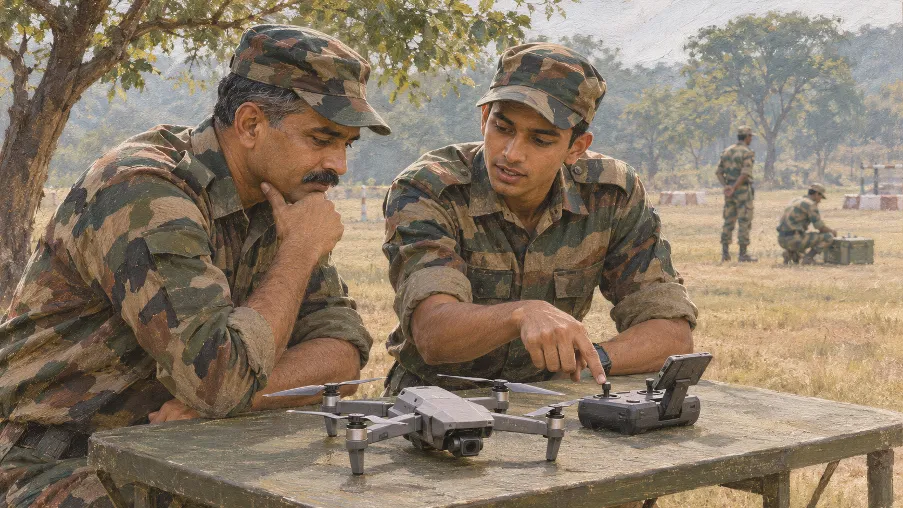
Emerging technologies make the question sharper still. Drones, electronic warfare, artificial intelligence, cyber operations and space-based systems are changing who possesses critical knowledge and how military decisions are made. A young technical specialist may understand a system better than the commander responsible for employing it. The commander, however, must judge its use within a wider operational and political context. This is a test of whether military authority can accommodate informed challenge without losing accountability, and whether technical specialists can exercise initiative without losing sight of collective responsibility. The same relationships will matter within theatre commands, where a decision in one domain may have immediate consequences in another. Trust cannot be created by a new command chart. It must be earned through shared preparation, clear responsibilities and demonstrated competence.
The test of reform
Here, then, is the connection that should concern India's defence leadership. Agnipath changes how long people serve and how experience accumulates. Theatreisation changes the arrangements through which that experience is brought into collective action. Technology changes the expertise required and the distribution of judgement and responsibility. Each reform affects the conditions under which the others can succeed. India could have younger soldiers, more advanced weapons and integrated headquarters, yet discover that the relationships needed to employ them effectively have not kept pace. These reforms could also reinforce one another, combining youthful energy with mature judgement, strong professional identities with genuine jointness, and technological agility with disciplined responsibility.
The difference will not be found in policy declarations alone. It will be revealed in the confidence of a young Agniveer in his comrades and commanders; in whether an experienced soldier can teach without dismissing new knowledge; in whether a specialist can speak candidly across rank and service; and in whether the institution honours its obligations when a person's service ends. The military's moral inheritance is not an inexhaustible reserve on which reformers can draw without replenishment. Izzat must be earned, namak honoured, and josh sustained by competence and trust.
The November decision offers India an opportunity to examine more than the future of Agniveers. It raises a question about the future of the Armed Forces themselves: are we redesigning recruitment, command and technology as separate reforms, or are we consciously building the fighting community that must make them work together? That is the human test of military reform and, ultimately, an operational one.
Join the conversation
Satish Pradhan
Independent Consultant
Satish Pradhan is an independent consultant.
He was on the Governing Council of Tata institute of Social Sciences and the board of Bombay Natural History Society and the Advisory Board of the School of Vocational studies at TISS. He was an Adjunct Faculty at TISS Tuljapur.
He Co-Chaired a Global HR Innovation Network with Walt Cleaver, and has been the Convener of the Social Innovation Conference of Pune International Centre.
He was Advisor to the Tata group from May 2013 till January 2015. He retired as Chief Group Human Resources, Tata Sons in May 2013. At Tata Sons he headed the Tata group HR function. In the preceding twelve years, he built on the legacy of the two (50-year-old) institutions of TAS (Tata Administrative Services) and TMTC (Tata Management Training Centre) and created a unique HR function in the group. Prior to joining the group in April 2001, he was with ICI Plc in London at their Head Office as Organisation Design & Development Manager (Group Human Resources).
He has a Masters in History from Delhi University and is a Chartered Fellow of the Chartered Institute of Personnel Development (UK) (equivalent to a PhD).
He has worked in Public Sector and Private Sector companies. During the last 40 years he has worked with Steel Authority of India Ltd, CMC Ltd, ICI India Ltd, Brooke Bond Lipton India Ltd (now Unilever India), ICI Plc. in various leadership roles.
He was on the Boards of the National Payments Corporation of India and Tal Manufacturing Solutions Limited till 2020, and on the Boards of Tata Autocomp Systems Ltd, , TGY Batteries , Tata Services Limited, Computational Research Laboratories and on the Strategic Advisory Board of IIT Roorkee, amongst others.
He has been a speaker and advisor in addition to being the recipient of many awards and honorary Doctorate.
Leadership , Board advisory, CEO coaching, organisation strategy and design are his areas of interest. Conservation and community are the other two spaces he has passionately worked in. He is a founder of The Leadership Centre and the Shrusti Conservation Foundation.
Beyond the noise is the signal.
FF Insights: Sharpen your edge, Monday–Friday.
FF Life: Culture, ideas and perspectives you won't find elsewhere — Saturday.

Founding Fuel is sustained by readers who value depth, context, and independent thinking.
If this essay helped you think more clearly, you may choose to support our work.

Founding Fuel is sustained by readers who value depth, context, and independent thinking.
If this essay helped you think more clearly, you may choose to support our work.
Loading comments...




Readers also liked

·Entrepreneurship, Startups & Innovation
FF Daily #365: What an entrepreneur needs to survive
May 5, 2021: How to increase the power of your voice; Statistics and stories; Music for the day: Naham janami
FF

Founding Fuel
FF Daily #365: What an entrepreneur needs to survive
May 5, 2021: How to increase the power of your voice; Statistics and stories; Music for the day: Naham janami

·Economy, Policy & Society
FF Daily #348: Reviewing what matters, until now
April 15, 2021: Organizational designers; What next for the J&J vaccine; The naan clock
FF
Founding Fuel
FF Daily #348: Reviewing what matters, until now
April 15, 2021: Organizational designers; What next for the J&J vaccine; The naan clock
Explore more
Dive into other themes from our network.