

·FF Life
The Happiness We Keep Postponing
A reflection on joy, and why the ordinary day may be enough
HC

Haresh Chawla
Investor | Entrepreneur
Many try to fix health with separate diets or willpower. A better way is to design the kitchen itself, so the easiest choice is also the healthy one—for everyone in the family.
I met him at the gym, not the clinic. Over fifty, strong, disciplined — shows up on schedule, lifts real weight — and still can't shift the fat sitting around his abdomen/gut, the visceral fat pouch that doesn't care how many sets you do. We got talking between reps, the way you do, and somewhere in that conversation he stopped talking about himself. His wife eats well most days, he said, then loses a whole weekend to a binge she can't explain. One daughter has always eaten sensibly and still hasn't shed the weight she gained in the pandemic. The other is lean, lives on packaged food, and has never once had to think about any of this. Could I speak to all of them?
I told him no. Not like that. Hand a family four different diet plans and it collapses within a week — someone always ends up cooking for someone else's plan by accident. You don't fix four people separately. You fix the one kitchen they all eat out of.
We spend years choosing the right doctor, the right gym, the right diet plan — and almost no time on the room that shapes health more than all three combined. As a clinical nutritionist treating liver, metabolic, muscle, and gut health every day, I've landed on one belief: the kitchen doesn't just cook food. It decides your health, meal after meal, long before anything reaches the table. That is where I started with this family.
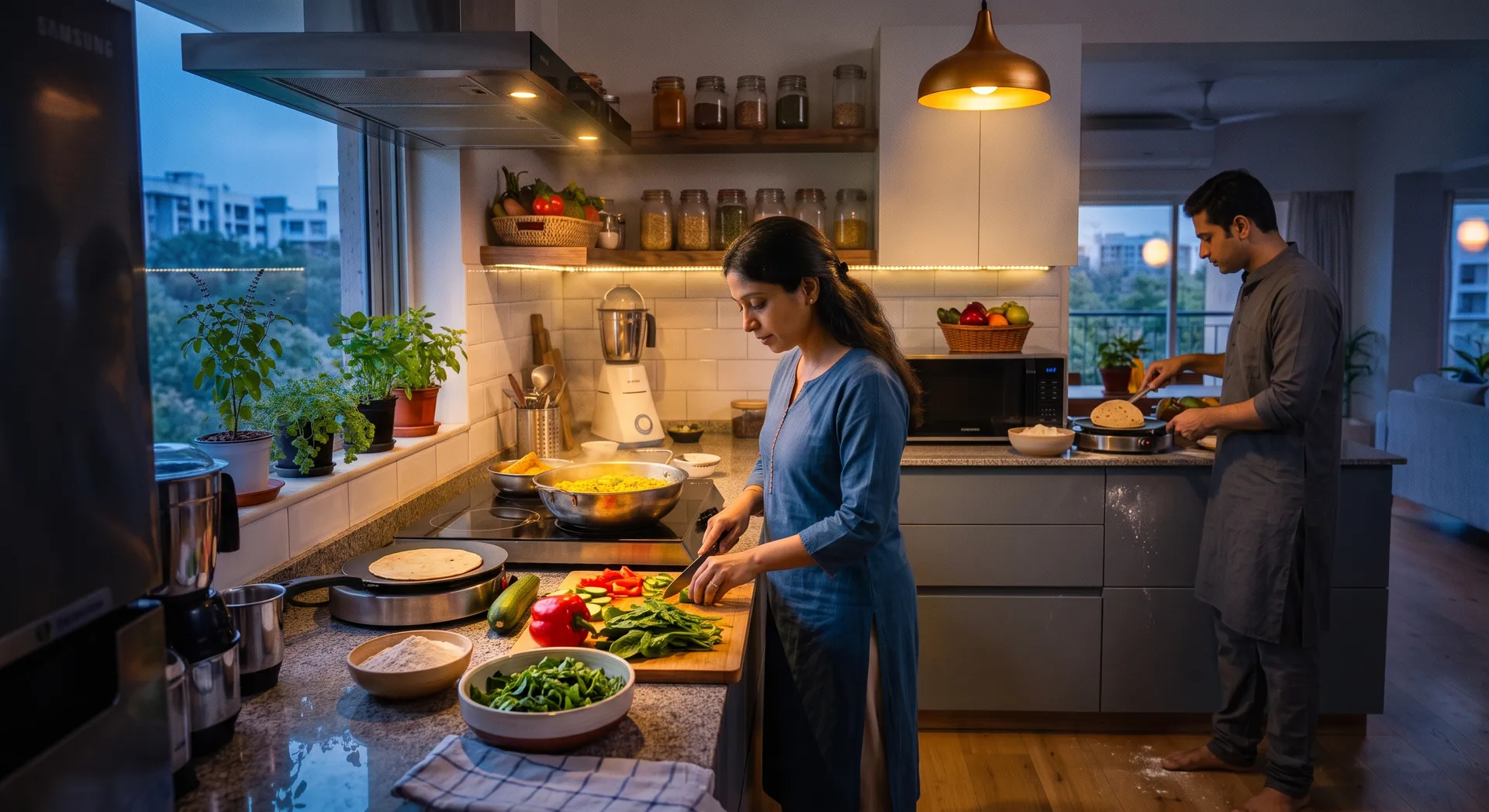
None of them needed a renovation. They needed a different relationship with the same four walls — how the kitchen was stocked, arranged, and used. Here is how we rebuilt it, shelf by shelf, starting at the door and ending at the table.
What you see first is what you eat first. Full stop. Keep fruit, nuts, and cut vegetables at eye level — both in the fridge and on the counter. Bury the biscuits and chips at the back of the highest shelf, out of sight, out of reach. This isn't willpower. It's kitchen architecture. Most snacking decisions get made in under ten seconds, before your brain even asks permission. For the mother in this family, this one shift did more than any lecture on discipline ever could: her binges were never decided in the moment. They were decided hours earlier, by whatever was easiest to grab.
Muscle is the most underrated organ in the body — and it isn't built in the gym. It's built and preserved by protein, at every meal, not just dinner. Stock lentils, chickpeas, paneer, eggs, yoghurt, and lean poultry or fish as your defaults, and ask one blunt question at every meal: what's the protein source here, in one word? Can't answer it?
The gym gets you halfway. The kitchen finishes the job.
The meal is carb-heavy and protein-poor — a pattern I see constantly in patients headed toward sarcopenia, the age-related muscle loss nobody talks about. It's exactly what was missing from the father's plate: all that training, none of the protein to match it. That's how a fit man still carries visceral fat. The gym gets you halfway. The kitchen finishes the job.
No single oil gives you a complete fatty-acid profile — which is exactly why the ICMR-NIN Dietary Guidelines for Indians say rotate two or three, don't commit to one for life. Keep a mustard, sesame, or groundnut oil for daily tempering, a rice bran or sunflower for occasional use, and treat ghee as a flourish, not a base. Pour from a small, clearly marked bottle — never straight from the tin — and never reuse oil that's already hit a high smoking point; repeated heating breaks it down into compounds linked to inflammation and heart disease.
Millets deserve the same loyalty test. Keep jowar, bajra, ragi, and foxtail millet flours in rotation with your regular atta, and stop eating the same wheat roti and white rice at every single meal. Millets carry more fibre and a gentler effect on blood sugar than refined wheat or polished rice — which matters enormously if you're managing insulin resistance, fatty liver, or diabetes. Variety across grains isn't a preference. It's protection, and it sits at the core of the ICMR-NIN guidelines.
Even the vessel is doing work you don't notice. Stainless steel is still the safest daily choice — inert, durable, no drama. Cast iron and earthen pots deserve a comeback for slow-cooked dals and curries: they cook gently and hold flavour the way steel never will. Retire non-stick the moment the coating scratches — a damaged surface leaches into food — and never cook or store anything acidic in aluminium or uncoated brass.
Your gut runs more of your body than you'd like to admit — immunity, metabolism, even mood, all steered by the trillions of bacteria living in your intestines. Feed them before you feed yourself: whole fruit with the skin on, a real rotation of vegetables, whole grains and millets, and at least one fermented food in the house at all times — curd, kanji, idli or dosa batter, pickles made without a sugar crutch. This was the one shelf every person in this family needed equally, whatever their individual goal.
Your gut runs more of your body than you'd like to admit — immunity, metabolism, even mood, all steered by the trillions of bacteria living in your intestines.
Then hydrate like you mean it. Thirst gets mistaken for hunger more often than anyone admits, and mild dehydration hides in people who feel completely fine. Keep a jug of water — cucumber, mint, or lemon thrown in — visible and within arm's reach all day. A water bottle you can see is a snack you don't eat.
Plate size decides portion size more than any amount of self-control. Swap the large dinner plates for smaller ones and watch people eat less without ever feeling like they're restricting anything — one of the simplest, most evidence-backed moves a household can make. For the daughter whose weight hasn't budged since the pandemic, this single swap outperformed every food change we tried: she was never eating badly. She was eating off a plate sized for a habit she'd already outgrown.
Speed matters just as much as size. Give the table five screen-free minutes at the start of every meal — that's all it takes for digestion to catch up and the brain to register it's full. Eat in front of a phone, and both signals get missed entirely.
If you're managing weight, fatty liver, prediabetes, or diabetes, this is where good intentions quietly collapse. Deep-fried snacks and sugar-loaded packaged food spike blood glucose and hand you empty calories for nothing in return — treat them as rare exceptions, not daily fillers. Swap in roasted chana, makhana, a small handful of nuts and dry fruit, seasonal fruit, sprouts, or a homemade trail mix — food that travels exactly as easily as a packet of chips, but works with your metabolism instead of against it. This was the hardest sell in the house: the daughter's entire diet ran on packaged snacks. But a tiffin that's just as fast as junk food is a trade she was actually willing to make.
That question, asked fresh every evening, is how takeout wins. Kill it with a one-page weekly planner stuck to the fridge door — it wipes out the daily decision fatigue that so often ends in fried food or a delivery app. Rotate grains and proteins through the week instead of repeating one pattern on loop; the template below is a starting point, built to be adapted to your own house. Click here to access the template.
Shop with two clear zones in mind—perishables for the fridge and staples for the dry pantry. Structuring your kitchen around these distinct purchase cycles streamlines meal planning, cuts down on food waste, and naturally guides you toward whole grains, millets, and healthy fats over processed convenience foods. A weekly 7-day schedule keeps short-shelf-life produce, dairy, and proteins fresh and nutrient-dense. Meanwhile, bulk restocking shelf-stable grains, pulses, cold-pressed oils, and nuts every 1 to 3 months ensures a fully stocked foundation without constant grocery runs.
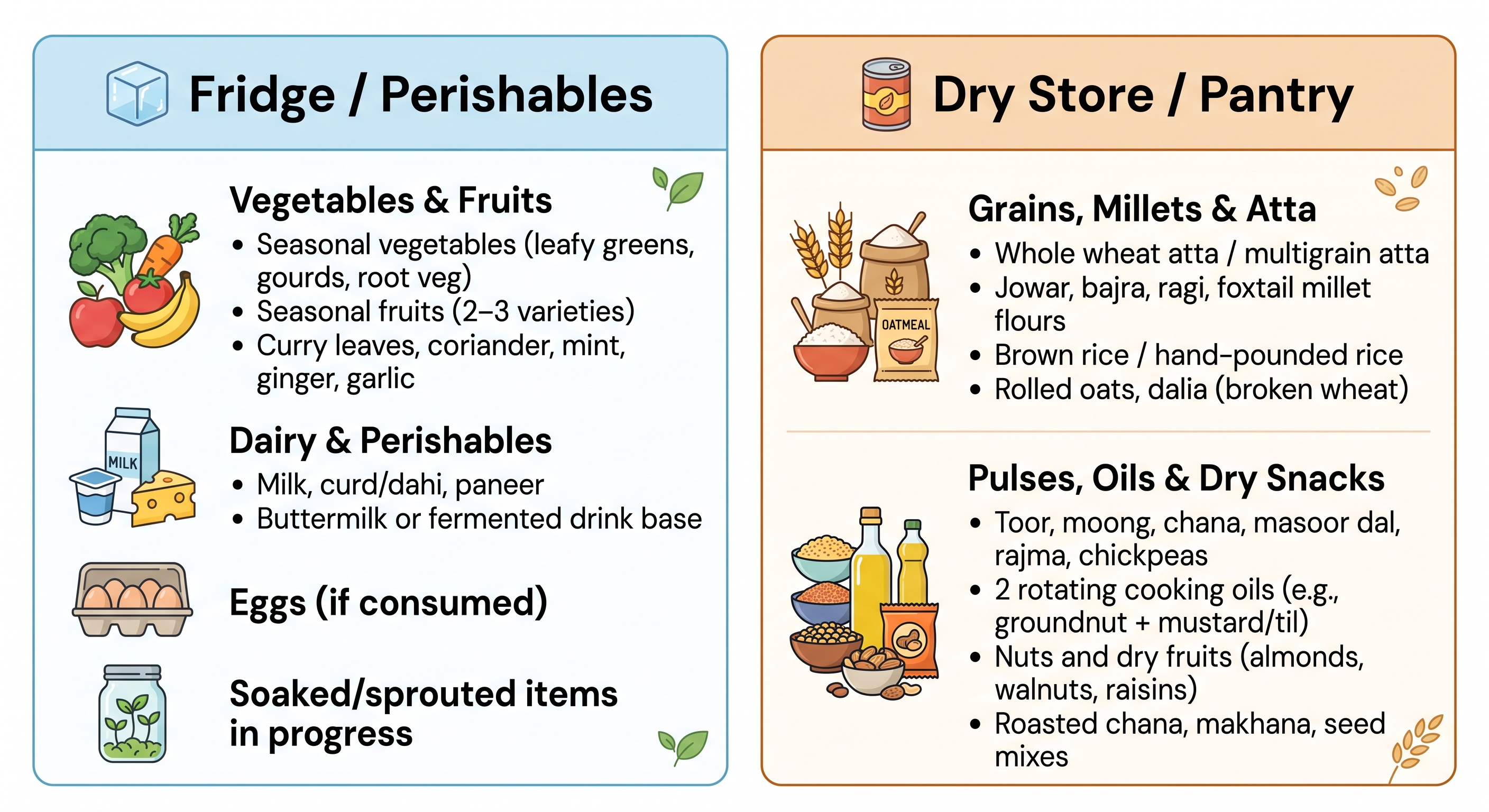
Put the actual weekly plan in front of them, and the reaction was instant: they couldn't live off this. Too boring, someone said, staring at the same roti-dal-sabzi shape repeating down the page—and looking at it cold, they weren’t wrong to worry. Here's what I told them, and what I'm telling you: no plan survives that isn't allowed to bend. What matters is the shelf it comes from, not the exact dish on a Tuesday. Healthy food doesn't have to be bland or repetitive; with a little time, experimentation, and understanding, nutritious ingredients can easily be turned into rich, varied, and genuinely delicious meals.
The real changes were smaller and stranger than I expected. Nobody announced a transformation. One of them just quietly started eating off a smaller plate—no comment, no fuss—until someone else noticed and asked why. The father went further than I ever asked: he built himself a phone prompt that photographs his plate before he eats and estimates the calories on it. Not because I told him to count anything, but because once the kitchen stopped hiding things from him, he wanted to see the rest for himself.
That's what a healed kitchen looks like from the inside. Not a family on a diet. A family that's quietly gotten a little more honest with itself, one plate at a time.
Clinical Nutritionist
FF Insights: Sharpen your edge, Monday–Friday.
FF Life: Culture, ideas and perspectives you won't find elsewhere — Saturday.

Founding Fuel is sustained by readers who value depth, context, and independent thinking.
If this essay helped you think more clearly, you may choose to support our work.

Founding Fuel is sustained by readers who value depth, context, and independent thinking.
If this essay helped you think more clearly, you may choose to support our work.
A reflection on joy, and why the ordinary day may be enough
Haresh Chawla
Investor | Entrepreneur
A reflection on joy, and why the ordinary day may be enough
Investor | Entrepreneur

Disability inclusion, leadership imagination, and the limits of intent


Subhashis Sinha & Nikunj Kumar Jain
Disability inclusion, leadership imagination, and the limits of intent
Subhashis Sinha & Nikunj Kumar Jain

Speed is not strategy. The real battle is over sovereignty, science and state capacity

Founding Fuel
Speed is not strategy. The real battle is over sovereignty, science and state capacity
Dive into other themes from our network.