The Story That Refuses to Die
Christopher Nolan's The Odyssey is more than another adaptation of Homer's epic. It is an invitation to rediscover why one ancient story continues to illuminate the human condition nearly three thousand years after it was first told.
24 July 2026· 6 min read· 2 comments
TL;DR
Christopher Nolan's The Odyssey is presented not merely as an adaptation, but as a profound inquiry into why Homer's epic continually illuminates the human condition across millennia. The article argues that this ancient narrative, rich with timeless questions of identity, memory, and consequence, profoundly aligns with Nolan's recurring cinematic themes, positioning the film as an artistic culmination. Significantly, Nolan's filmmaking process mirrors the epic's spirit of arduous journey and discovery, prioritizing authentic, real-world filming over digital spectacle and embracing uncertainty. This unique approach transforms the retelling into Nolan's personal odyssey, inviting audiences to rediscover the enduring resonance of a story that perpetually calls out to new generations.
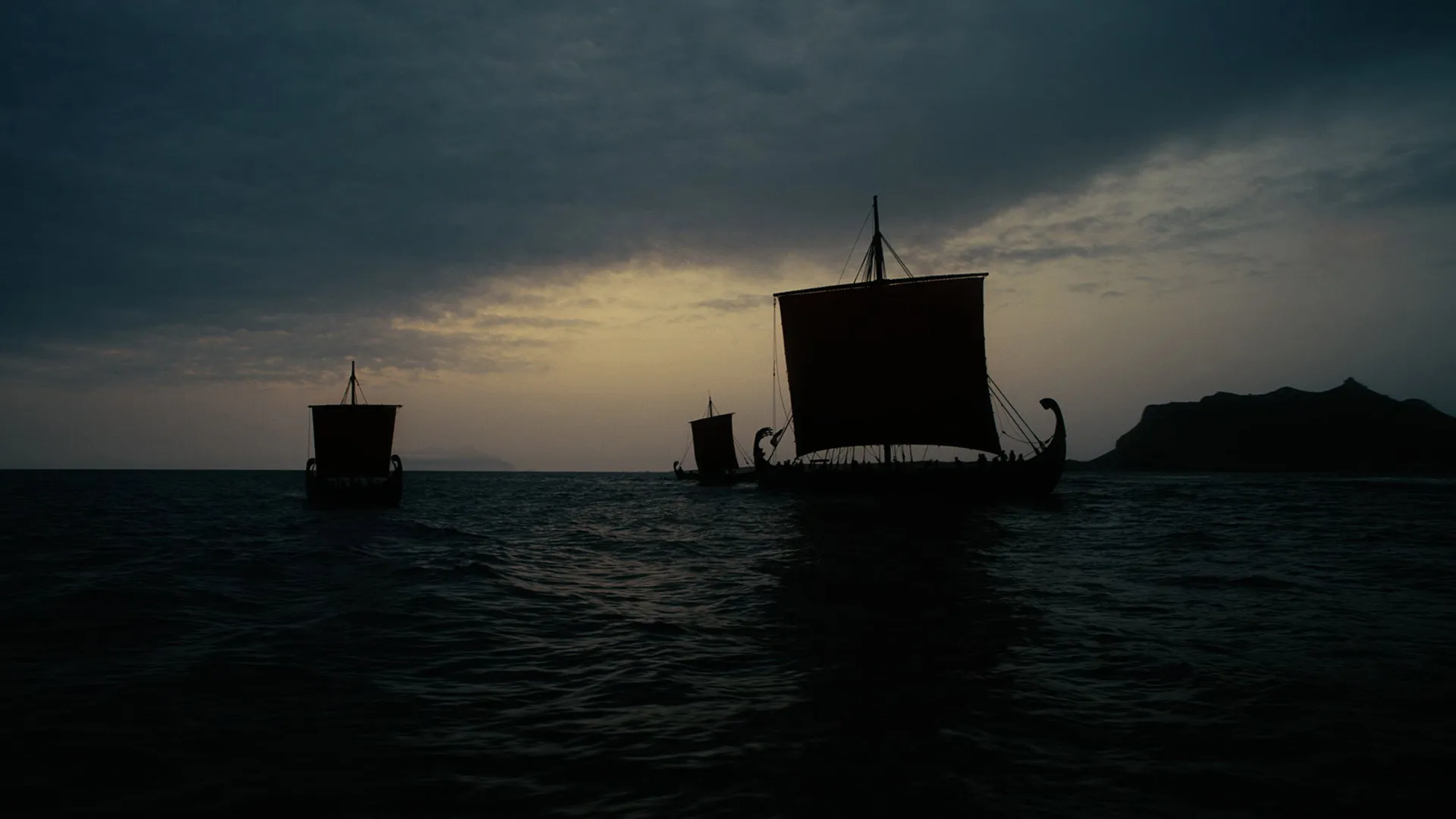
Some stories refuse to remain buried in the past. They return century after century, asking each generation the same fundamental questions in a different language. Homer's Odyssey is one such story. It has travelled across nearly 3,000 years, because humanity has not exhausted its meaning. Every generation returns to it, finding something that speaks to its own anxieties, hopes and aspirations.
The answers are rarely stated outright. They lie beneath the surface of the epic, waiting to be discovered through reflection and experience. Great works of art do not simply tell stories; they invite us to inhabit them, wrestling with the same questions their characters confront. That, perhaps, is why every age discovers its own Odyssey.
Christopher Nolan's encounter with The Odyssey feels almost inevitable. Across his films, he has repeatedly returned to questions of time, memory, identity, choice and consequence—themes that feel unmistakably Homeric. Seen in that light, The Odyssey feels less like a departure than the culmination of a journey he has been making throughout his career.
That may well explain why this ancient story found him when it did. Nolan turns to Emily Wilson’s celebrated translation of Homer.
Instead of revisiting Homer before entering the theatre, I chose to encounter Nolan's film on its own terms. I wanted to travel with Odysseus, but I also wanted to observe another journey unfolding alongside his: Nolan's own odyssey as a filmmaker. How would he interpret this vast, non-linear epic? What would he discover in it that still spoke to our own age?
As the lights dimmed, I realised I was about to watch more than an adaptation of an ancient poem. I was about to witness another artist beginning an odyssey of his own. Whether he succeeded or failed seemed, for the moment, less important than the question that had brought him there in the first place:
Why does this story still call out to us?
Making an Odyssey
If The Odyssey found Christopher Nolan, it also demanded something of him. Homer's epic is not merely a story to be adapted. It is a journey that asks to be undertaken. Looking closely at Nolan's methods, I found myself wondering whether he was trying to make the film in the very spirit of the epic itself.
Rather than relying on digital spectacle, Nolan takes his cast and crew to landscapes that still possess something of the elemental world Homer imagined—windswept coastlines, unforgiving seas and rugged terrain. The actors live with discomfort rather than perform it. They climb to remote locations, endure rough weather, squeeze into the belly of the Trojan Horse and spend long days on open water. Nolan is there with them, sharing the same conditions. The objective is not hardship for its own sake, but authenticity: a belief that some experiences cannot simply be simulated because they leave a different imprint on those who undertake them.
Anne Hathaway has spoken of discovering Penelope not as an icon of patient virtue, but as a woman fighting for her life. Matt Damon has recalled asking Nolan how he intended to shoot a particularly complex sequence. Nolan's answer was disarmingly simple: "I don't know."
The remark stayed with me because it seemed to reveal something larger about the way Nolan works. For him, the process is not merely a means to an end; it is where the work discovers itself. Many filmmakers arrive on set with answers. Nolan seems willing to arrive with questions, trusting that the journey of making the film will reveal possibilities he cannot entirely foresee.
That, perhaps, is what makes his approach feel unexpectedly Homeric. Odysseus never knows what awaits him beyond the next horizon. Every island changes him in ways he could not have anticipated, and every encounter leaves him a little wiser than before. Nolan seems to approach filmmaking with a similar openness. His commitment to real locations, practical effects and physical endurance is not simply an aesthetic preference; it reflects a deeper faith that some journeys cannot be shortened without diminishing the person who undertakes them.
Once I began looking at the film through that lens, the production stories stopped feeling like behind-the-scenes anecdotes. They became expressions of a larger conviction about artistic creation. Perhaps great works of art are discovered through the process of making rather than designed entirely in advance. Homer seems to suggest that about Odysseus. Nolan appears to believe it about cinema. Watching the film, I found it difficult to separate the artist from the journey he had chosen to undertake.
Every Island Is a Classroom
Both for Homer and for Nolan, the journey is never merely physical. It is inward. Every island that Odysseus reaches appears, at first, to delay his voyage home. Yet looking back, it becomes clear that this was never their real purpose. Each encounter compels him to confront a different aspect of himself. Each strips away another illusion. The voyage across the sea is, in truth, a voyage into character.
Wisdom, Homer seems to suggest, begins with recognising the limits of one's own will before it is put to the test.
The episode of the Sirens is often remembered as a story about irresistible temptation. Yet Homer is asking a subtler question. Odysseus understands that courage alone will not save him. He knows that, when temptation arrives, he may no longer be able to trust his own judgement. So he prepares for that moment in advance. His sailors stop their ears with wax; he asks to be tied to the mast and orders them not to release him, however desperately he pleads. The episode becomes less a lesson in resisting temptation than in understanding oneself. Wisdom, Homer seems to suggest, begins with recognising the limits of one's own will before it is put to the test.
The encounter with the Cyclops asks a very different question. Trapped inside the cave, Odysseus survives not because he is stronger than the monster but because he is more resourceful. Yet having escaped, he cannot resist shouting back his name. It is a fleeting moment of triumph that immediately becomes a moment of loss, for it invites Poseidon's wrath and prolongs his suffering. Homer seems to understand something that feels as relevant today as it must have been 3,000 years ago: the hardest temptation is often not power itself, but the desire to be recognised. Odysseus escapes the Cyclops, only to be undone, for a while, by his own ego.
The longest and perhaps most poignant lesson comes with Calypso. She offers Odysseus everything that most people might spend a lifetime pursuing: comfort, safety, love and even immortality. There is no struggle here, no uncertainty, no hardship. Time itself seems to lose its urgency. Yet it is precisely this life without friction that leaves him restless. When he finally tells Calypso, “I feel someone is waiting for me,” he is not merely expressing a longing for Ithaca. He is recognising that purpose cannot exist without responsibility. Homer gently suggests that comfort, however seductive, can never substitute for a life that asks something of us.
Seen together, the islands begin to look less like destinations than stages in an education of character. Each encounter teaches Odysseus something he does not yet know about himself, leaving him a little humbler, a little wiser and a little better prepared for the journey ahead. By the time he finally reaches Ithaca, he has travelled much further than the distance between Troy and home. He has become the kind of man who can recognise what home truly means.
The Long Journey Home
Home is one of the simplest words in any language. Yet Homer spends twenty years teaching us that it is also one of the most difficult. Odysseus’ story is not simply about reaching Ithaca. It is about becoming the man who can finally return to it.
Homecoming, Homer suggests, is never simply about returning to a place. It is about discovering whether the place, and the person returning to it, still recognise each other.
By the time he reaches home, the journey has changed everyone. Penelope has travelled no less than Odysseus, though hers has been a quieter odyssey—one measured not in storms or distant islands, but in patience, judgement and endurance. Twenty years of waiting have demanded a different kind of courage, transforming her as surely as hardship has transformed her husband.
Perhaps that is why Odysseus does not immediately reveal himself. Before stepping back into his old life, he needs to know not only whether Penelope will recognise him, but whether he still belongs in the world he left behind. Homecoming, Homer suggests, is never simply about returning to a place. It is about discovering whether the place, and the person returning to it, still recognise each other.
When Penelope finally recognises him, the reunion is moving not because a long separation has ended, but because two people who have travelled very different roads find one another again. Neither is the person they once were. Home, too, has changed. It is no longer simply Ithaca; it is the fragile recognition that survives change, distance and time.
We often imagine that the destination gives meaning to the journey. Homer quietly suggests the opposite: the journey gives meaning to the destination. Ithaca matters not because it is where Odysseus' travels end, but because it is where the long education of his character finally reveals itself. Homecoming is meaningful not because he has returned to the place he left behind, but because he returns as someone transformed by the journey.
Coda: To Strive, To Seek, To Find...
As the film ended, I found myself thinking less about Nolan than about the questions Homer had carried across nearly 3,000 years.
What is worth striving for? What gives life meaning? How do we prepare ourselves for temptation? And what kind of person do we become through the journeys we undertake?
Nolan's film is one generation's response to those questions. It will not be the last. Long after this adaptation has taken its place alongside countless others, another artist will return to Homer, drawn by the same mystery that has kept The Odyssey alive.
Perhaps that is the secret of the epic's enduring life. Its monsters, islands and storms have never really been the point. They are simply the landscape through which Homer explores what it means to become more fully human. Some stories survive because they refuse to leave us unchanged. The Odyssey is one of them.
It is perhaps for that reason that Tennyson's words continue to resonate—not as the closing lines of another poet's meditation on Odysseus, but as an invitation to each of us:
To strive, to seek, to find, and not to yield.
Carry These Questions With You
- What does success cost when recognition becomes more important than wisdom?
- How do we prepare for temptation rather than merely resist it?
- What gives life meaning beyond comfort?
- What does it mean to return home transformed?
- Why do some journeys change us while others merely take us elsewhere?
Dig Deeper
- Watch Christopher Nolan On The Odyssey, IMAX & A Dream He Chased Since 16 | InFocus | THR India (Play Time: 10:30 min)
- Watch The Secret Of The Odyssey - with Christopher Nolan, Matt Damon, Anne Hathaway, Tom Holland & Zendaya | BBC Radio 1 (Play Time: 41:42 mins)
Join the conversation
Uma Narain
Former Founding Dean | School of Liberal Arts, NMIMS University
Uma Narain is a Fulbright fellow, former Founding Dean, School of Liberal Arts, NMIMS University and former Professor, General Management at S.P. Jain Institute of Management & Research.
Currently, she is an independent Consultant, advising universities and schools on New Education policy and Liberal Arts Education.
Uma is an avid reader, a movie buff, a theatre enthusiast, and an enterprising traveller interested in different cultures and people.
Beyond the noise is the signal.
FF Insights: Sharpen your edge, Monday–Friday.
FF Life: Culture, ideas and perspectives you won't find elsewhere — Saturday.

Founding Fuel is sustained by readers who value depth, context, and independent thinking.
If this essay helped you think more clearly, you may choose to support our work.

Founding Fuel is sustained by readers who value depth, context, and independent thinking.
If this essay helped you think more clearly, you may choose to support our work.
Loading comments...


Readers also liked

·Economy, Policy & Society
12 Places That Helped Shape Post-Independence India
They tell the story of modern India’s evolution
FF

Founding Fuel
12 Places That Helped Shape Post-Independence India
They tell the story of modern India’s evolution

·Economy, Policy & Society
NPAs: A problem that refuses to go away
An extract from Rajrishi Singhal’s book, 'Slip, Stitch and Stumble: The Untold Story of India's Financial Sector Reforms'
FF
Founding Fuel
NPAs: A problem that refuses to go away
An extract from Rajrishi Singhal’s book, 'Slip, Stitch and Stumble: The Untold Story of India's Financial Sector Reforms'

·FF Life
FF Life: Story of a love affair
A bicycle that’s built only for me — and the engineering and art behind it
CA

Charles Assisi
Co-founder and Director | Founding Fuel
FF Life: Story of a love affair
A bicycle that’s built only for me — and the engineering and art behind it
Co-founder and Director | Founding Fuel
Explore more
Dive into other themes from our network.