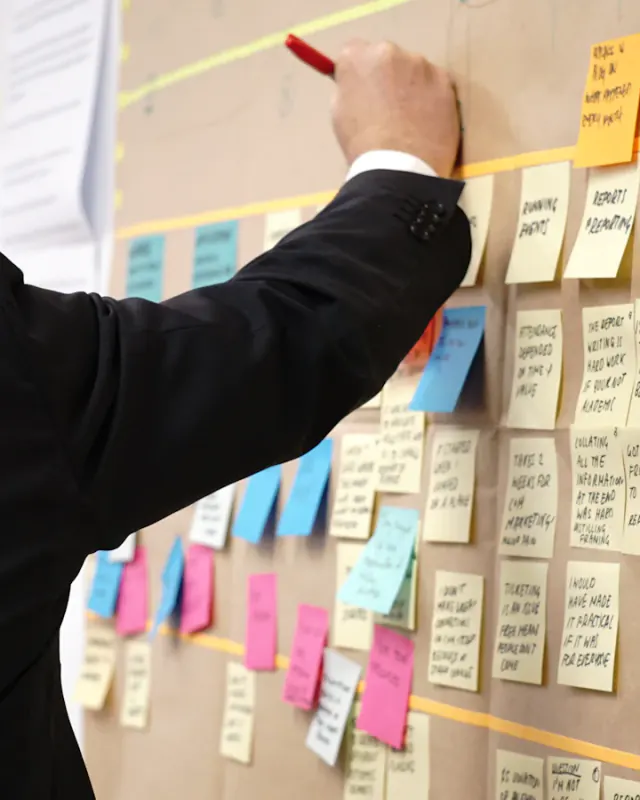
The walls of innovation
It requires sustained effort to move innovation from a poster on the wall to conversation and action in the hall
1 September 2019· 3 min read
TL;DR
Many organizations champion "innovation," yet often struggle to move it from an aspirational value to a lived reality. This article compellingly argues that genuine innovation transcends speeches and training, demanding sustained effort and courageous leadership. It challenges business leaders to scrutinize not just money spent, but the actual time invested and, crucially, the strategic trade-offs made. True commitment is revealed when organizations prioritize long-term potential over immediate pressures, tolerating experimentation and even "failed" attempts. Leaders must actively cultivate a culture that embraces calculated risks and makes difficult choices, demonstrating, rather than merely declaring, innovation's paramount importance by overcoming inertia and embedding it deeply into their operational DNA.

Dear friend,
Innovation is a core value in several organisations I happen to frequent. Now, Innovation is an evergreen value. I mean, who can argue against innovation? It keeps energy alive. It hums of hope and drips promise. Yet, organisations that aim to get innovation woven into their DNA come a cropper. That usually is not for want of intent.
To move innovation from a poster on the wall to conversation and action in the hall, requires sustained effort.
The typical drill organisations go through come from familiar farms. Someone outlines the importance of innovation. CXOs make stellar speeches on the importance of innovation. Many a time, training programmes on innovation are organised and every one wonders why nothing changed at the end of the year.
Sometimes, a project team is formed to work in isolation and to come up with recommendations. For a while, there is action, noise and conversations. The team makes progress and are much in news. Until a pressing problem like a declining quarterly revenue or a quality issue usurps collective attention. And then like a star who fades into retirement, the project team sinks to an obscure corner.
This is a classic case of priorities of the present engulfing important options for the future.
I usually ask a few questions to understand if innovation is truly valued or is a value for value’s sake! First the easy bit. How much money was spent on innovation? Organisations will have a story or two about the projects that the money spent resulted in. The second area of inquiry is estimating how much time got spent on the idea of innovation, by whom and doing what. That usually is a revealing picture.
The third one, the one that we spend time on, is understanding the trade-offs the organisation faced while working on innovation. For example, was an experiment stopped if sales were down in that quarter? At another level, is the organisation willing to make a few mistakes or is it keen on getting it right the first time? How are people who ran failed experiments treated? Does success score over experimentation?
Clues that tell a compelling story emerge from this inquiry. We understand the distance between what is sought to be a way of life and what actually is!
The most sincere intent fades if there’s no courage to make hard trade-offs. Even when the hurdle of courage is crossed, many falter to cross the chasm of established culture, routines and inertia.
Speaking of routines, my colleague Charles Assisi has an interesting piece on routines. He signs off with this line: "But as that saying goes, routine, in an intelligent man, is a sign of ambition." It is a different take and one that must be given time in this age of disruption.
The thing about the age of disruption is that it is becoming quite routine! Every age thinks that it is getting disrupted faster than the one that went before. We need to sift through the cesspool of noise and make sense of the disruption. That is one reason I look forward to NS Ramnath's column. He has never disappointed. I didn't know, for instance, that the commerce on the internet was illegal till 1993! History teaches us many a lesson. Hegel said, “We learn from history that we don’t learn from history.”
And finally, a fantastic conversation between Charles Assisi, Anand Deshpande and Amit Ranjan that brings the importance of ecosystems to the fore. A reality check on the state of entrepreneurship, with a ground up understanding of complexities involved and a sprinkling of optimism.
Innovate we must, as we work our way through critical challenges in complex times. Our work at Founding Fuel puts us front and centre of the emerging narratives on innovation. It is hard, sustained work that innovative organisations put in. In the absence of such work, you are left with the writing on the wall.
Best,
Kavi Arasu
Featured Stories
Growth forces you to take risks that are not always sensible

Ecosystems have consumers with problems, authorities seeking to facilitate resolutions, and entrepreneurs who see growth in attempting to resolve it. An interview with Anand Deshpande and Amit Ranjan. (By Charles Assisi. Read Time: 23 mins; Video play time: 51 mins)
The measured, routine life

Some think all things must be quantified and managed. Others think of it as ridiculous. But the truth has nuances. (By Charles Assisi. Read Time: 2 mins)
The lessons of history

August 30, 2019: A roundup of news and perspectives on disruptive technology from around the world. In this issue: Aadhaar-based eKYC, facial recognition, intuition and rationality, US-China tech war, and platform responsibility. (By N S Ramnath. Read Time: 5 mins)
What We Are Reading
Four ways to create learning culture in your team
What you know is less relevant than what you may learn, and knowing the answer to questions is less critical than having the ability to ask the right questions in the first place.
How to tell if you’re being ‘breadcrumbed’ at work
Whether you’re being strung along in a drawn-out hiring process or your existing employer is leading you on, breadcrumbing gives you “just enough” to keep you on the line.
Here’s what most people get wrong about minimum viable products
What is often missed is that a minimum viable product isn’t merely a stripped down version of a prototype. It is a method to test assumptions and that’s something very different.
From Our Archives
6 life lessons I learnt from the racing track

On track or in organizations, competition is the essential friction that brings forth progress and performance. (By Sanjay Handu)
The power of eight employee experiences

And take a one question diagnostic on how you fare in delivering them. (By Hari Abburi)
Putting psychometrics in perspective

Psychometrics, when used to create awareness and insights about a person’s orientations, is valuable for their development. However, when it is used for assessment it can make selection unreliable. (By K Ramkumar)
Join the conversation
Founding Fuel aims to create the new playbook of entrepreneurship. Think of us as a hub for entrepreneurs- the go-to place for ideas, insights, practices and wisdom essential to build the enterprise of tomorrow. It is co-founded by veteran journalists Indrajit Gupta and Charles Assisi, along with CS Swaminathan, the former president of Pearson's online learning venture.
Beyond the noise is the signal.
FF Insights: Sharpen your edge, Monday–Friday.
FF Life: Culture, ideas and perspectives you won't find elsewhere — Saturday.

Founding Fuel is sustained by readers who value depth, context, and independent thinking.
If this essay helped you think more clearly, you may choose to support our work.

Founding Fuel is sustained by readers who value depth, context, and independent thinking.
If this essay helped you think more clearly, you may choose to support our work.
Loading comments...




Readers also liked

·Entrepreneurship, Startups & Innovation
Trendspotting 2021: Inside India’s Great Digital Reset
A new set of winners and losers are poised to emerge from the ashes of the pandemic. And a wall of foreign capital is pouring in to fund a slew of digital startups. A peek into what 2021 portends
HC

Haresh Chawla
Investor | Entrepreneur
Trendspotting 2021: Inside India’s Great Digital Reset
A new set of winners and losers are poised to emerge from the ashes of the pandemic. And a wall of foreign capital is pouring in to fund a slew of digital startups. A peek into what 2021 portends
Investor | Entrepreneur

·Entrepreneurship, Startups & Innovation
The 33kV Wall
The energy transition is creating a brief opening in one of the hardest industrial sectors to crack. Can a new generation of Indian companies build lasting capabilities before the window closes?
BK

Bharti Krishnan
Founder | Finetrain
The 33kV Wall
The energy transition is creating a brief opening in one of the hardest industrial sectors to crack. Can a new generation of Indian companies build lasting capabilities before the window closes?
Founder | Finetrain

·FF Life
The Happiness We Keep Postponing
A reflection on joy, and why the ordinary day may be enough
HC
Haresh Chawla
Investor | Entrepreneur
The Happiness We Keep Postponing
A reflection on joy, and why the ordinary day may be enough
Investor | Entrepreneur
Explore more
Dive into other themes from our network.