
We Passed the Exam. We Failed the Economy
On how India built its education system faster than it built the economy to absorb it
6 April 2026· 9 min read
TL;DR
A recent report, "The State of Working India 2026," unveils a critical paradox in India's development. Over four decades, India remarkably expanded its education system, producing its most educated generation. Yet, this growth was not mirrored by the creation of productive employment. The result is a persistent graduate unemployment rate of 35-40% for decades, revealing a profound mismatch between educational attainment and economic absorption. This structural challenge jeopardises India's anticipated demographic dividend. While the nation excelled in educating its youth, it fundamentally failed to build an economy capable of fully harnessing their potential.
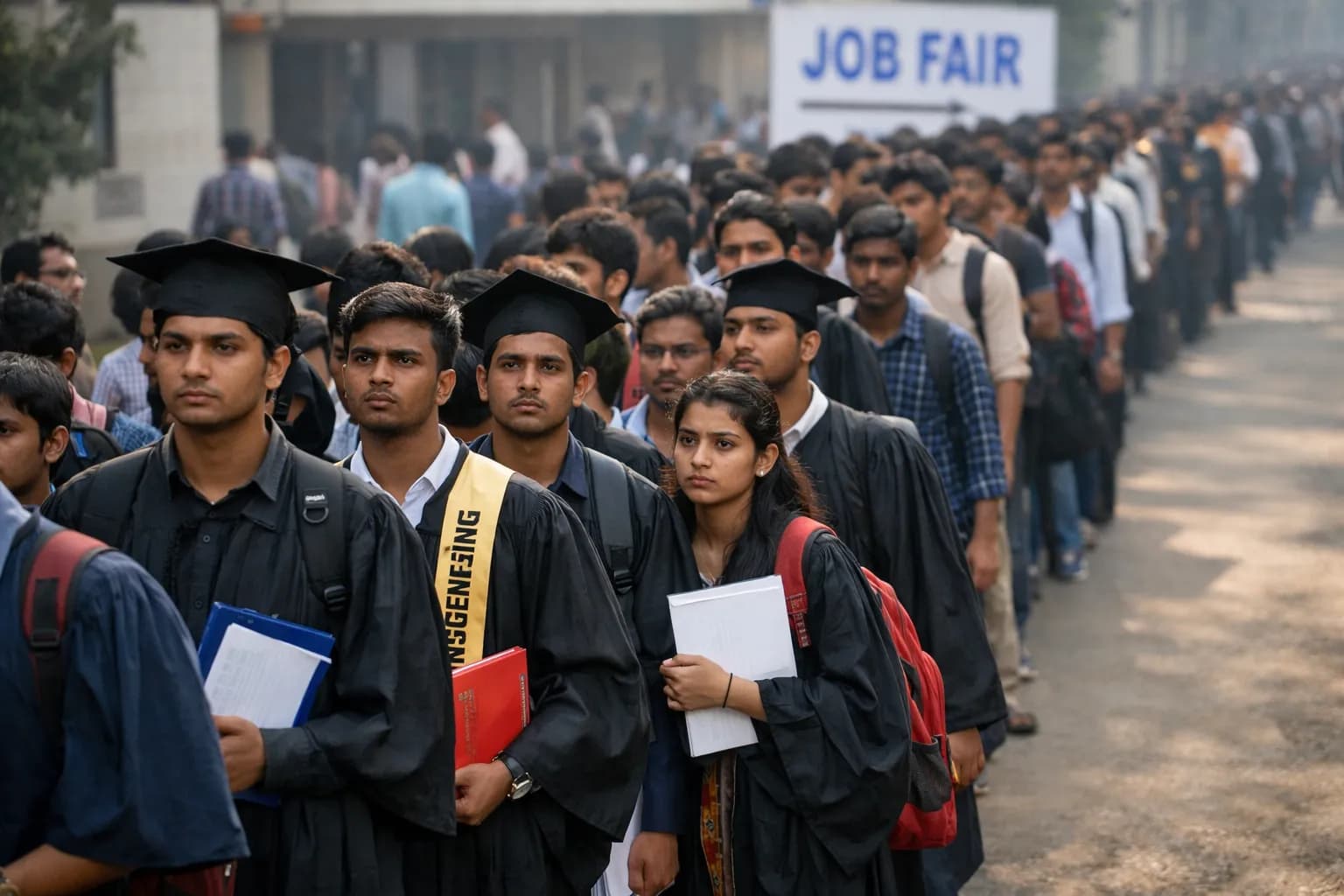
India has spent four decades expanding education. It did not spend those decades building the economy that education was meant to feed.
A report landed earlier this month that deserves more attention than it will get.
The State of Working India 2026, published by Azim Premji University's Centre for Sustainable Employment, is the most comprehensive examination of Indian youth employment produced in recent years. It draws on four decades of official labour data.
It shows that while access to education expanded rapidly, the pathways from education into productive work did not.
India has done this over forty years, through multiple governments and reform cycles, across every ideological shade of economic policy. It has watched the gap between what its universities produce and what the labour market absorbs widen steadily and responded, each time, by building more universities.
This essay is about that gap—the comfortable story we tell ourselves, that demography will eventually do what policy has not. And what it means for the 367 million young Indians who were supposed to deliver that demographic dividend.
If you have read the two earlier essays in this series, you know where the argument has been going. The first, India Cannot App its way to Prosperity, pointed out that we celebrated the wrong growth story for over a decade. Platform capitalism built a dazzling convenience layer for a hundred million people while the middle engine of productive employment sat idle.
The second, The Economy We Have, Not the One We Imagined, unveiled the gap between the economy we imagined and the one we actually have. That the numbers had been obscuring a structural deterioration that the Gulf crisis has finally made impossible to average away.
Of the 367 million Indians aged 15–29, roughly 263 million are already outside the formal education system and form the immediate potential workforce.
India’s demographic dividend will peak around 2030, after which the share of working-age population will begin to decline.
We got the sectors wrong. We got the numbers wrong. And we built the wrong pathway between education and work.
India Passed the Education Test
Let’s begin with what India genuinely achieved, because the achievement is real and it matters.
The report details that between liberalisation and 2023, India expanded its higher education infrastructure at a pace that would have seemed implausible to the generation that built it. The number of institutions grew from 1,644 to 69,534. More than half of it happened in a single decade—between 2000 and 2010, the number of higher education institutions rose by 150%. The private sector led it. Today, eight in ten higher education institutions in India are privately operated.
Among young women aged 15–19, the share staying in education rose from 38% in 1983 to 68% in 2023—one of the quiet revolutions of modern India. The labour market they entered afterwards did not change at the same pace.
This transformation represented millions of families making sacrifices they could barely afford on the belief that education was the primary pathway to a better life. Gender gaps that seemed structural have narrowed. Young Indians today are more educated than any generation before them. The economy they are entering is not ready for them.
The families who funded this expansion did not wait for the state. Professional degrees in medicine and engineering cost more than a poorest quartile household earns in a year, and that gap is only widening. They paid anyway. Begged, borrowed, went without to fund their child’s dream.
It is that belief that the economy has silently betrayed.
Learning, Not Earning
Graduate unemployment among young Indians has stayed solidly stuck between 35% and 40% for 40 consecutive years. Not just during the pandemic. Through liberalisation, through the IT boom, through a decade of the Production Linked Incentive (PLI) schemes and Make in India and every reform that tried structural transformation.
India built the universities. It did not build the economy that was supposed to absorb their output. Youth unemployment is typically higher than overall unemployment globally, but in India the gap is unusually large, with graduate unemployment rates approaching four times the non-youth rate.
In 1983, graduates accounted for about 13% of unemployed youth. By 2023 they accounted for nearly two-thirds. Each year's unabsorbed graduates joined the previous year’s.
When the unemployment rate among graduates remains stuck across four decades, the problem is not the graduate. The problem is not primarily the curriculum, nor easily explained as a skills gap
Forty years is not a mismatch. It is a verdict on the system that was supposed to be waiting at the other end of the bridge.
India built the universities. It did not build the economy that was supposed to absorb them.
The Bridge That Didn’t Connect
Consider the Industrial Training Institutes (ITIs). The institution was specifically designed to bridge this problem.
ITIs were India's solution to the school-to-work gap. Practical, employer-aligned, built to take young people not heading to university and give them a direct pathway into manufacturing and industry. The theory was sound: workers trained for real jobs, in the skills those jobs actually required, placed into the economy without the four-year detour of a degree.
Since 2005, the number of ITIs has grown by nearly 300%—from 3,674 to over 14,000 institutions, 80% of them privately operated. The state expanded the system. The private sector responded to the incentive. On paper, this is the kind of public-private scaling that reformers call for.
The Azim Premji University report found something else.
Quality metrics—pass rates, trade diversity, instructor ratios, employer linkages—deteriorated steadily as the system grew. The newer the institution, the worse it performs. Private ITIs rank below public ones on every quality indicator. The report finds no perceptible association between the location of ITIs and the location of manufacturing firms.
The system expanded at three times its original size without any meaningful alignment with the employers it was supposed to serve.
The metric that determined institutional survival was enrolment. Enrolment could be achieved without proximity to manufacturing clusters, without qualified instructors, without a single employer partnership. It forgot the thing it was built for.
The higher education system ran the same logic at a larger scale.
Nearly 80% of India’s higher education institutions today are privately run. The All India Council for Technical Education (AICTE) norms recommend 15–20 students per teacher. In practice, private colleges average 28 students per teacher and public colleges around 47.
Enrolment expanded. The graduate unemployment band stayed put, exactly where it sat in 1983. The universities were rewarded for throughput. Whether that throughput found employment was nobody's problem, because the system never measured it.
What happened in ITIs is not an exception. It is a pattern.
What the Numbers Actually Say
Each year, roughly 5 million graduates enter the Indian labour market. About 2.8 million find employment. Of those, only around 1.7 million find salaried work. The report states that graduate unemployment remains high—nearly 40% among the 15- to 25-year-olds, and 20% among the 25- to 29-year-olds.
More than two million people every year add to a growing stock of educated, aspirational, underemployed young Indians for whom the family’s investment has not yet found its return.
There are now 11 million unemployed graduates between the ages of 20 and 29—out of a total graduate population of 63 million in that age group.
One in six.
Among unemployed young graduates tracked for a year, only about 7% obtain permanent salaried employment within that period.
These are not children of privilege holding out for the right offer. They are, increasingly, the first generation in their families to hold a degree, the return on a bet placed on the education system that the labour market has declined to honour.
Among young men aged 15 to 24 who have stopped studying, the share citing the need to support household incomes as their reason has risen from 58% in 2017 to 72% in 2023. Nearly three in four young men withdrawing from education are doing so because their families ran out of time and money.
The gap between learning and earning was not eliminated. It was quietly shifted to the households least able to carry it.
When households start shortening the educational pathway because they cannot afford the gap between investment and return, the system has crossed a line that aggregate statistics cannot see. Aspiration has not declined. What has declined is the family's capacity to hold the bridge open long enough for someone to cross it.
The young man who leaves college in his second year to join Zomato or Swiggy and do deliveries is not making an irrational choice. He is making the only rational choice available to a household that cannot absorb one more semester of uncertainty.
Multiply this across the youngest population in the world and you do not have an education problem.
You have a demand problem.
Where the Jobs Actually Went
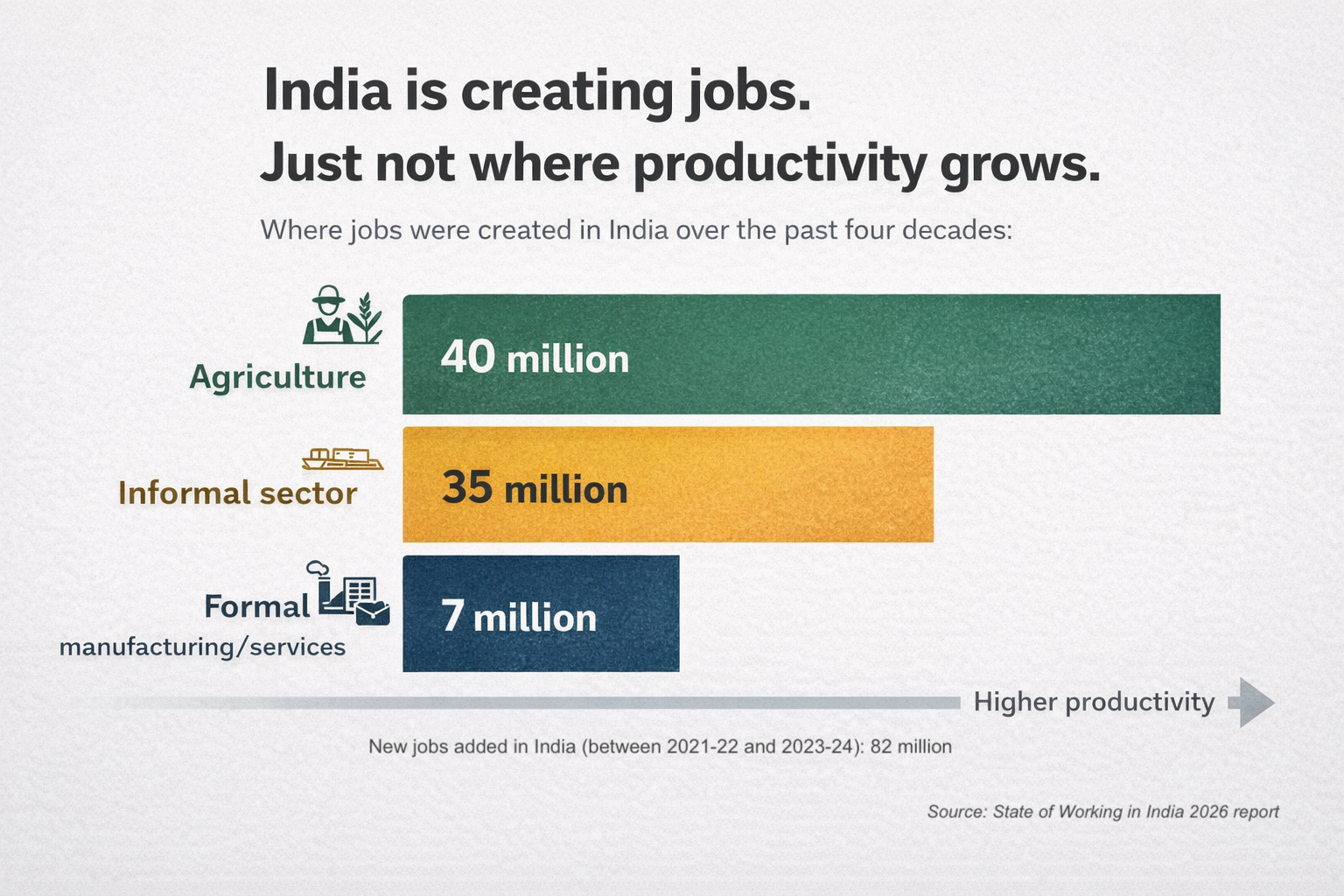
Between 2021-22 and 2023-24, India added roughly 82 million employed people. This is the figure that appears in policy speeches and media commentary as evidence of economic resilience. What the State of Working India report makes clear is that nearly 40 million of those 82 million jobs were added in agriculture. Much of this increase came from women, whose post-pandemic employment gains were concentrated overwhelmingly in rural self-employment, particularly agriculture.
Nearly half of all employment creation in one of the world’s fastest-growing major economies went into farms averaging about 1.1 hectares. At that scale, nothing compounds. The farmer works harder and earns roughly the same.
This falls short of structural transformation. Structural transformation means labour moving from farms to factories. The farm-to-factory transition that lifted East Asia's working poor into the middle class over two generations. That transition requires manufacturing to expand fast enough to pull workers off the land.
The evidence is in the manufacturing numbers themselves. As per a recent Times of India report, estimates from the National Statistical Office’s Annual Survey of Unincorporated Sector Enterprises shows that employment in India’s vast informal manufacturing sector has remained almost unchanged over the past decade. Roughly 3.6 crore workers in 2015–16 and about 3.5 crore in 2025, even as the number of establishments increased. Over the same period, employment in the formal manufacturing sector, tracked through the Annual Survey of Industries, rose from about 1.4 crore to roughly 2 crore workers. The result is not broad-based industrial absorption, but a widening divide between a small formal sector that is growing and a much larger informal sector that is not.
In effect, factories are being added faster than jobs.
In most successful development transitions, informal manufacturing expands first. It is the bridge between farms and factories, accessible to workers without credentials or capital. In India, that bridge has remained largely unchanged for a decade. The farm gate is open. The factory floor is not.
The female labour force participation rate rise has been celebrated. What the headline conceals is what the Azim Premji University data makes clear: the increase is overwhelmingly in low-productivity rural self-employment. Participation is up. Earnings are not. “The number that would actually represent transformation—adult women in formal, salaried, industrial roles—sits below 5%.”
India has the largest female youth cohort on earth, backed by four decades of rising female educational participation. Successive governments identified female workforce integration as an economic imperative, but have managed to bring less than one in twenty adult women into formal salaried employment.
Migration Is Not a Strategy
Migration has become the system's pressure valve.
It has always played this role. As Chinmay Tumbe, a scholar at IIM Ahmedabad, shows, Indian workers have historically moved in large numbers from labour-surplus regions to labour-demand regions—from eastern Uttar Pradesh and Bihar to Punjab’s farms, from tribal belts to industrial Gujarat, and from drought-prone districts to construction sites in growing cities. From younger states to ageing ones. Migration allows the economy to function even when regional development remains deeply uneven.
In a narrow sense, it works. Workers reach employers. Incomes rise relative to rural alternatives. Remittances flow home. Youth constitute roughly 40% of India's informal migrant workforce. Young men and women carry their capabilities to wherever the market will absorb them—because the market has not come to them.
But there is a difference between migration as one option among many and migration as the primary pathway through which young people access work. The first is a sign of a functioning economy. The second is a sign that opportunity is not spreading. It is being chased.
Migration allows labour markets to adjust. It does not allow economies to transform.
An economy that routes its demographic dividend through informal migration networks—young people working without contracts, living without social protection, sending money home to households that needed them to leave in order to survive—is not harnessing its human capital. It is rationing it. The dividend is being collected, one migrant worker at a time, at the lowest possible price.
It would be wrong to say nothing has been attempted. The new labour codes, long delayed in implementation, were designed to make formal hiring easier and employment relationships more flexible, in principle, addressing one of the long-standing frictions between education and employment. But legislation changes the framework within which firms operate. It does not automatically create the demand for labour that converts education into employment. Even among the HR leaders who advocated these reforms for years, there is quiet acknowledgment that employer behaviour has been slower to change than the law itself.
The codes reformed the rulebook. Nobody rewrote the incentive to hire.
The Window Is Narrower Than We Think
The demographic dividend is not a structural gift. It is a time-bound obligation. One that falls due whether or not the economy is ready to honour it.
India has been collecting the headline without paying the bill.
Enrolment numbers look right. Participation rates trend upward. Gross enrolment ratios sit in line with peer economies. These are the metrics that appear in policy speeches and investor decks. They measure what went in. Not what came out.
What came out, for millions of young Indians who could not wait for formal employment to arrive, was the gig economy. This was not incidental. The explosion of delivery platforms and ride-hailing over the past decade was not simply a technology story. It was an absorption mechanism. The economy’s way of parking educated, aspirational young people in flexible, low-protection, piece-rate work while the formal labour market failed to scale. The platforms did not create this pool of available labour. They found it waiting.
The gig economy is counted, in some quarters, as a success of India's digital transformation. In a narrow sense it is—it gave millions of young men an income they would not otherwise have had. But it is income without trajectory. Work without accumulation. A gig worker does not build skills that compound, access credit that grows, or climb a ladder that exists. He earns today and starts again tomorrow. The platform captured the demographic dividend at its cheapest possible price and called it disruption.
The families who funded the education that produced these workers absorbed the remainder privately. Shorter pathways for younger siblings. Earlier entry into whatever work was available. Young men leaving college mid-degree to keep the household afloat. The gap between learning and earning was not eliminated. It was quietly distributed—to the households least able to carry it, in forms that never surface in the aggregate numbers that reassure us everything is broadly on track.
The window is narrowing. After 2030, the working-age population begins to shrink relative to dependents. The arithmetic that makes the demographic story compelling starts working in reverse.
The countries that used their demographic window built industrial capacity first. They brought women into formal employment. They created the consuming middle class that sustains domestic demand. Today they are harvesting those investments.
India is still deferring the bill.
The potential is not in doubt. Three-hundred-and-sixty-seven million young people, the best-educated generation in Indian history, increasingly aware of what the economy has and has not delivered—they are here. The question is whether the systems that are supposed to convert that potential into economic capability can be redesigned before the window closes.
That is not a labour market question. It is not a skilling question. It is a question about institutional accountability. It is about who owns the outcome when the bridge stops halfway across.
That is where the next essay begins.
If you have arrived here without reading the two earlier pieces—on the platform decade that built the wrong growth story, and the GDP numbers that obscured a structural deterioration—that argument is the foundation for what follows here. The case has been building across three essays.
We are no longer asking whether the demographic dividend will arrive. We are asking what we did with it while we had the chance.

Founding Fuel is sustained by readers who value depth, context, and independent thinking.
If this essay helped you think more clearly, you may choose to support our work.

Founding Fuel is sustained by readers who value depth, context, and independent thinking.
If this essay helped you think more clearly, you may choose to support our work.
Join the conversation
Haresh Chawla
Investor | Entrepreneur
Haresh Chawla is an investor, entrepreneur and business builder with over three decades of experience across media, consumer businesses and the digital economy in India.
He currently invests independently in consumer, food and digital businesses, working closely with founders and management teams to help build and scale enduring companies.
He also serves as a visiting faculty at SPJIMR where he teaches a course that lies at the intersection of Digital Transformation and Entrepreneurship.
Previously, Haresh was a Partner at True North (formerly India Value Fund Advisors), one of India’s most respected private equity firms, where he focused on investments in the food and consumer sectors and worked closely with management teams to transform and scale mid-sized businesses.
He is widely recognised for his role in building and transforming the Network18 Group into one of India’s most influential media networks. As Founding CEO, he led Network18 through a period of extraordinary growth, turning it into India’s fastest-growing media and entertainment company. Over a 12-year tenure, he scaled revenues from $3 million in 1999 to over $500 million in 2012.
In his dual leadership roles across Network18 and Viacom18, he helped create a multi-platform media conglomerate reaching more than 300 million households across television, print, film, mobile and digital. Under his leadership, the group expanded from a single TV production business into India’s leading multimedia network with over 11 television channels, including Colors, CNBC-TV18, CNN-IBN, MTV India and Nick India. He also forged landmark partnerships and joint ventures with global media leaders such as NBC (Comcast), CNN, Viacom, Forbes and A&E Networks.
Haresh has been closely associated with India’s consumer internet evolution since its early days and has played a role in building several of the country’s most recognised digital platforms, including Moneycontrol and BookMyShow.
He continues to mentor and invest in emerging consumer and technology ventures.
Earlier in his career, he was part of founding teams at HCL Comnet; ABCL, where he set up the film distribution business; and the Times of India Group, where he launched Times Music.
Haresh holds a Bachelor’s degree in Engineering from IIT Bombay and a Master’s degree in Business Management from IIM Calcutta.
Beyond the noise is the signal.
FF Insights: Sharpen your edge, Monday–Friday.
FF Life: Culture, ideas and perspectives you won't find elsewhere — Saturday.
Loading comments...



Readers also liked

·Economy, Policy & Society
The Economy We Have, Not the One We Imagined
Why the Gulf crisis may be India’s moment for the next phase of reform
HC

Haresh Chawla
Investor | Entrepreneur
The Economy We Have, Not the One We Imagined
Why the Gulf crisis may be India’s moment for the next phase of reform
Investor | Entrepreneur

·FF Life
The Happiness We Keep Postponing
A reflection on joy, and why the ordinary day may be enough
HC
Haresh Chawla
Investor | Entrepreneur
The Happiness We Keep Postponing
A reflection on joy, and why the ordinary day may be enough
Investor | Entrepreneur

·Technology & the Future
When We Stopped Taking Things Apart
How abstraction, AI, and frictionless systems may be reshaping confidence, cognition, and first-principles thinking
AC

Ajay Chacko
Director | Keya Foods International
When We Stopped Taking Things Apart
How abstraction, AI, and frictionless systems may be reshaping confidence, cognition, and first-principles thinking
Director | Keya Foods International
Explore more
Dive into other themes from our network.