Who Builds the Next Bhabha Movement?
Can India build a new compact between the state, science, industry and entrepreneurs?
13 September 2026· 6 min read
TL;DR
India confronts a pivotal challenge: forging a new "Bhabha compact" uniting the state, science, industry, and entrepreneurs to cultivate next-generation strategic technologies. Inspired by Homi Bhabha's historic feat of building comprehensive national capabilities, the article argues for moving beyond an innovation-centric approach suited for globalization. Despite India's robust scientific and entrepreneurial strengths, the evolving geopolitical landscape necessitates a profound shift towards "strategic capability." This ensures self-reliance in developing and sustaining critical technologies—from AI to quantum computing—recognising their escalating role as instruments of national power, not just commercial interests.
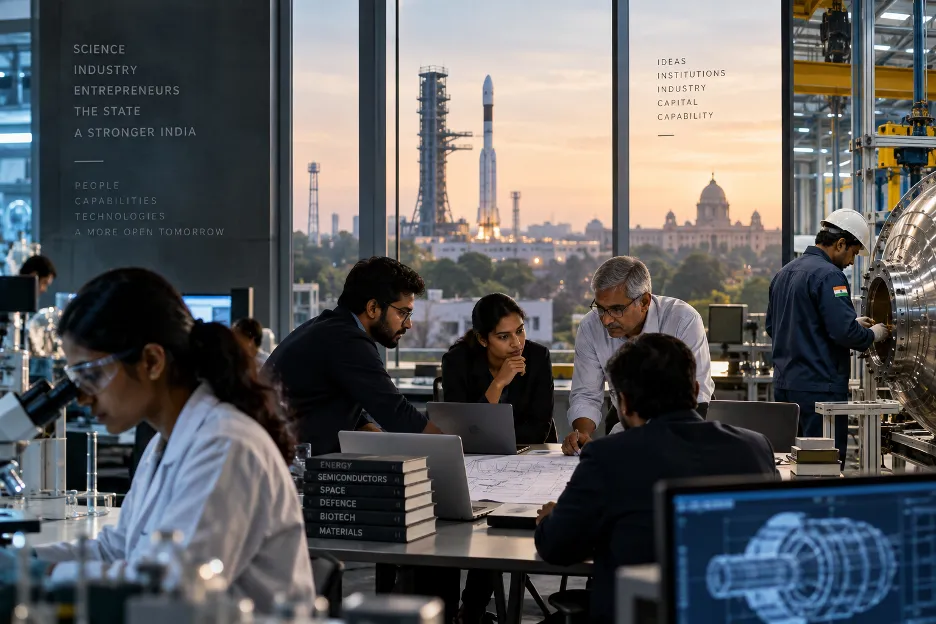
India built an innovation ecosystem in a globalising world. The question now is whether it can build the strategic capabilities it will need for a new geopolitical and technological era.
After Founding Fuel published my story on Copenhagen Atomics and its attempt to reinvent nuclear power, its editor and co-founder Indrajit Gupta asked me a question.
Could we use the nuclear story to ask a much larger one?
Can India build a new compact between the state, science, industry and entrepreneurs to create the next generation of strategic technologies?
The more I have thought about it, the more I think the question isn't simply whether India can. It is what such a compact should seek to accomplish—and what each participant in it might have to do differently.
The obvious historical reference is Homi Bhabha.
Not because we should romanticise the Nehru-Bhabha era, or reopen the familiar argument about whether the state or private enterprise is better at building technology.
But because of what Bhabha actually built.
His great achievement wasn't simply choosing nuclear energy or designing India's three-stage nuclear programme. It was helping create an extraordinary chain of capabilities around a national technological purpose: science, laboratories, engineering, people, industrial capacity, fuel-cycle capabilities, state funding, international partnerships and institutions capable of persisting for decades.
He did this when India possessed remarkably little of the ecosystem required.
India today is much better endowed.
We have a substantial scientific establishment, thanks in great measure to institutions created by Bhabha and his generation. We have globally competitive companies, private capital, extraordinary engineering talent and a flourishing start-up ecosystem. And we have a generation of entrepreneurs willing to enter fields—space, defence, AI, quantum technologies, semiconductors and advanced energy—that not long ago were assumed to belong almost exclusively to governments and giant corporations.
So why would we need another Bhabha compact?
Because the problem has changed.
From innovation to capability
For roughly three decades, India has been quite successful in a world organised around globalisation, expanding trade and relatively easy access to technology.
The dominant language of technology policy consequently became the language of innovation.
Create markets. Encourage entrepreneurship. Liberalise. Bring in private capital. Transfer technology out of government laboratories. Let firms compete. Connect Indian companies to global value chains.
Much of this was necessary. Much of it remains necessary.
But innovation and strategic capability are not quite the same thing.
Innovation is about: Who can develop this faster, cheaper or better? Who can manufacture it more efficiently? Who can commercialise it?
Strategic capability is about: What must India remain capable of doing by itself? Where is dependence acceptable, and where might it constrain our choices? Where does the underlying knowledge reside? Who possesses the people, infrastructure and manufacturing capability? Can India reproduce, adapt and improve the technology if circumstances change?
But innovation and strategic capability are not quite the same thing.
Those questions matter more today because the world around us has changed.
AI, semiconductors, space, defence, quantum technologies, advanced materials, critical minerals, biotechnology and energy are becoming instruments not merely of commerce but of national power. Technologies once traded relatively freely are increasingly subject to export controls, industrial policy, strategic competition and national-security considerations.
At the same time, many of these technologies are converging.
AI depends on semiconductors, data centres and enormous quantities of energy. Quantum technologies depend on exotic materials, precision manufacturing and advanced electronics. Space and defence share propulsion, sensors, materials, communications and computing. Advanced nuclear systems require materials science, manufacturing, chemistry and sophisticated digital control.
We continue to treat these as separate sectors. Increasingly, they are parts of a common technological-industrial system.
That makes the old question—should government or the private sector build it?—almost beside the point.
A more useful question may be:
How do we make the state, science, industry, capital and entrepreneurs parts of a system that continually builds national capability?
An innovation compact—or a capability compact?
There are at least two ways of imagining such a system.
In one, government creates an enabling environment, funds some research, removes barriers, transfers mature technologies to private industry and allows entrepreneurs and capital to discover the opportunities.
Call this an innovation compact.
There is nothing inherently wrong with it.
But strategic technologies require something more: a capability compact.
Government has a role that cannot simply be outsourced. It needs to understand critical technological dependencies, make choices, set long-term missions, maintain capabilities whose value exceeds their immediate commercial return, create enabling infrastructure and become an intelligent, demanding customer.
Science has to do more than produce knowledge. It has to preserve technological depth, train people, sustain long-horizon exploration and create pathways through which knowledge becomes engineering capability.
Industry must bring the ability to turn technologies into manufacturable systems, build supply chains, drive costs down and operate at scale.
Entrepreneurs have to play another role -- challenge inherited assumptions, attack architectures incumbents have learnt to live with, combine technologies in unexpected ways, and sometimes discover that a problem everybody regarded as fundamental was merely a consequence of the way an industry had always done things.
That was what fascinated me about Copenhagen Atomics.
And then there is capital.
Strategic technologies often sit awkwardly with conventional venture-capital models. The journey from a scientific result to an industrial capability can take a decade or more and require enormous amounts of money. Financial returns may arrive long after the technological risk has been taken. And some of the return may accrue not to the investor but to the country in the form of knowledge, skills, supply chains and strategic options.
Who finances that journey?
Building technology isn't enough
There is another problem.
India is becoming better at creating deep-tech companies. But creating them is not the same as creating an ecosystem in which their capabilities can deepen.
If we train brilliant scientists, they need places where they can exercise those capabilities. Companies building difficult technologies need sophisticated customers. Technologies emerging from laboratories need industrial systems capable of absorbing them.
Otherwise we risk creating an odd conveyor belt: India funds science, develops talent, builds technology and creates companies—while the most demanding customers, deepest pools of capital and strongest industrial ecosystems that exist somewhere else become their primary beneficiaries, or even lure them away with corporate and national policies that are difficult to resist. Every advanced economy today has a nationally-driven global talent recruitment policy in place, and some of them are even building teams within their India embassies and consulates to perform this function, even as they increasingly refuse visas and close their borders to ordinary immigration.
The answer cannot be to prevent people from leaving or Indian companies from pursuing global markets. That would be both undesirable and futile.
The harder challenge is to make India a sufficiently demanding place in which to do difficult things.
That means sophisticated demand. Procurement. Patient capital. Testing infrastructure. Large companies willing to industrialise technologies. And problems ambitious enough to force technologies—and the people building them—to improve.
In other words, the home market itself has to be part of national technological capability.
Nuclear as a live test
This brings us back to nuclear energy.
As India contemplates a larger role for private participation in nuclear power, the choices before it are not simply about who finances or operates the next generation of plants.
There are deeper technological and industrial choices underneath.
What capabilities must India retain and deepen? How should decades of investment in indigenous technology, engineering expertise and domestic supply chains be used? Where can foreign technologies accelerate India's ambitions? What new dependencies might they create? And how should India evaluate emerging technological architectures that could challenge both?
These questions aren't unique to nuclear.
Versions of them have appeared whenever strategic sectors have opened to greater private participation. They are visible in space and defence. They arise in semiconductors, AI and critical minerals.
Opening a sector is not a technologically neutral act. Decisions about standards, procurement, competition, technology and market architecture can determine which capabilities a country develops—and which it never does.
Then there is sovereignty
There is an even harder question.
What does it mean for a strategic technological capability to be Indian in a world in which capital, talent, intellectual property, supply chains and markets cross borders?
An Indian company may depend critically on foreign equipment or technology. An Indian-origin company may need global capital, manufacture across jurisdictions and sell predominantly outside India. A technology developed here may ultimately become embedded in an ecosystem elsewhere.
Conversely, technological sovereignty cannot plausibly mean building everything within India's borders.
So where should the lines be drawn?
What must India control? What must it understand well enough to reproduce or adapt? Where is interdependence desirable? When does interdependence become vulnerability?
And for companies building technologies that governments increasingly regard as strategic, there is another question:
Where can such a company actually reside without becoming captive to the geopolitical interests of a particular country or bloc?
There may not be simple answers.
But the questions are becoming difficult to avoid.
Not state versus market
That is why this cannot become another argument between advocates of the state and champions of private enterprise.
India needs both—and more.
The state can set national missions, aggregate demand, finance long horizons and preserve capabilities against contingencies that markets struggle to price.
Entrepreneurs bring speed, irreverence and appetite for technological risk.
Large industry brings manufacturing experience, supply chains, managerial capacity and the balance sheets required for scale.
Scientific institutions hold accumulated knowledge and human capital.
Capital determines which ideas survive the long journey from laboratory to industrial system.
The challenge isn't merely putting these actors in the same room. It is creating a common purpose while allowing each to do what it does best.
The challenge isn't merely putting these actors in the same room. It is creating a common purpose while allowing each to do what it does best.
Perhaps that is what a new Bhabha compact might mean.
Not recreating the state of the 1950s. Not searching for another extraordinary scientist with Bhabha's access to political power. And certainly not asking government to build everything.
It may mean recovering something more fundamental from that era: the recognition that scientific and technological capability is an element of national power, and that building and continually renewing it is a deliberate undertaking.
But that leaves some large questions unresolved.
Which technological capabilities must India possess for itself?
How should the state decide where to lead, where to enable and where to get out of the way?
How do we create enough sophisticated domestic demand to deepen capabilities without trapping Indian companies inside the home market?
And what should technological sovereignty mean in a world where the best science, capital, companies and markets are inevitably global?
Perhaps, then, the question isn't: Who will be the next Bhabha?
It is:
How can India build a system in which the state, science, industry, capital and entrepreneurs together perform the function that Bhabha once performed—seeing what will matter, building capability before others recognise its importance, industrialising it, and continually renewing it as technology changes?
That seems to me a conversation worth having. Perhaps even urgent.
Help us open the conversation
This essay begins a Founding Fuel inquiry into how India builds strategic technological capability.
We'd particularly like to hear from people working across science, industry, entrepreneurship, investing and public policy.
What are we missing? A capability, actor, constraint or geopolitical consideration that this essay hasn't adequately accounted for.
Where do you disagree? An assumption in this framing that deserves to be challenged.
What have you seen work? An example from India or elsewhere—from nuclear, space, defence, semiconductors or another strategic technology—that might help us think differently.
Have a perspective on this? Sign in and add your comments below. We'll be reading every response closely as we take this inquiry forward.
Join the conversation
S. Raghotham
Journalist and strategic analyst
S. Raghotham is a journalist and strategic analyst based in Bengaluru.
Over the last 30 years, he has worked with multiple publications, print and online, and with think-tanks in India and the UK. He researches and writes on strategic affairs, technology, and politics.
Beyond the noise is the signal.
FF Insights: Sharpen your edge, Monday–Friday.
FF Life: Culture, ideas and perspectives you won't find elsewhere — Saturday.

Founding Fuel is sustained by readers who value depth, context, and independent thinking.
If this essay helped you think more clearly, you may choose to support our work.

Founding Fuel is sustained by readers who value depth, context, and independent thinking.
If this essay helped you think more clearly, you may choose to support our work.
Loading comments...
More by S. Raghotham
Readers also liked

·Economy, Policy & Society
Who Was the School Day Built For?
India’s school system was built to educate at scale. Its classrooms, exams and incentives reveal what that design rewards—and the individual child it struggles to see.
NA

Nandita Abraham
Founding Dean | BITS Design School, Mumbai
Who Was the School Day Built For?
India’s school system was built to educate at scale. Its classrooms, exams and incentives reveal what that design rewards—and the individual child it struggles to see.
Founding Dean | BITS Design School, Mumbai

·Leadership & Organisation
Who Owns the Fire?
A leader can light the spark. The harder question is what happens to the fire afterwards?
SP

Satish Pradhan
Independent Consultant
Who Owns the Fire?
A leader can light the spark. The harder question is what happens to the fire afterwards?
Independent Consultant

·Economy, Policy & Society
Who Was India's Healthcare Built For?
India has spent eight decades bringing healthcare within reach. But roads, trust, gender and the freedom to be sick still determine who can actually use it.
NA
Nandita Abraham
Founding Dean | BITS Design School, Mumbai
Who Was India's Healthcare Built For?
India has spent eight decades bringing healthcare within reach. But roads, trust, gender and the freedom to be sick still determine who can actually use it.
Founding Dean | BITS Design School, Mumbai
Explore more
Dive into other themes from our network.