

Understanding the Living Will—Clarity, Autonomy, and Care at the End of Life
Why talking about death early may be the most humane act of care we offer our families—and ourselves
22 December 2025· 5 min read
When Founding Fuel published its story on living wills, the volume and emotional intensity of the response surprised us. Readers wrote in about ageing parents, prolonged illnesses, decisions deferred until they became crises, and the quiet guilt that followed.
We realised that we don’t really have spaces to talk about end-of-life care with honesty, calmness, or clarity. This AMA is our way of opening that space.
This AMA is not about repeating the law or the checklist. It is about mapping the human terrain of end-of-life care: fear, uncertainty, money, family dynamics—and the fragile trust between doctors and caregivers.
Our guest experts have shaped this space in different ways:
Dr R.K. Mani is an Intensivist and a pioneer of ethical, patient-centred palliative care in India. He is Director, Clinical Services, Respiratory & Sleep Medicine and Critical Care at Yashoda Super Speciality Hospital, Koshambi and Yashoda Medicity, Indirapuram.
Dr Roopkumar Gursahani is a senior neurologist at PD Hinduja Hospital in Mumbai. He is deeply engaged with families at the bedside, and is a prominent advocate of Advance Care Planning.
Rituparna Padhy is Lawyer and Research Fellow at Vidhi Centre for Legal Policy. She is part of the effort to simplify the Supreme Court guidelines on Advance Medical Directives—or living wills.
What follows are edited takeaways from the conversation.
Key Takeaways
(Read Time: 4 mins)
1. The ICU is an emotional vortex—long before death enters the picture
“Studies have shown that 70% of families suffer from depression and anxiety—and this is when you’re not even facing end of life.” — Dr Mani
End-of-life decisions feel overwhelming not because families are irrational, but because the system places them inside an emotionally charged space with little information and enormous stakes.
Add financial stress, poor communication, and physical exhaustion, and families are left to decide for loved ones without medical literacy—or emotional bandwidth.
2. Patients often want a roadmap—but doctors don’t prepare them for it
“What patients and families want is a roadmap ahead—for doctors to take them through this dying process and explain what is happening, to be prepared for these symptoms and handle them as they come up.” — Dr Gursahani
Doctors can usually tell when someone is in the last months of life, though there’s a limit to how much they can warn patients about what lies ahead. What patients seek at that point is not false reassurance, but orientation.
They want time to close life’s accounts, to give and seek forgiveness. Without honest conversations, that window quietly closes.
3. A living will is not about ‘giving up’—it’s about clarity
“You take the decision on your own shoulders and say, this is my decision.” — Dr Gursahani
A living will does two things: it expresses autonomy and relieves families of moral burden.
In India, this autonomy is rarely individualistic. It is relational—we want to take our decisions in the context of the people who care for us, who love us.
It is meant to protect families from default, technology-driven decisions that prolong suffering without meaning.
4. Without planning, medicine defaults to escalation
“You get crushed between the immovable rock of biology and the irresistible force of medical technology.” — Dr Gursahani
When no guidance exists, patients get trapped between biology and technology.
Advance care planning is the only real exit from that trap.
5. For doctors, a living will restores the person to the patient
“We move away from physiological aberrations and talk about the person of the patient.” — Dr Mani
Doctors face the challenge of taking an appropriate personalised decision for the patient—this is a clinical and ethical challenge. In most cases they’re dependent on the family to tell what the patient's choice, values, and wishes are.
An Advance Medical Directive (AMD) gives doctors a glimpse of what the patient would like to have in this situation. It doesn’t replace clinical judgment—but it allows doctors to see if the patient’s values and wishes can be respected and fitted into this current scenario.
6. The law has finally made it accessible
“Earlier, the system involved collectors and judicial magistrates physically examining patients to confirm that further escalation of treatment is not beneficial. It was inaccessible.” — Rituparna
The court has recognized that as long as you are conscious, you have decision-making capacity, you have a right to refuse medical treatment.
India’s 2023 Supreme Court clarification simplified what was once an unusable process. It places more trust in the medical process, and also with the patients and their families. Now, decisions rest primarily with two medical boards, with the state informed—not in control.
7. Making an AMD is as much an inner process as a legal one
“This is a difficult conversation, not only with others, but also with yourselves.” — Rituparna
It begins with honest self-reflection on your values and preferences—often the hardest conversation is with yourself. From there, two things should happen in parallel: document your wishes clearly (a template can help with language), and talk early to trusted people who may one day make decisions on your behalf.
Choosing and briefing designated healthcare representatives is crucial. So is following the Supreme Court’s procedural requirements—proper signing, independent witnesses, and notarisation or attestation. Once done, share copies widely: with representatives, family doctors, and local authorities.
Above all, treat the directive as a living document—keep discussing it with healthcare professionals, revisit it every few years, and revise it as your values and understanding evolve.
8. Making a living will is a process, not just a document
“Advanced care planning must precede the document—open, empathetic discussions over time.” — Dr Mani
Writing preferences without conversation is inadequate.
This includes conversations with doctors, family, and designated healthcare representatives—and revisiting the document as values evolve. These conversations will help one make an informed document, which will be effective in the scenario projected.
9. Choosing a designated healthcare representative matters more than ticking boxes
“You don’t want just instructions. You want a human in the loop.” — Dr Gursahani
Say, an AMD says ‘I don't want a ventilator’. But there may be a chance of recovering with two-three days on the ventilator. The representative can pick up that thread and complete it.
This person must understand your values—and be able to speak for you when situations are medically grey.
It should not be somebody who might have a vested interest in making these decisions.
10. Even for doctors, most situations fall in a gray zone. And clarity between family and physician is key
“Doctors should start a candid and sympathetic conversation as early as possible with the family. And build trust” — Dr Mani
“It is now one of the metrics of good ICU care to have a full sit-down family meeting within 72 hours of your admission” — Dr Gursahani
“We recommend that if there is no consensus, do not go ahead with the withdrawal of life support. Continue the treatment, but continue discussions as well.” — Rituparna
If it's bad news, doctors have to ask the family, do you want to go ahead? And spell it out as clearly as possible.
It is a principle that a healthcare professional cannot be forced to provide treatment that they think is not in the best interests of the patient.
11. Talking with elders: Elicit their unspoken fears
“Be more listening than talking.” — Dr Mani
You have to play by ear and wait for cues. In the course of conversation, it is bound to come up. The elderly do have unspoken fears, existential fears and they have definite opinions which they've come to. If given the opportunity and the space, they will express. We need to have patience.
12. Conflict in families is normal—and usually resolvable
“This is not about voting or hierarchy. It’s about supporting emotion, not forcing opinion.” — Dr Mani
Disagreement among siblings is not a failure; it’s part of grief processing.
Time, information, and visible palliative care often move families from resistance to consensus.
13. This is not euthanasia—and words matter
“There is no such thing as ‘passive euthanasia’. What we are talking about is withholding or withdrawing life-sustaining treatment.” — Rituparna
Clarity here is critical.
Language shapes fear. Precision reduces it.
14. One Line to Take Home
“It is always too early—until it is too late.” — Dr Gursahani
“This is very central to being a humane society.” — Dr Mani
“For the next one week, write down one thing that you fear—every day, for seven days.” — Rituparna
Resources
The Conversation Project: Free guides on starting a conversation with family and doctors
End-of-life-care toolkit, Vidhi Centre for Legal Policy: Has a ready reckoner, FAQs, and model Advance Medical Directive

Founding Fuel is sustained by readers who value depth, context, and independent thinking.
If this essay helped you think more clearly, you may choose to support our work.

Founding Fuel is sustained by readers who value depth, context, and independent thinking.
If this essay helped you think more clearly, you may choose to support our work.
Join the conversation
Founding Fuel aims to create the new playbook of entrepreneurship. Think of us as a hub for entrepreneurs- the go-to place for ideas, insights, practices and wisdom essential to build the enterprise of tomorrow. It is co-founded by veteran journalists Indrajit Gupta and Charles Assisi, along with CS Swaminathan, the former president of Pearson's online learning venture.
Beyond the noise is the signal.
FF Insights: Sharpen your edge, Monday–Friday.
FF Life: Culture, ideas and perspectives you won't find elsewhere — Saturday.
Loading comments...



Readers also liked
·Business & Strategy
Understanding platform power—disruption or destruction?
Platforms. data, analytics are not going to go away. The good news for incumbents: they do have strengths they can play to. The bad news: They will need a different mindset and rethink customer experience
AU
Author
Understanding platform power—disruption or destruction?
Platforms. data, analytics are not going to go away. The good news for incumbents: they do have strengths they can play to. The bad news: They will need a different mindset and rethink customer experience
A
Author
·Business & Strategy
Understanding the TikTok phenomenon
A Facebook Live conversation with Piyul Mukherjee from Quipper Research; Damodar Mall from Reliance Retail; and Ashwin Suresh from Pocket Aces
AU
Author
Understanding the TikTok phenomenon
A Facebook Live conversation with Piyul Mukherjee from Quipper Research; Damodar Mall from Reliance Retail; and Ashwin Suresh from Pocket Aces
A
Author
·Entrepreneurship, Startups & Innovation
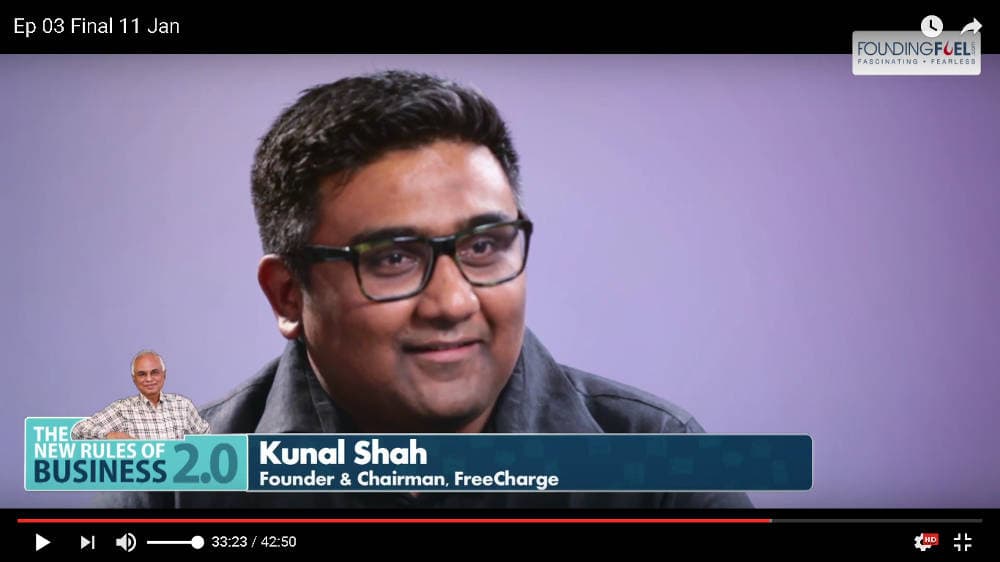
Kunal Shah: ‘Understanding humans is core to great businesses’
In this video, Kunal Shah, founder and chairman of FreeCharge, talks about the behavioural insights behind FreeCharge and how trust in people gets you the best outcomes
AU
Author
Kunal Shah: ‘Understanding humans is core to great businesses’
In this video, Kunal Shah, founder and chairman of FreeCharge, talks about the behavioural insights behind FreeCharge and how trust in people gets you the best outcomes
A
Author
Explore more
Dive into other themes from our network.