Alive in the In-Between
Inspired by Brisbane’s “Vibrantly Vacant” windows—on how renewal begins in life’s pauses
24 October 2025· 3 min read· 2 comments
TL;DR
Inspired by Brisbane's "Vibrantly Vacant" urban renewal program, this article offers a compelling insight for business leaders: true growth often emerges from intentional pauses, not ceaseless activity. It challenges the conventional rush to fill every gap, arguing that actively "holding space" during transitions—be it after a major project, merger, or challenging quarter—is crucial. Just as a fallow field regains strength or Steve Jobs' "fallow decade" refined his vision, organizations thrive by allowing for reflection and recalibration. Leaders who cultivate such intelligent pauses protect their teams from burnout and foster a fertile environment for innovation and strategic clarity, ultimately ensuring sustained vitality and smarter growth.

Walking through Brisbane on a quiet morning, I came across something that made me stop. A shopfront that wasn’t open for business—yet didn’t look abandoned either.
Its glass window was covered in bright illustrations of birds, flowers and abstract forms. It felt cared for, not forgotten. Later, I learnt it was part of “Vibrantly Vacant”—a Brisbane City Council programme that gives unused shopfronts a temporary life through decals—large, removable vinyl artworks, like oversized stickers, created by local artist Ingrid Bartkowiak.
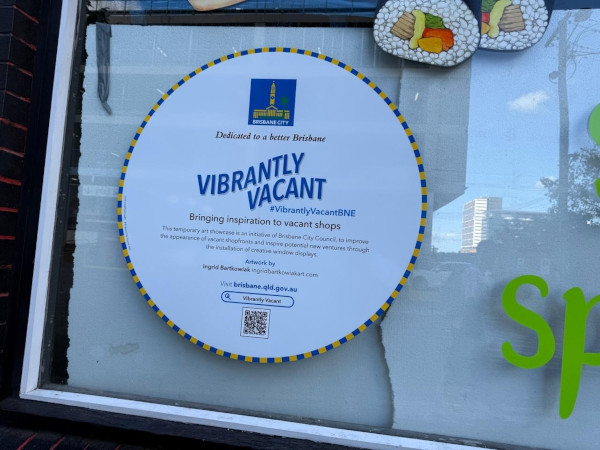
[Part of Brisbane City Council’s “Vibrantly Vacant” programme—transforming empty shopfronts into vibrant public art that keeps the city’s streets alive even in transition.]
The idea is simple and smart. Property owners of empty spaces are offered a free makeover. Partial decals keep the “For Lease” sign visible, inviting new tenants. Full decals turn long-term vacancies into engaging public art, discouraging vandalism and signalling that the street is still being looked after.
The decals do not hide the vacancy; they hold it. They acknowledge that the space is in transition—not abandoned, just between purposes. And that distinction is powerful.
In cities, as in organisations and lives, how we treat the in-between says a great deal about how we understand growth.
The Mistake We Make
Pauses make us uneasy.
When a career ends, a project slows down or a relationship breaks, we rush to move on. We tell ourselves: get busy, find the next thing, fill the silence.
But the rush often makes things worse. We accept jobs that shrink us. We start relationships that numb us. We settle, simply to stop feeling vacant.
What if the wiser path is to be—like Brisbane’s windows—vibrantly vacant?
The Space Between
William Bridges, who studied how people navigate change, wrote that change is external—a new role, a new address, a new beginning.
Transition, however, is internal—the psychological reorientation that follows an ending but precedes a new start.
Between the two lies the neutral zone—that uncomfortable, fertile middle space. Most people rush through it, but that is where renewal begins.
Like a farmer leaving a field fallow after harvest, we need time to replenish the soil before planting again. Nothing visible grows, yet the earth restores its strength underground.
The Fallow Years
When Steve Jobs was fired from Apple at thirty, he could easily have launched into something loud to prove a point. Instead, he wandered.
He founded NeXT, a computer company that went largely unnoticed, and acquired Pixar, which at the time made experimental animation shorts. Those years looked unproductive from the outside. But inside, he was rebuilding—his aesthetic sense, his patience, his philosophy.
He later said, “Getting fired from Apple was the best thing that could have happened to me… the heaviness of being successful was replaced by the lightness of being a beginner again.”
That decade—his fallow decade—produced everything that made Apple’s rebirth possible: simplicity, elegance, storytelling, restraint.
Jobs did not fill his vacancy. He tended it.
The Organisational Pause
What’s true for individuals is equally true for teams and institutions.
After a major launch, a merger or a tough quarter, rushing into the next initiative can drain energy and clarity.
Leaders who deliberately create space for reflection, feedback and recalibration, protect their system’s capacity to learn.
A company’s vitality depends not only on how fast it moves but on how intelligently it pauses.
The ability to hold space—to wait with purpose—may be one of the most underrated leadership capabilities of our time.
The pause between projects is where coherence is built. It is where teams rediscover direction and culture before acceleration resumes.
What Vibrantly Vacant Could Mean for Us
Being vibrantly vacant is more than sitting still. It is being alive in the in-between—attentive, reflective, open to what might emerge.
It is the difference between vacancy and neglect. Between drifting and composting.
For a professional between jobs, it may mean using the neutral zone for reflection, not panic.
For a leader after a major project, it may mean listening deeply before launching the next.
For someone after loss, it may mean allowing stillness to do its quiet repair.
Vacancy is inevitable. Vibrancy is optional.
How to Stay Vibrant in the Pause
It is deeply human to pause. Life rarely moves in straight lines, no matter how neatly it appears on an Instagram reel. The belief that everything will stay smooth and perfectly sequenced may be comforting, but it is also misleading.
Pauses and detours are not failures; they are how we grow, reset and make sense of change. The wiser move is to expect pauses and even welcome them. They are not interruptions. They are chapters in themselves.
To navigate a transition, give the in-between some structure and care. Set aside time to think, read and write—not to find answers but to ask better questions: What did I learn? What do I want to carry forward? What can I release?
Try small, low-risk experiments—a short project, a new skill, a community engagement. Don’t chase the perfect fit; notice what sparks curiosity. Don’t rush to fill the silence. Like a fallow field, this phase needs air more than activity.
While you wait, make the pause visible. Add small acts of beauty to your days—a walk, a meal, music, a call with a friend. They remind you that this space still matters. Stay connected. Tell your story, even if unfinished. People understand in-betweens more than we think.
Being vibrantly vacant is renewal in progress, not vague emptiness.
Staying Vibrant
People, like cities, find space for growth depending on how they treat their pauses.
A boarded-up window invites decay. A cared-for vacancy invites possibility. The same is true of organisations—and of us.
Steve Jobs’ fallow years, the farmer’s resting field, Brisbane’s bright windows—they all teach the same lesson: care is the bridge between endings and beginnings.
So, if you find yourself between roles, projects or relationships right now, resist the urge to rush.
Hold the space. Add colour. Experiment. Reflect.
Stay vacant, but stay vibrant—because what looks like a lull from the outside may be the season that prepares you for everything next.
Join the conversation
Kavi Arasu
Works at the intersection of people, systems, and organisational change
Kavi Arasu works at the intersection of people, systems, and organisational change. His work has taken him across multinational corporations and high-growth enterprises in India and internationally, giving him a grounded view of how transformation actually plays out, as opposed to how it gets described in strategy decks.
Over the last decade, his work has centred on partnering with CEOs and senior leadership teams through business transitions, digital transformation, and cultural change. He has supported leadership transitions, post-M&A cultural integration, and the kind of long-term stewardship of values that rarely gets noticed until it's missing. AI is now one strand of that work. Leaders are trying to work out what it changes and what it doesn't, and that question sits comfortably inside the change problems he has spent decades on.
He runs Flyntrok, an advisory practice built around change challenges that rarely arrive with instructions. He also teaches at a leading business school and speaks at leadership forums internationally. He used to run long distances. These days he runs Flyntrok instead, which he maintains is no less demanding.
He works very closely with the core team at Founding Fuel on learning and change initiatives and is a regular contributor. He lives in Mumbai, a city he finds well suited to thinking clearly amid constant motion.
Beyond the noise is the signal.
FF Insights: Sharpen your edge, Monday–Friday.
FF Life: Culture, ideas and perspectives you won't find elsewhere — Saturday.

Founding Fuel is sustained by readers who value depth, context, and independent thinking.
If this essay helped you think more clearly, you may choose to support our work.

Founding Fuel is sustained by readers who value depth, context, and independent thinking.
If this essay helped you think more clearly, you may choose to support our work.
Loading comments...



Readers also liked

·Work, Careers & Personal Mastery
FF Insights #657: Make your brain better
May 24, 2022: Are wind farms just wind?; Sustainable nonprofits; Hope keeps us alive
FF

Founding Fuel
FF Insights #657: Make your brain better
May 24, 2022: Are wind farms just wind?; Sustainable nonprofits; Hope keeps us alive

·Work, Careers & Personal Mastery
WFH Daily #124: Personal renewal; stayin’ alive; and the constants of technology
July 25: John Gardner on how to examine ourselves and prepare for what lies ahead; Thomas Byers on ethics and entrepreneurship; and why staying constant is not an option for technologists
FF
Founding Fuel
WFH Daily #124: Personal renewal; stayin’ alive; and the constants of technology
July 25: John Gardner on how to examine ourselves and prepare for what lies ahead; Thomas Byers on ethics and entrepreneurship; and why staying constant is not an option for technologists

·FF Life
FF Life: Art in the name of the Mother Goddess
Kolkata’s creative spark is virulent. And it all comes alive during Durga Puja
RR

Ronaan Roy
Former Deputy General Manager | Mahindra
FF Life: Art in the name of the Mother Goddess
Kolkata’s creative spark is virulent. And it all comes alive during Durga Puja
Former Deputy General Manager | Mahindra
Explore more
Dive into other themes from our network.