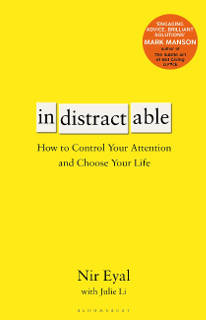
Indistractable: How to Control Your Attention and Choose Your Life
By Nir Eyal
Nir Eyal wrote the definitive book on how to design tech products that will get people hooked. His latest book ‘Indistractable’ has advice on how to avoid digital distractions and hold our own in this war for our attention. Some insights from the book
By Nir Eyal
Nir Eyal has taught at Stanford Graduate School of Business. He wrote an earlier bestseller, Hooked: How to Develop Habit-Forming Products.
2 of 38
The first step is to recognise that distraction starts from within. We need to learn how to avoid distraction.
3 of 38
Distractions: actions that move us away from what we really want.
Traction: actions that move us towards what we really want.
4 of 38
All motivation is a desire to escape discomfort.
5 of 38
If distraction costs us time, then time management is pain management.
6 of 38
Four psychological factors make satisfaction temporary
7 of 38
It’s good to know that feeling bad isn’t actually bad, it’s exactly what survival of the fittest intended.
8 of 38
Flight attendants who were smokers were studied and asked when they had a craving to smoke on the flight. The cravings were directly related to the time to destination and arrival and not a fixed number of minutes.
9 of 38
Fun and play don’t have to make us feel good. However, they might be used as tools to help us focus.
10 of 38
What we say to ourselves matters. Labelling yourself as having poor self-control is self-defeating.
11 of 38
People are frugal in managing their personal property but squander away their time.
12 of 38
Only a third of Americans have a daily schedule they monitor.
13 of 38
You can’t call something a distraction till you know what it is distracting you from.
14 of 38
Reflect on and refine your schedule. This will help you focus on what matters most.
15 of 38
Input is more certain than outcome, so many people think of tasks as opposed to results.
16 of 38
When we get too busy with work, we starve our relationships—family, friends etc. That's how friendships die—they starve to death.
17 of 38
The biggest unknown/problem for employees is that they don’t know where to spend their time.
18 of 38
Having a detailed, timeboxed schedule builds trust between employees and employers.
19 of 38
Dr BJ Fogg from Stanford University taught mass interpersonal persuasion.
20 of 38
The Fogg behaviour model states that for a behaviour (B) to occur, three things must be present: motivation (M), ability (A), and trigger (T).
So, B=MAT
21 of 38
Today, much of our distraction is a struggle with external triggers.
22 of 38
In the medical profession, distractions can be dangerous. In the airlines profession, distractions below 10,000 feet are dangerous.
23 of 38
Open office floor plans are a big distraction at work. Most companies do not recognise it.
24 of 38
To receive fewer e-mails, we must send fewer e-mails.
25 of 38
Many things become irrelevant when you give them some time to breathe.
26 of 38
Meetings today are full of people barely paying attention and sending messages or e-mails about how bored they are in the meeting.
27 of 38
The primary objective of a meeting is to get consensus around a decision or direction and not a forum for senior managers to hear themselves think.
28 of 38
Having many apps or links on the home screen of your phone or laptop is actually a trigger that distracts you. If you have a clean screen, you have fewer triggers to get distracted.
29 of 38
Our perception of who we are changes what we do.
30 of 38
Though conventional wisdom says that our beliefs shape our behaviour, the opposite is also true.
31 of 38
The modern workplace is a constant source of distraction. We are always pulled into something or the other when we should be focused.
32 of 38
Dysfunctional work culture is the culprit, not technology.
33 of 38
Technology is not evil for children. You need to teach your kids to be indistractable.
34 of 38
Since 1955, children’s free play has been continuously declining partly because of ever increasing parental control.
35 of 38
Without a clear plan, many kids are left to make impulsive decisions that often involve digital distraction.
36 of 38
As parents we often forget that a kid wanting something really, really badly is not a good enough reason.
37 of 38
Social norms are changing but whether for the good or bad depends on us.
38 of 38
By Nir Eyal

Founding Fuel is sustained by readers who value depth, context, and independent thinking.
If this essay helped you think more clearly, you may choose to support our work.

Founding Fuel is sustained by readers who value depth, context, and independent thinking.
If this essay helped you think more clearly, you may choose to support our work.


FF Insights: Sharpen your edge, Monday–Friday.
FF Life: Culture, ideas and perspectives you won't find elsewhere — Saturday.

Why the Gulf crisis may be India’s moment for the next phase of reform

Haresh Chawla
Investor | Entrepreneur
Why the Gulf crisis may be India’s moment for the next phase of reform

Investor | Entrepreneur

As AI agents embed intelligence into systems, the real shift is not automation—but how knowledge is owned, shared, and scaled across organisations

Arjo Basu
Systems thinker & technologist | Entrepreneur
As AI agents embed intelligence into systems, the real shift is not automation—but how knowledge is owned, shared, and scaled across organisations

Systems thinker & technologist | Entrepreneur

A conversation between Charles Assisi and Shrinath V on rebuilding Founding Fuel

Charles Assisi
Co-founder and Director | Founding Fuel

A conversation between Charles Assisi and Shrinath V on rebuilding Founding Fuel

Co-founder and Director | Founding Fuel
Dive into other themes from our network.