Founding FuelFounding Fuel

Get your people to unleash their own potential

The onus of motivation is on the individual, says Susan Fowler in her book 'Why Motivating People Doesn't Work'. It also tells leaders what they can do, but not control, to motivate people

18 September 2015· 1 min read

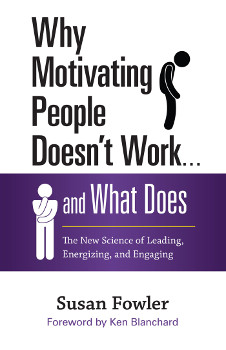
Why Motivating People Doesn't Work

By Susan Fowler

Slide

The motivation dilemma

The motivation dilemma is that leaders are being held accountable to do something they cannot do—motivate others.

Understanding the nature of motivation

People don’t understand the nature of their own motivation; when they are unhappy at work they ask for more money.

Psychological need #1: autonomy

The first psychological need is autonomy. Autonomy is our human need to perceive that we have choices.

Diverse studies over the past 20 years indicate that adults never lose their psychological need for autonomy.

What is autonomy?

Autonomy doesn’t mean that managers are permissive or hands off, but rather that employees feel they have influence in the workplace.

It is ultimately all your own choice

It is a challenge for some people to grasp that everything they do is their own choice. Whether they are formally empowered or not, people can choose their own level of autonomy.

A workplace axiom says that autonomy is 20% given and 80% taken.

Quiet coaches get better results

A quiet and attentive coach is a better coach than a goading coach. Quiet coaches get better results than those that goad.

Psychological need #2: to connect

The second psychological need is relatedness. Relatedness is our need to care about and be cared about by others. It is our need to feel connected without concerns about ulterior motives.

Why we seek friends

The employee’s desire to be in touch with friends outside of work is due to the lack of friends and relatedness at work.

Your role as a leader

One of the great opportunities you have as a leader is to help your people find meaning, contribute and have healthy interpersonal relationships at work as they work as a team.

Psychological need #3: competence

The third psychological need is competence. Employees are like kids, they find joy in learning, growing and gaining mastery.

It’s a need to feel effective

Competence is our need to feel effective at meeting everyday challenges and opportunities. It is demonstrating skill over time. It is feeling a sense of growth.

Growth and learning

Motivating people doesn’t work because you cannot impose growth and learning on a person. But a leader can and should provide a learning environment that doesn’t undermine people’s sense of competence.

The drive theory

One of the most popular motivational theories of the past 100 years is called drive theory. It made sense based on the idea that we are motivated to get what we don’t have.

Your psychological needs are not drives. Drives dissipate when they are satiated.

Satisfy your psychological needs

When psychological needs are satisfied, you feel energetic, you want more.

Dysfunction exists when our psychological needs aren’t being addressed.

Self-regulation

Self-regulation is mindfully managing feelings, thoughts, values and purpose for immediate and sustained positive effort.

Mindfulness

The first point of self regulation is mindfulness. Mindfulness is noticing, is being aware and attuned to what is happening without judgement or an automatic reaction. It is a skill that is developed through process, practice and patience.

Values

The second point of self-regulation is values. Values are premeditated standards of what a person considers good or bad. Values are enduring beliefs that a person has chosen as guidelines for how they work.

Values are at the heart of high-quality self regulation.

Purpose

The third point of self-regulation is purpose. Purpose is a deep and meaningful reason for doing something. Purpose is acting with a noble and right intention when your actions are honest.

Peak performers are values based

Peak performers are not goal driven, they are values based and inspired by more than goals.

Activate your motivation

Activating optimal motivation requires you to identify your current motivation outlook, shift or maintain it to the optimal/desired one and then for you to reflect.

Leadership is not a role, it is a practice

When you practice leadership, you have to invest time in understanding what is happening and how people are feeling in the organization.

What works in leadership

  • Acknowledge and validate people’s feelings and emotions by listening
  • Offer pure or descriptive feedback, not personalized praising
  • Ask open-ended questions and seek feedback repeatedly.

Phrases that reflect suboptimal motivational outlook

  • I have to
  • I must
  • I am required to
  • I have to follow the rules
  • I am paid for this

Phrases that reflect optimal motivational outlook

  • I want to
  • I have selected to
  • I am proud to
  • This is personal and I value it
  • I enjoy this
  • I have a rationale for this
  • You are free to question me if you disagree
  • I ought to do this

How sports stars do it

Scratch beneath the surface of great sports stars. They dedicate time and effort to autonomy, camaraderie and a sense of purpose. They say winning is everything; what they mean is, winning gives them data. Winning and losing present a scoreboard of information they use to make sounder choices. Non sports stars can use the same logic.

Why Motivating People Doesn’t Work

By: Susan Fowler

Buy it on Amazon

Buy it on Flipkart

Founding Fuel is sustained by readers who value depth, context, and independent thinking.

If this essay helped you think more clearly, you may choose to support our work.

Illustration of supportersIllustration of supporters
Loading comments...

Readers also liked

Does your team have runners or passive riders?
·Leadership & Organisation

Does your team have runners or passive riders?

In his book ‘Move Your Bus’, Ron Clark talks about the different kinds of people companies typically have—high performers, the dependables, average workers and deadweights—and what leaders can do to get the best out of their teams

AU

Author