Founding FuelFounding Fuel

How we think and how we can get better at collaboration

Insights from Dawna Markova and Angie McArthur’s book, ‘Collaborative Intelligence: Thinking with People Who Think Differently’
7 April 2016· 1 min read

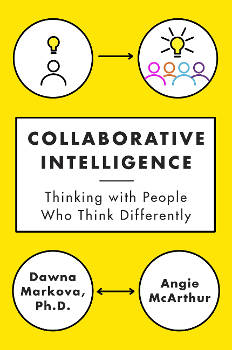
Collaborative Intelligence

Thinking with People Who Think Differently

Dawna Markova and Angie McArthur

Slide

Thinking together

Great minds don’t think alike, but they can learn to think together.

Being open to different thinking

The most significant gift we have is the gift to think. The most significant danger to the world is our inability to think with those who think differently.

What causes miscommunication

We habitually misread people and therefore miscommunicate with them.

We seek personal connect

Despite our unending love for digital devices, we still crave face-to-face interaction with other people.

Your collaborative quotient

It’s called CQ.

Many of the barriers keeping us apart are actually present only in our minds.

Team questions to ask

Ask five people in your team to rate the team and themselves on:

  1. Respect: How much admiration and sense of each other’s value exists between you?
  2. Aliveness: How much zest, vitality and energy is there between you?
  3. Understanding: How secure do you feel in communicating your needs, fears, ideas and enthusiasm?
  4. Growth: How much do you grow each other’s capacity for exploring new possibilities and ideas?

Other people affect our capacity

We either grow or diminish our capacity through the people with whom we spend the most time.

Collaborative intelligence

Collaborative intelligence is the flow of energy and information within and between us.

Effectiveness of your CQ as an individual

Rate yourself on a scale of 1 to 10:

  1. The ease with which I contribute ideas in meetings.
  2. The frequency with which I share my talents and resources with other team members.
  3. The frequency with which other members share their talent and resources with me and one another.
  4. From my perspective, the opportunity for a minority opinion in team meetings to be considered and accepted.
  5. The frequency with which I think cross-functionally.

Effectiveness of your CQ - Part 2

Rate yourself on a scale of 1 to 10:

  1. The options for different styles I create in meetings—visual, auditory, etc.
  2. My knowledge of the talents each person brings to the table and the ability to leverage that.
  3. My effectiveness with challenging customers, co-workers, clients.
  4. My ability to get people to act together.
  5. My ability to get people to think effectively together.

We see and do what we expect

We are used to seeing what we expect to see, hearing what we expect to hear and doing what we expect to do.

Talent comes first

Talent attracts capital far more than capital attracts talent

How are you smart?

When we meet smart people our question has to be not “Are you smart?” but “How are you smart?” The answer leads to mind patterns.

We pay attention in three ways

Focused: Alert, detailed, sequential, externally oriented.

Sorting: Confused, exploring, trying to understand.

Open: Imaginative, symbolic, connective.

Don’t lose connection

“A leader who loses connection to his people soon loses the ability to lead them.” – Robert Ley

Intersecting with other minds

“Our minds are partly determined by their intersection with other minds” – Daniel Siegel

Rate your thinking talents (part 1)

Your thinking talents

Always

Sometimes

Never

How can I adapt to what’s happening now?


Does this mesh with my beliefs?


How can I be closer and more genuine with people?


How can I relate to the new person?


How is this something part of something larger?


Rate your thinking talents (part 2)

Your thinking talents

Always

Sometimes

Never

Is everyone being treated fairly?


What are people feeling now?


What’s the solution to this problem?


What’s the point here?


What can I do right now?


What can I accomplish today?


Rate your thinking talents (part 3)

Your thinking talents

Always

Sometimes

Never

How can this be done differently?


What can I learn next?


What can help grow others?


What is the common ground?


How can I order this chaos?


Rate your thinking talents (part 4)

Your thinking talents

Always

Sometimes

Never

How can this be excellent?


What are the alternative scenarios and what is the best route?


How can I get others aligned with me?


Why is this true? Prove it to me.


Am I better at this than anyone else?


Know your talents

Knowing the talents you lack is as important as the talents you have.

A CEO is a coach

Being a CEO requires you to be a coach and to get people to develop potential to win as a team.

The coach and the players have a reciprocal need for each other if they want to achieve greatness, just as a leader and his direct reports do.

The signals to watch

If you ever feel lost, overwhelmed or disengaged when working with your group, consider it as a signal that the intellectual capital of your team is not being fully engaged.

What is influence?

Influence is the ability to accept and evoke change. This requires knowing how to shift your mind from certain rigidity to flexible curiosity.

Asking great questions

Great questions create expanding possibilities.

Asking great questions can be challenging, especially for people in leadership positions.

The inquiry style of learning asks:

  1. What can I learn from this?
  2. How can I grow my capacity?
  3. How can I do this better?

The mindset shift needed for collaboration

From

To

Uses power to win over others Uses influence with others to connect
Leads as a hero Leads as a host
Perceives differences as a deficit Dignifies differences as a resource
I have it and you don’t The more we share, the more we have
How smart am I? How are we smart?

The mindset shift needed for collaboration (part 2)

From

To

Asks for who is wrong Asks what’s possible from here
Analytical thinking Analytical with innovative and relational thinking
Considers value is created by things Considers value is created by ideas and connections
What will others think of me? How can I grow my capacity?
Values independence Values interdependence

Creating a possible future

Attention with intention and imagination creates a possible future.

Collaborative Intelligence

Thinking with People Who Think Differently

By: Dawna Markova and Angie McArthur

Buy it on Flipkart

Buy it on Amazon

Founding Fuel is sustained by readers who value depth, context, and independent thinking.

If this essay helped you think more clearly, you may choose to support our work.

Illustration of supportersIllustration of supporters

Beyond the noise is the signal.

FF Insights: Sharpen your edge, Monday–Friday.
FF Life: Culture, ideas and perspectives you won't find elsewhere — Saturday.

Readers also liked

Talent drives strategy in the digital era. Is HR ready?
·Leadership & Organisation

Talent drives strategy in the digital era. Is HR ready?

Today business strategy means sensing new opportunities, and people are the key to creating value. So how do you approach human capital in this new era? Corporate guru Ram Charan, McKinsey’s Dominic Barton and Korn Ferry’s Dennis Carey explore in their book ‘Talent Wins’

AU

Author

Are you persuadable?
·Leadership & Organisation

Are you persuadable?

An ability to change decisions is not about inconsistency, it is about flexibility. Insights from Al Pittampalli’s book ‘Persuadable: How Great Leaders Change Their Mind to Change the World’

AU

Author

How to be an objective leader
·Leadership & Organisation

How to be an objective leader

Seeing things as they are, without letting our biases distort things, is key to taking the right actions, says Elizabeth Thornton in her book, 'The Objective Leader'

AU

Author