Founding FuelFounding Fuel

So You Think You've Got a Strategy

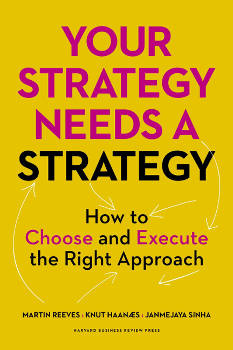
The best approach depends on the problem at hand, says the book—Your Strategy Needs a Strategy by Martin Reeves, Knut Haanaes and Janmejaya Sinha
18 July 2015· 1 min read

Your Strategy Needs a Strategy

By Martin Reeves, Knut Haanaes and Janmejaya Sinha

Slide

A Means to an End

Strategy is a means to an end: favourable business outcomes.

How to Approach Strategy

It's not that we lack powerful ways to approach strategy, we lack a robust way to select the right one for the right circumstances.

Strategy is in essence problem solving, and the best approach depends on the problem at hand. Your environment dictates your approach to strategy.

Types of Strategies

Classical strategy: where you can predict what will happen.

Adaptive strategy: where you can't predict it, nor can you change it.

Visionary strategy: where you can predict it and change/shape it.

Shaping strategy: where you can't predict it, but can change it.

Renewal strategy: where your resources are limited or severely constrained.

The Visionary Approach

The visionary approach is about imagination and realization and is essentially creative.

All for Scale

Paul Michaels, former president of Mars, said: "Scale is critical to our business, to drive utilization, costs and value."

Pick a Direction and Implement Well

Jack Welch said: "Strategy is simple, you pick a direction and implement like hell."

Decide What Not to Do

Michael Porter said: "Strategy requires you to make choices - what not to do."

Indiscriminate Growth Is a Bad Idea

The worst thing a firm can do is to pursue growth indiscriminately by offering discounts, promotions and freebies.

What Brings Competitive Advantage

In any given context, advantage comes from scale, differentiation and superior capabilities.

Superior competitive and market information can also be an advantage.

Execution Is Equally Important

Many CEOs say that execution is as hard as formulating strategy.

Measure It

Peter Drucker said: "What's measured , improves."

Signs of a Weak Organization

A poor organization will show conservatism, poor horizontal communication, lack of collaboration, rigidity and overall complexity ahead of simplicity.

A Disciplined Culture

Because a classical firm needs to pursue excellence in relation to a static advantage, the culture needs to be disciplined, focused, analytical-minded, goal-oriented and geared towards accountability.

The Adaptive Approach

An adaptive approach is based on experimentation.

The Market Leaders May Not be the Most Profitable

The value of incumbency has also diminished. The probability that the top three leaders in a market are also the top three in profitability has decreased from 35% in 1955 to 7% in 2013.

You need Insights More than Information

Possessing information as opposed to insights is not an advantage anymore.

Blind Spots

Large companies find it difficult to deal with blind spots.

Adaptive Leaders Set Context

Adaptive leaders lead through setting context and not goals. They create a friendly atmosphere, open and transparent communication.

Too Many Leaders Spoil the Game

Don't be like the US basketball team of 2008 - great athletes, wrong team, too many leaders, too many leadership games, no one put USA ahead of themselves and their egos.

The Visionary Approach

A visionary culture combines a clear sense of direction to ensure speed and flexibility

Visionary leaders are Pragmatic Dreamers

Visionary leaders have charisma and enthusiasm, but more importantly, they are pragmatic dreamers.

The Winning Move

Our key question is can we construct a world of competition in a way that will help us win.

Harness the Ecosystem

The very concept of an ecosystem is to harness outside resources to support rapid, parallel innovation.

Collaborate Rather than Compete

The culture of a shaping firm needs to be outward, have an inclusive attitude towards external parties, collaborate rather than compete.

You Need Trust to Build Relationships

Openness and humility help to generate the trust necessary to build long-term successful interaction with the ecosystem.

The Renewal Strategy

A renewal strategy renews the vitality of the firm to operate in a harsh environment.

Company Lifespan Is Falling

According to the BCG Institute, the average life of a company has dropped from 55 years in 1950 to 20 years now.

Firms Need to be Trim

Firms need to cut costs, take away unnecessary assets, reduce inventories and keep terms low in order to succeed.

In harsh environments, firms win by preserving resources and not expecting unnecessary effort on exploration.

Focus the Plan, then Pivot It

Renewal firms need to balance two things: reducing costs and then innovating to win.

A successful renewal strategy executes the plan to focus and economize and then pivots to a new strategy for long-term value creation.

You May Need a Top-Down Approach

In a renewal journey, firms must get top-down to execute better.

You May Also Need a Culture Change

Leaders need to emphasize the cultural aspects if a company needs to renew; a renewal is not possible without attacking culture change.

Transformation Needs Effective Communication

An effective leader needs considerable powers of persuasion and communication. All transformational moves produce organization inertia.

A Company that is Affecting a Turnaround Needs to...

  1. Reduce cash burn rate
  2. Limit use of capital
  3. Focus your activities
  4. Create a restructuring plan
  5. Execute through an overlay structure
  6. Pivot to growth through innovation and careful investment

Cost Cuts

Immediately cut costs with courage.

What PepsiCo Needs to do

PepsiCo needs to employ multiple approaches to strategy at the same time. It needs to take a classical approach to capitalize scale and legacy brands while developing an adaptive approach to fast changing and unpredictable markets.

Deal with Shift in Consumer Behaviour, New Competitors

PepsiCo needs to be adaptive to changing consumer shifts to healthy living and to deal with unfamiliar competitors beyond the traditional Coca-Cola.

Different Stages of Strategy

"Different businesses at different stages go through different stages of strategy." - Indra Nooyi

Business Must Run while Reinventing Itself

"Business leaders need to negotiate the central contradiction that lies at the heart of the company. A business must both run and reinvent itself." - Indra Nooyi

Multiple Approaches

"You cannot have a single approach to strategy." - Indra Nooyi

In a Complex World, Mixed Growth Is Expected

Peter Hancock of AIG said: "I always hear people tell me you are giving me mixed messages. I say - You are a leader, you are paid to deliver mixed messages. We live in a complex world, we will grow in one place and shrink elsewhere."

Scale, Market Share and Cost

"When investors are talking to you, it's often about giving them inputs for a row and a column (of a spreadsheet), so whatever you do, you have to land the plane by scale, market share and cost. Only after you land the plane, while the taxing is happening can you say - I am doing something else too." - Indra Nooyi

Tips and Traps for leaders

Tips

  1. Embrace contradiction
  2. Embrace complexity
  3. Explain simply
  4. Look outward, external orientation
  5. When in doubt, disrupt

Traps

  1. One single approach
  2. Managing instead of leading
  3. Planning the unplannable
  4. Rigidity

Your Strategy Needs a Strategy

By Martin Reeves, Knut Haanaes and Janmejaya Sinha

Buy it on Amazon

Buy it on Flipkart

Founding Fuel is sustained by readers who value depth, context, and independent thinking.

If this essay helped you think more clearly, you may choose to support our work.

Illustration of supportersIllustration of supporters

Beyond the noise is the signal.

FF Insights: Sharpen your edge, Monday–Friday.
FF Life: Culture, ideas and perspectives you won't find elsewhere — Saturday.

Readers also liked

Talent drives strategy in the digital era. Is HR ready?
·Leadership & Organisation

Talent drives strategy in the digital era. Is HR ready?

Today business strategy means sensing new opportunities, and people are the key to creating value. So how do you approach human capital in this new era? Corporate guru Ram Charan, McKinsey’s Dominic Barton and Korn Ferry’s Dennis Carey explore in their book ‘Talent Wins’

AU

Author